San Domenico: Dominican Church in Caltanissetta, Italy


Site at a Glance
- Rating
- 4.5
- Popularity
- Very Low
- Country
- Italy
- Primary era
- Early Modern
- Eras represented
- Medieval, Early Modern, Modern
- Civilizations
- Crown of Aragon, Spanish
- Site type
- Religious
- Remains
- Church
On this page11 sections
History
San Domenico is a fifteenth-century Roman Catholic church in Caltanissetta, Italy, associated with the Dominican Order and dedicated to Saint Dominic of Guzmán, the Spanish founder of the order. Its foundation is dated to 1458, after the Moncada family established itself in Caltanissetta, and the church became an important religious and burial site for the town’s noble families.
Foundation and Dominican Settlement
Tradition attributes the foundation to Blessed Reginaldo Lombardo, a disciple of Saint Dominic. A more probable explanation connects it with Antonio Moncada, the third count of Caltanissetta. In 1458, Antonio is said to have abandoned the clerical habit so that he could inherit his title. As compensation to the Dominican Order, to which he had belonged, he founded a church with an attached convent.
The patrons who brought the Dominicans to Caltanissetta may have belonged to the House of Montcada, the Aragonese feudal family that ruled in the region. The convent became the tenth Dominican foundation in Sicily when it was formally established in 1479. Giovanni da Cursu was serving as its prior by 1475.
Burial Place and Expansion
The Moncadas first selected San Domenico as their family burial place. Other noble families in Caltanissetta adopted the same practice during later centuries. Don Francesco Moncada, the first prince of Paterno, was buried in the church in 1566.
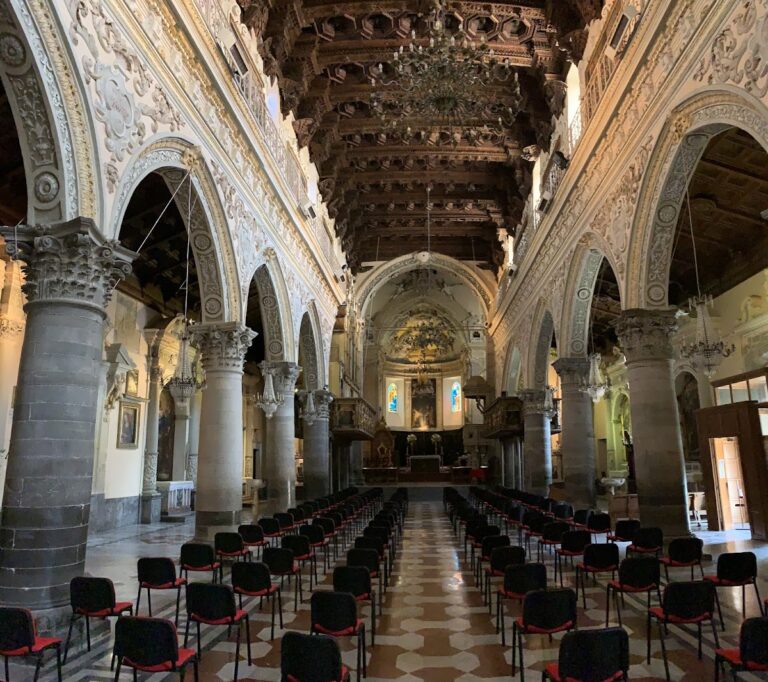
The convent was enlarged in 1573 with financial support, and a cloister was commissioned in the early seventeenth century and completed during that century’s first decade. Further enlargement brought the present facade around 1700, while the interior stucco decoration dates from the nineteenth century.
Building work in 1650 revealed human remains behind the altar. One of the three bodies was traditionally identified as Countess Adelasia, a niece of Roger II, the Norman ruler of Sicily who had earlier been known as the Grand Count. According to the tradition, she had been buried at Pietrarossa Castle and was transferred after the castle collapsed.
Suppression and Religious Return
After Italian unification and the suppression of religious orders, the convent was converted into a barracks. The church was deconsecrated and used as a warehouse before being reconsecrated in 1923.
San Domenico was also connected with the Confraternity of the Rosary, a Catholic devotional association whose members commissioned the principal altarpiece, Filippo Paladini’s Madonna del Rosario of 1614. When the church and convent were suppressed in 1866, the state sold paintings and furnishings. Local residents bought many of them and donated them to churches in Caltanissetta, including San Domenico when it returned to religious use.
Remains
Church Layout and Facade
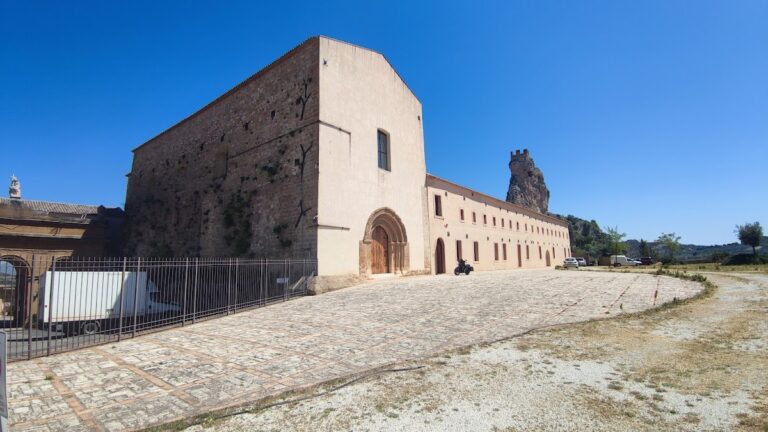
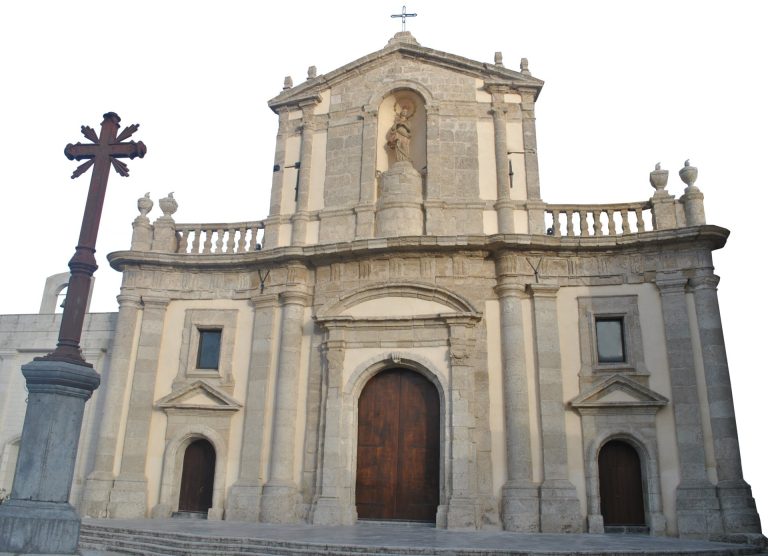
The church has three naves and a Baroque facade organized around a convex central section and concave lateral sections. Its composition remains incomplete because the bell tower was never finished. The entrance is marked by a Baroque portal framed by stone pilasters and topped by a broken pediment.
Paintings and Devotional Art
Filippo Paladini’s Madonna del Rosario
Filippo Paladini’s signed and dated Madonna del Rosario was painted in 1614 for the Confraternity of the Rosary. The Virgin gives a rosary to a Dominican nun, while the standing Christ Child gives another to a Dominican friar. The painting was kept in the convent after Vincenzo Roggeri’s later version occupied the main altar.
Vincenzo Roggeri’s Dominican Paintings
Vincenzo Roggeri’s seventeenth-century Ecstasy of Saint Thomas Aquinas shows the Dominican theologian kneeling before an altar and crucifix while two angels support him. A book appears at lower right as his principal attribute. The composition refers to the story of Thomas’s resistance to sexual temptation and the angels’ gift of a chastity belt.
Roggeri’s seventeenth-century Martyrdom of Saint Peter represents Peter of Verona, also known as Saint Peter Martyr, at the moment of his murder near the forest of Barlassina. Angels above hold his palm, crown, and lily, while the other friar who accompanied him flees in the background. Roggeri also painted the seventeenth-century Apparition of Saints Peter and Paul to Saint Dominic.
Roggeri’s Madonna del Rosario
Another Madonna del Rosario by Roggeri, painted in the last decades of the seventeenth century, shows the Virgin and Child giving a rosary to Saint Dominic. Saint Catherine of Siena kneels opposite them and displays her stigmata, while winged putti hold the saints’ attributes, including a crucifix, roses, and lilies. The painting was formerly venerated on the main altar, and Roggeri’s body was buried in the church.
The image of Catherine’s stigmata reflects a dispute between the Dominican and Franciscan orders over how these marks should be represented. Pope Sixtus IV prohibited depictions of Catherine with bloody stigmata in 1475. In 1630, Pope Urban VIII directed that they should instead appear as luminous or symbolic wounds.
Works Associated with San Domenico
Guglielmo Borremans, a painter active in Sicily, produced Saint Vincent Ferrer in oil on canvas between 1720 and 1725. The work was temporarily kept in Caltanissetta Cathedral and is now exhibited in the diocesan museum.
Filippo Paladini also painted the Madonna of Carmel, dated 1604. It is associated with San Domenico but is now kept in Caltanissetta Cathedral rather than in the church.