Enna Cathedral: A Medieval and Baroque Mother Church in Sicily


Site at a Glance
- Rating
- 4.7
- Popularity
- Medium
- Country
- Italy
- Primary era
- Medieval
- Eras represented
- Medieval, Early Modern
- Civilizations
- Crown of Aragon, Spanish
- Site type
- Religious
- Remains
- Church
On this page22 sections
History
Enna Cathedral, formally the Church of Maria Santissima della Visitazione, is a historic Christian church in Enna, Italy. Construction of the present building began in 1307 during the Aragonese period, when Aragonese political influence was being established in Sicily, and the church was completed in 1311. Built in the Gothic tradition, it became Enna’s mother church and is commonly called the Duomo, although it is not a bishop’s seat and belongs to the Diocese of Piazza Armerina.
Early Christian and Islamic-period traditions
The cathedral’s site is traditionally linked with an earlier church called Santa Maria Maiuri. That church was said to have occupied the remains of a pagan temple dedicated to Proserpina, the daughter of the grain deity Ceres. Around the fifth century, Santa Maria Maiuri was built there, associating the place with the veneration of the Virgin Mary rather than the earlier cult of Ceres and Proserpina.
During the Arab occupation of Castrogiovanni, the Christian church reportedly prompted the construction of a mosque opposite it. The area associated with that mosque is identified with the site now occupied by the Church of San Michele Arcangelo.
Aragonese foundation and changing dedication
The present church was initiated by Eleonora d’Angiò, an Angevin princess and the wife of Frederick III of Aragon, to celebrate the birth of their son Pietro. It stood on level ground just outside the walls of the Castle of Lombardy, where the deteriorated earlier church was traditionally believed to have been located.
The building was originally dedicated to the Assumption of the Virgin. In 1412, its dedication changed to the Visitation of Mary, and a statue of Maria Santissima della Visitazione acquired in Venice that year became Enna’s patronal image. The cathedral later became the setting for the city’s principal religious observances, including Holy Week rites and the celebrations held for its patron.
Fire, rebuilding, and architectural renewal
A fire in 1446 severely damaged the Gothic church. Only one apse and part of the right side survived. Pope Eugene IV proclaimed a seven-year extraordinary jubilee to help raise money for reconstruction, while King Alfonso V of Aragon sold several estates to support the rebuilding. The Gothic Holy Door, which opens onto the southern transept, dates from 1447.
The central nave colonnade later collapsed, prompting another major renewal. Giandomenico Gagini rebuilt two columns, and Jacopo Salemi worked on the remaining ones. The rebuilding and decoration culminated in 1570 with the completion of the Porta Sottana.
Later alterations and continuing religious life
The bell tower collapsed in 1619 and was reconstructed in a taller, more slender form. It collapsed again in 1676 after the structure became excessively heavy. The Chapel of the Marbles was refaced in 1700, and the nave paving was completed in 1781. The sacristy underwent renovation in 2006.
The cathedral remains the culmination of Enna’s Holy Week observances and patronal celebrations. The procession associated with Maria Santissima della Visitazione takes place on 2 July, while the image is displayed for public veneration from 29 June and during the following two weeks. Other observances include Easter-week processional rites, commemorations of the Virgin’s patronage of the city, and thanksgiving connected with protection during the 1693 Val di Noto earthquake and the end of the Second World War.
Victor Emmanuel III declared the cathedral a national monument in 1943. Since 2008, it has also been identified as a UNESCO “place of peace.”
Remains
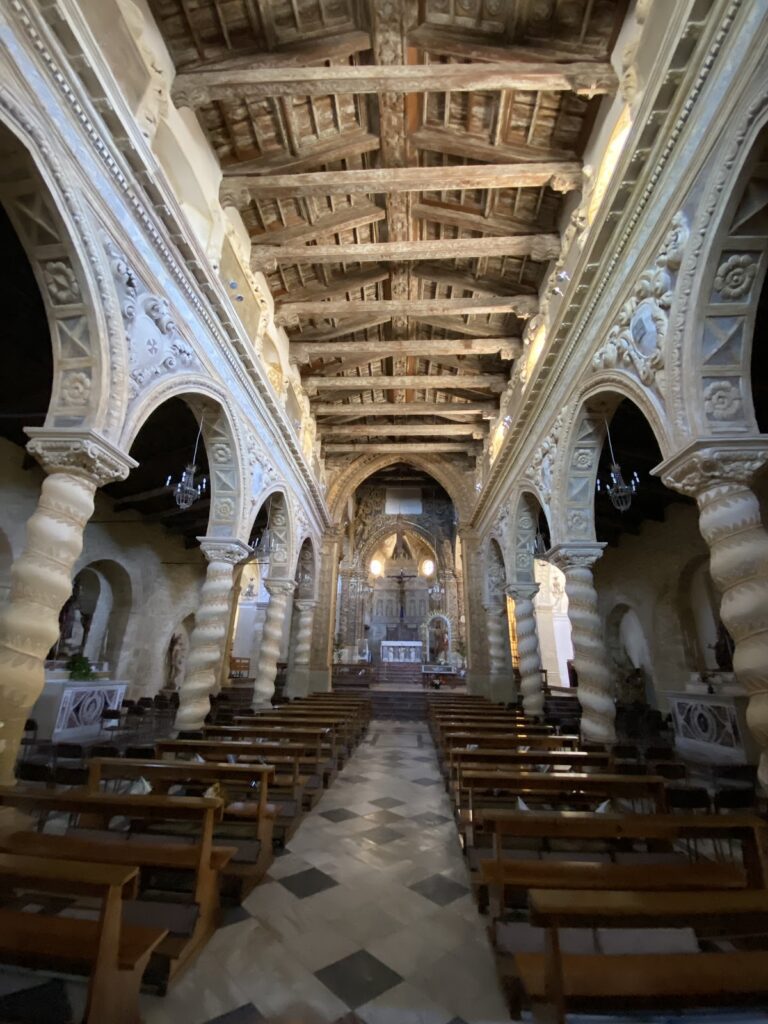
Enna Cathedral occupies the northern side of Piazza Mazzini in Enna’s historic centre, along Via Roma, and faces Piazza Duomo with its bell-tower facade. The surrounding square is enclosed by the canonry and other eighteenth-century buildings. The church has a Latin-cross plan, meaning that a long nave is crossed by a shorter transept, and a basilical interior of three naves, three apses, and a transept. Two rows of black-basalt Corinthian columns divide the interior spaces.
Facade, tower, and entrances
Main facade and bell tower
A broad staircase leads to the main facade, whose portico has three portals framed by six columns. Above them are round-arched windows, cornices, reliefs, human faces, pilasters, and Doric and Corinthian columns. The facade combines Gothic, Renaissance, and Baroque elements. Its early-eighteenth-century Baroque facing is built of tuff and influenced the facades of other churches in southeastern Sicily.
The bell tower rises above the facade in two tall, quadrangular levels dating from the late seventeenth century. Cornices and reliefs decorate its exterior, while the tower contains the enormous bell known as the “101-quintal bell,” described as comparable in size to the bell of Catania Cathedral.
Holy Door
The Gothic Porta del Giubileo, or Holy Door, is now walled up. Its opening is framed by six columns with decorated capitals and an arch surmounted by a statue of the Madonna and Child. A round arch surrounds the statue, with zigzag and foliate ornament completing the composition.
Porta Sottana and Porta Soprana
The lateral Porta Sottana, dating from 1447 and opening onto Piazza Mazzini, has two pairs of Corinthian columns and a crowning pediment. Its late-Renaissance marble relief shows Saint Martin dividing his cloak with the poor. The relief came from an older church formerly located in the Castle of Lombardy. Another smaller opening is known as the Porta Soprana.
Nave, columns, and chapels
Nave furnishings and carved columns
A richly carved wooden coffered ceiling, formed from repeated recessed panels, extends across the three naves and the transept. The central nave contains an inlaid wooden choir loft, while an organ loft opposite it has wooden niches holding icons of saints. A Classical-Renaissance pulpit also survives within the nave.
The first two columns of the central nave have especially elaborate bases and capitals carved by Giandomenico Gagini, a Renaissance sculptor active in Sicily. Their decoration includes acanthus leaves, paired masks, two-headed figures, grotesques, birds, fantastic animals, putti, griffins, angels’ heads, Evangelists, prophets, and saints. One column also carries a carved Baptism of Christ beneath the protection of God the Father and the Holy Spirit, together with the insignia of Pope Pius IV, Philip II of Spain, and Castrogiovanni.
Paintings along the nave
Twelve paintings by Vincenzo Roggeri line the cornice in monumental stucco frames. Commissioned in 1668 and delivered in 1672, they depict saints associated with Enna’s Basilian order, a Christian monastic tradition following the rule associated with Saint Basil the Great. The subjects include the martyrdoms of Saint Barbara, Saint Elias, and Saint Ursula, Saint Nicholas of Bari, and the Basilian saints Elias the Elder, Daniel, Elias the Younger, Vitalis the abbot, Luke the abbot, Catherine, Angel, and Theodore.
Right-side chapels
The right-side chapels include the Chapel of the Transit, which contains Vincenzo Roggeri’s 1668 painting of the Dormition of the Virgin. The Chapel of Saints Lucilla and Hyacinth has a painting by Damiano Basile dated 1600. In the Chapel of Saint Agatha is Guglielmo Borremans’s 1721 Apparition of Saint Agatha to Saint Lucy, while the Chapel of Saint John the Baptist contains Borremans’s 1721 Baptism of Christ.
Left-side chapels and first bay
The Chapel of Saint Martin contains Borremans’s 1722 painting of Saint Martin of Tours. The Chapel of the Madonna has an anonymous painting of the Madonna and Child. The Chapel of Saint Constantine contains Borremans’s 1722 Sleep of Constantine with Saints Peter and Paul, together with an anonymous Madonna and Child with Saint Anthony.
The first bay on the left contains the ascent to the bell tower and a Renaissance baptismal font dated 1544, enclosed by a wrought-iron railing. The third bay houses the Great Golden Ship used in processional rites, and another opening connects the nave with the sacristy.
Transept and apses
Chapel of the Virgin of the Visitation
The right apsidiole, a small apse adjoining the principal apse, contains the Chapel of the Virgin of the Visitation, also called the Chapel of the Marbles. Stucco, twisted columns, and polychrome marble were made by Andrea Amato, Domenico Bevilacqua, and Francesco Battaglia. The altar niche holds the venerated statue purchased in Venice in 1412. Painted doors show the Nativity of the Virgin on their inner faces and the Visitation on their outer faces, with paintings by Damiano Basile. Seven keys are needed to open the statue’s enclosure, and they are kept in the Church of San Pietro.
Nativity and Blessed Sacrament chapels
The right transept contains the Chapel of the Nativity, with Vincenzo Roggeri’s 1675 Adoration of the Magi on its altar. The original Holy Door opens externally from this transept.
The left apsidiole contains the Chapel of the Blessed Sacrament, which includes marble work by Domenico Bevilacqua and stucco on the vault ribs by Pietro Rosso. The chapel is regarded as one of the finest examples of Gothic art in Sicily. The left transept contains the Chapel of the Madonna del Pilar, with Guglielmo Borremans’s 1733 painting of the Madonna del Pilar.
Principal apse
The principal apse has a high relief of the Coronation of Mary as Queen of Heaven by Christ and God the Father. Five oil altarpieces by Filippo Paladini, painted between 1612 and 1613, depict the Presentation of Jesus in the Temple, the Immaculate Conception, the Assumption of Mary, the Presentation of the Virgin in the Temple, and the Visitation of the Virgin Mary to Saint Elizabeth.
A late-sixteenth-century walnut choir for the canons occupies the apse. Its carved panels show biblical scenes. The furnishings also include a chased and repoussé silver antependium, a decorative covering for the front of an altar, by the Palermo artist Francesco Mancino, and a crucifix attributed to Pietro Ruzzolone. The crucifix shows the suffering Christ, known as the Christus Patiens, on its front and the triumphant Christ, or Christus Triumphans, on its back.
Sacristy and treasury
Sacristy furnishings and decoration
The sacristy and antisacristy contain a large carved walnut cabinet with scenes from the life of Jesus, as well as a chapel, altar, and painting dedicated to Saint Andrew. Other works include two paintings of the Martyrdom of Saint Agatha, a nineteenth-century fresco by Saverio Marchese depicting Raphael’s Transfiguration, and a white marble lavabo made in 1648 by Giovanni Gallina.
Stucco decoration incorporates paintings by Pietro Novelli, while Giovanni Piccinelli’s 1662 medallions depict the martyrdoms of Saint Agatha and Saint Catherine. The floor is decorated with restored polychrome maiolica, glazed ceramic tiles with painted decoration, showing Moses Giving Water to the Israelites and the Gathering of Manna. The sacristy also includes a treasury room.
Cathedral treasury
The cathedral treasury is kept in the Alessi Museum rather than inside the church. It includes silver candlesticks made by Annibale Gagini in 1595, a gold crown set with precious stones and enamels for the patronal celebrations, and a silver-gilt and enamel monstrance from 1768 attributed to Salvatore Mercurio. The collection also contains coins and medieval art.
Nearby sites