St. Christoph’s Church, Mainz: A Medieval Church and War Memorial


Site at a Glance
- Rating
- 4.6
- Popularity
- Low
- Country
- Germany
- Primary era
- Medieval
- External website
- Open
- Eras represented
- Medieval, Modern
- Civilizations
- Holy Roman Empire
- Site type
- Religious
- Remains
- Church
On this page15 sections
History
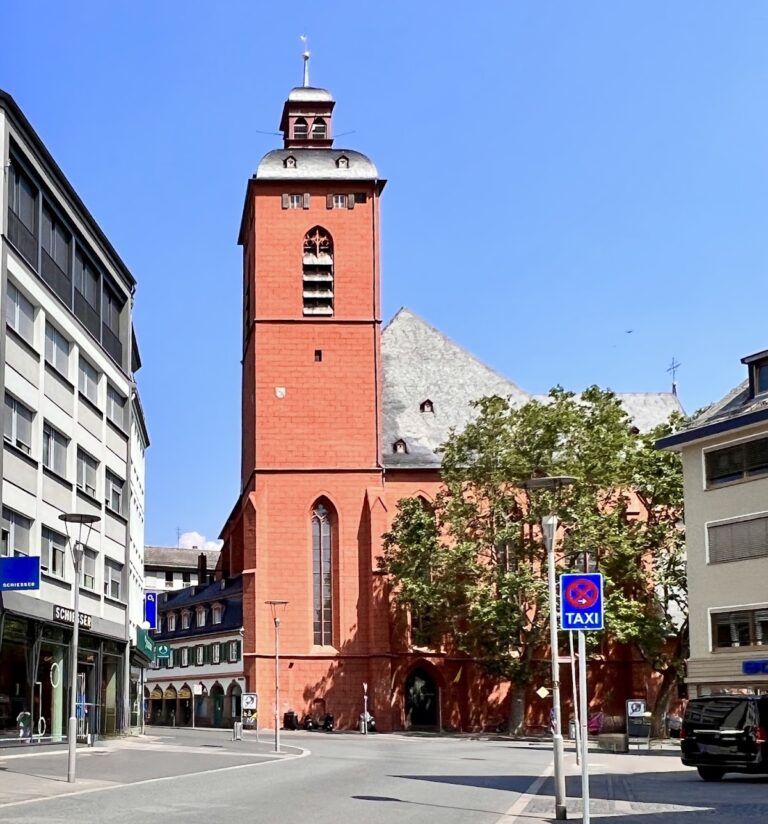
St. Christoph’s Church is a former Roman Catholic parish church in Mainz, Germany, whose medieval fabric developed in an early Gothic form between 1240 and 1330. Standing in the historic city centre beside Karmeliterplatz, the church is associated with Mainz’s religious history, Johannes Gutenberg, and the city’s wartime destruction.
Medieval foundations and parish history
The church’s early history is conventionally linked with a chapel donated by King Arnulf, a ninth-century Carolingian ruler, to St. Maximin’s Abbey in Trier on 11 February 893. The abbey was a historic Benedictine monastery, and St. Christoph was under its patronage by the twelfth century. King Charles III of West Francia confirmed the donation on 1 January 912, while Pope Innocent II confirmed St. Maximin’s patronage of the church on 6 May 1140.
St. Christoph was serving as a parish church by 1272. Its associated Michael Chapel appears in the historical record from 1330. The present church took shape during the thirteenth and early fourteenth centuries. The Romanesque lower tower and its paired arched windows belong to around 1240, while most of the remaining medieval fabric dates from approximately 1280 to 1330.
Gutenberg and the sixteenth century
Johannes Gutenberg, the Mainz goldsmith and printer whose development of movable-type printing became central to European printing history, is traditionally associated with baptism at St. Christoph around 1400. A Gothic baptismal font from his period survives in the eastern part of the church.
St. Christoph also has an important connection with Petrus Canisius, a Dutch-German Catholic theologian and Jesuit leader. On 8 May 1543, Canisius entered the Society of Jesus, commonly known as the Jesuits, as its eighth member and first German member. He made his vow in the church’s rectory. The high altar was rededicated on 20 April 1568 to God, the Virgin Mary, Saint Christopher, and several other saints.
Alterations and changing use
The Michael Chapel was described as dilapidated in 1575. In 1667, the organ builder Johann Peter Geissel received a contract for a new organ. Extensive renovation of the church and chapel followed between 1687 and 1700. Later, under the direction of the building councillor Johann Peter Jäger, the choir and Valentinus Chapel were demolished and rebuilt between 1761 and 1782. A new altar was ordered in 1773 and a new organ in 1776. The Michael Chapel, again considered dilapidated, was sold in 1786.
Further renovation and alteration began in 1868 under the architect H. Geier. A sacristy was added after 1890, and the church underwent another renovation in 1929. The history of its furnishings also reflects these changes. The organ made by Geissel in 1667 was sold to Gau-Bischofsheim after 1773, and parts of it survive in the parish church there. A Rococo sculpture of Saint Valentine was rescued from the wartime destruction and transferred to the Carmelite Church, together with the associated Valentine pilgrimage. The Mainz Miracle Cross, a devotional cross from the early fourteenth century, was venerated at St. Christoph from 1792 until 1942 before being moved to the Franciscan Chapel of the Mainz seminary.
Destruction and the postwar memorial
St. Christoph was almost destroyed to its foundations during the Second World War. Fire consumed the church during the major air raid on Mainz on 12–13 August 1942. Renewed bombardment on 27 February 1945 brought down the vaults and completed the destruction of much of the building.
After the war, the proposal to rebuild the church as a complete place of worship was rejected. Instead, the nave, tower, and surviving walls were retained as a war memorial commemorating the victims and destruction of Mainz, particularly the bombing of 27 February 1945. The outer walls were rebuilt, and the north side was secured with concrete supports in 1963–64. In this form, the ruins became a central war memorial of Mainz and an architectural landmark.
Contemporary religious and commemorative role
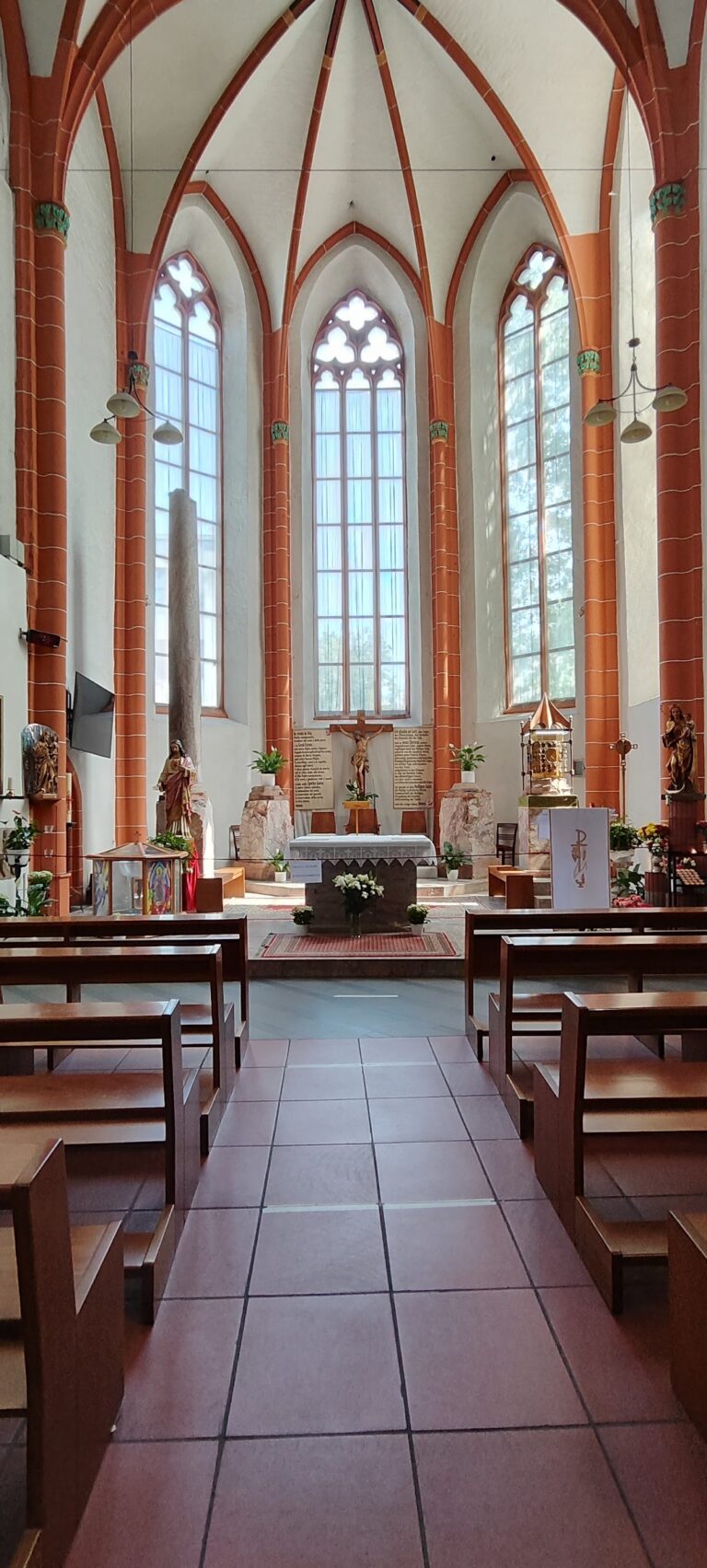
The restored eastern chancel now accommodates changing installations associated with Roman Catholic urban ministry. Since 2020, the chapel has hosted weekly ecumenical prayers for peace on Fridays in the tradition of the Coventry Cross of Nails. This Christian prayer tradition began at Coventry Cathedral after its destruction during the Second World War and expresses reconciliation and peace after wartime devastation. Roman Catholic urban ministry, the Old Catholic Church, and the Episcopal Church also conduct worship there at various times.
The chapel in the lower level of the Romanesque tower is used by the international Orthodox Parish of St. Christoph for mainly German-language services in the Byzantine rite, a family of Christian liturgical traditions historically associated with the churches of the eastern Roman Empire. The chapel belongs to the Roman Catholic Diocese of Mainz. The remaining ruins, including the part of the tower above the sacristy, belong to and are maintained by the City of Mainz.
The church and surrounding square received a new lighting design in 2005, with separate treatment for the interior and exterior areas. The Initiative St. Christoph was founded in 2012 to promote the monument, and a renovation programme was developed with the City of Mainz. In 2025, the tower received an abstract spire made of steel. Approximately 20 metres high and weighing 15 tonnes, it reproduces the ridges and valleys of the historical spire without attempting an exact reconstruction. A platform approximately 30 metres above ground was planned as part of the work.
Remains
Church layout and surviving medieval fabric
St. Christoph was built as a three-aisled basilica, a church with a central nave flanked by lower side aisles. The nave has four bays, while the one-bay choir ends in a polygonal apse, formed internally by five sides of an imagined octagon and externally by four. Between the nave and choir lies a one-bay transverse structure. Its northern section forms the tower, whose Romanesque lower level preserves paired arched windows dating from around 1240.
The western two bays of the north aisle formerly opened into the Valentinus Chapel. The Michael Chapel stood as an associated structure and was repeatedly repaired or considered dilapidated before its sale in 1786. The postwar monument retains the nave, tower, and outer walls as ruins. Its northern side is strengthened by concrete supports and modern buttresses, while the eastern choir has been rebuilt in a reduced form.
Memorial structures and artistic features
Concrete buttresses and memorial plaque
The modern buttresses on the north side carry reliefs by Heinz Hemrich, a Mainz sculptor. Their symbolic representations draw on the history of Mainz and integrate historical imagery into the postwar structure. A floor plaque in the memorial carries the inscription, “In memory of the dead / as a reminder for the living.”
Chancel and tower chapel windows
The windows of the choir and the glass wall in the chancel area were designed by Alois Plum, a glass artist from Mainz. Plum also designed the windows in the chapel occupying the lower level of the Romanesque tower. These elements belong to the later religious and memorial presentation of the surviving building.
Associated sculptures, furnishings, and objects
Gutenberg statue and baptismal font
An iron statue of Johannes Gutenberg stands directly beside the church. Created by the Mainz sculptor Karlheinz Oswald for the Gutenberg Year celebrations in 2000, it shows Gutenberg at a printing press. The press is represented as a wooden machine whose construction, mechanism, and operation resemble those of a wine press.
A Gothic baptismal font dating from Gutenberg’s period remains in the eastern part of the church. Four lion heads support the font, linking a surviving medieval furnishing with the church’s traditional association with Gutenberg.
Transferred devotional works
The Rococo sculpture of Saint Valentine survived the wartime destruction and is now in the Carmelite Church, where the associated Valentine pilgrimage was also transferred. The Mainz Miracle Cross, a devotional cross from the early fourteenth century that was venerated at St. Christoph between 1792 and 1942, is now kept in the Franciscan Chapel of the Mainz seminary.
Surviving organ parts
Geissel’s 1667 organ was sold to Gau-Bischofsheim after the installation of a later instrument. Parts of the earlier organ survive in the parish church there, where it is described as the oldest surviving organ in the Diocese of Mainz.