Church of Saints Stephen and Lawrence: A Fifteenth-Century Collegiate Church in Italy


Site at a Glance
- Rating
- 4.8
- Popularity
- Very Low
- Country
- Italy
- Primary era
- Medieval
- External website
- Open
- Eras represented
- Medieval, Modern
- Civilizations
- Duchy of Milan, Holy Roman Empire
- Site type
- Religious
- Remains
- Church
On this page15 sections
History
Foundation and construction
The Church of Saints Stephen and Lawrence is a Catholic collegiate church in Italy, overlooking Castiglione Olona in the historic Seprio region. Also known as the Collegiate Church because it was served by a chapter, or college, of canons, it was commissioned by Cardinal Branda Castiglioni and built in the Lombard Gothic style over the ruins of Castiglione Olona Castle. The fortification had been destroyed several times between the late Middle Ages and the early Renaissance. Design of the new church was assigned to the Ticinese brothers Alberto, Giovanni, and Pietro Solari, sons of Marco da Carona.
Construction lasted three years, and the church was consecrated on 25 March 1425. Its stated completion date is 1435. The new building formed the centre of Cardinal Branda Castiglioni’s religious foundation on the hill, incorporating parts of the earlier castle into its surrounding structures.
The collegiate chapter
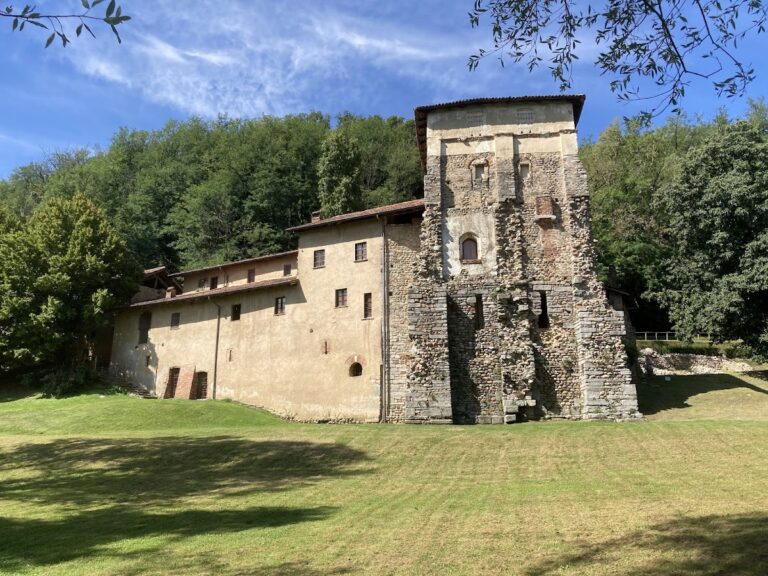
The collegiate chapter remained active until its suppression in 1798. A cloister formerly stood near the church, while the baptistery and campanile were established on the bases of towers belonging to the earlier castle. The church remains a Catholic building of the Ambrosian rite, the liturgical tradition associated especially with the Archdiocese of Milan, to which it belongs.
Collections and restoration
From 2013, three rooms of the former canonry have housed the Collegiate Church Museum. Its holdings include the surviving part of the church treasury, with paintings, Ambrosian chant codices, goldsmiths’ work, and sacred furnishings, predominantly from the fifteenth century. Restoration in 2003 brought the Transit of the Virgin on the front of the triumphal arch back to view. The church’s fifteenth-century Flemish or German chandelier was restored in 2016, and Cardinal Branda Castiglioni’s embroidered funeral veil was restored in 2022.
Remains
Exterior and interior plan
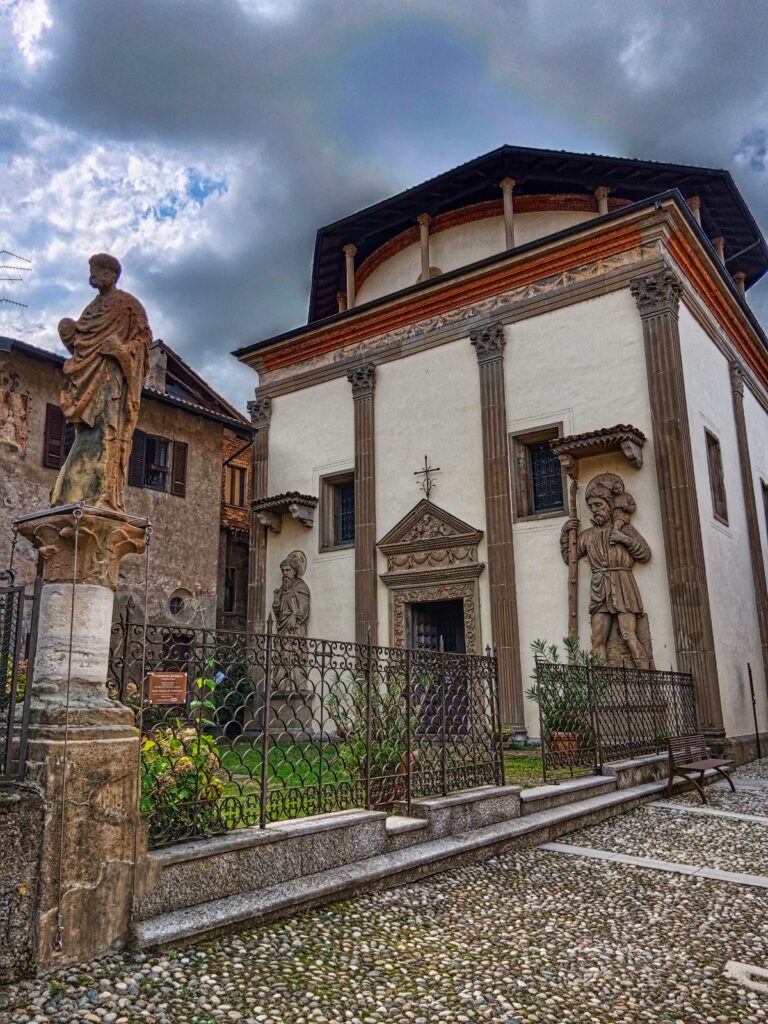
The church has exposed brickwork, a gabled facade, buttresses that mark the internal divisions, and a frieze of small arches. A large rose window and sculpted portal dominate the front. Above the entrance is a sculpted lunette dated 1428, made by the Carona masters Filippo Solari and Andrea da Carona. The Madonna and Child occupy its centre. Saint Lawrence, Saint Clement, and the kneeling Cardinal Branda Castiglioni appear on the left, while Saint Ambrose and Saint Stephen appear on the right. The architrave carries the symbols of the four Evangelists.
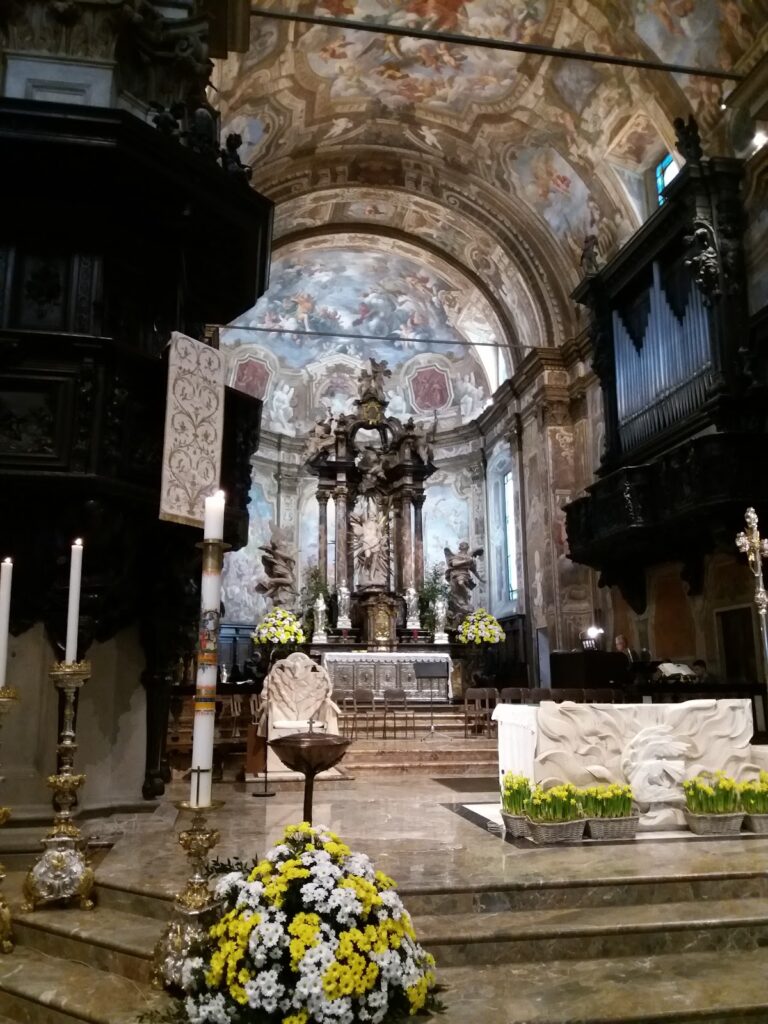
Inside, five stone columns divide three aisles. Three central square bays correspond on either side to six smaller bays of the same design, and the aisles end in three apses. The vault decoration belongs to the nineteenth-century Neo-Gothic period. A rare fifteenth-century chandelier hangs in the central aisle. It was made during the third or fourth decade of the fifteenth century by a Flemish workshop in Dinant or a German workshop in Nuremberg, and resembles the chandelier shown in Jan van Eyck’s Portrait of the Arnolfini Couple. Its central shrine, brought to Castiglione through Cardinal Branda Castiglioni’s foreign missions and international relationships, contains statues of the Virgin, Saints Stephen and Lawrence, and Saint George with the dragon.
Presbytery and burial monument
Frescoes of the presbytery
The presbytery contains frescoes by a group of Tuscan artists. Masolino da Panicale painted the six sections of the central vault, signing his work and depicting episodes from the life of the Virgin between 1432 and 1433, or possibly in 1435. The scenes are the Nativity, Annunciation, Coronation of Mary, Marriage of the Virgin, Adoration of the Magi, and Assumption. They are arranged without following the chronological order of the events.
The apse contains the Stories of Saints Lawrence and Stephen, both martyrs. Paolo Schiavo is associated with the lunettes and the first scenes on the right wall, while Lorenzo di Pietro, known as Vecchietta, painted the left and rear walls. Paolo Schiavo is also credited with the Transit of the Virgin on the triumphal arch and with a Crucifixion in the presbytery. The Crucifixion was originally painted for another building before being installed in the Collegiate Church.
Tomb of Cardinal Branda Castiglioni
Beneath the arch between the central and left apses stands the tomb of Cardinal Branda Castiglioni. Its elaborate marble sarcophagus is supported by Virtues represented as caryatids, sculpted female figures serving as architectural supports. An ancient tabernacle stands near the burial.
Chapels and baptistery
Side chapels
The side chapels contain two polychrome-stone polyptychs, altarpieces formed from multiple panels or sections, dating from the first half of the fifteenth century. The chapel on the right is dedicated to the Twelve Apostles and shows Christ with the Apostles. The chapel on the left, known as the Chapel of Saint Clement, shows the Madonna and Child with Saints Stephen and Lawrence. Saint Clement was the titular saint of the Roman basilica for which Cardinal Branda Castiglioni held the cardinal’s title.
Baptistery
The baptistery was built on the foundations of a tower from the earlier castle. It contains Masolino da Panicale’s Stories of Saint John the Baptist, dated 1435, together with a fifteenth-century baptismal font made by Carona masters. The campanile likewise stands on the base of a former castle tower.
Collegiate Church Museum
Paintings and manuscripts
The museum preserves a Crucifixion by Neri di Bicci, dated approximately 1465, and an Annunciation by Apollonio di Giovanni, dated approximately 1440. Its collection also includes Ambrosian chant choir books from the first half of the fifteenth century, a sixteenth-century tempera-on-panel Madonna and Child attributed to Bernardino Butinone, and Willem van Herp’s seventeenth-century Resurrection of Christ.
Relics, sculpture, and furnishings
The museum holds Lombard goldsmiths’ work and crafts, a staurotheke, or reliquary for a relic of the True Cross, made by Venetian and Mosan goldsmiths during the first half of the fifteenth century, and an ivory reliquary made by Florentine craftsmen in the same period. Other works include a late-fifteenth-century Lombard carved-wood Crucified Christ, a tempera-on-panel Holy Family with Saint Catherine of Siena by a Venetian-Cretan master, and a carved-wood Ecce Homo by a Lombard sculptor. The collection also contains Cardinal Branda Castiglioni’s embroidered funeral veil, found over his face during the examination of his tomb in 1935, and an eighteenth-century wrought-iron and wooden brazier.