Santa Dorotea: Baroque Church and Conventual Franciscan Church in Rome


Site at a Glance
- Rating
- 4.7
- Popularity
- Low
- Country
- Italy
- Primary era
- Early Modern
- External website
- Open
- Eras represented
- Medieval, Early Modern
- Civilizations
- Papal States
- Site type
- Religious
- Remains
- Church
On this page14 sections
History
Santa Dorotea is a Roman Catholic parish and convent church in Rome, Italy, in the Trastevere district. Its present Baroque building was constructed between 1750 and 1756 on the site of a medieval church, whose earliest foundation has been associated with the fourth, eighth, or eleventh century.
Medieval Origins and Changing Dedications
The church first appears in a papal bull issued by Callistus II in 1123. It was then dedicated to Saint Silvester and known as San Silvestro alla Porta Settimiana, probably serving as a subsidiary church of Santa Maria in Trastevere. During the fourteenth century it was called San Silvestro della Malva.
A rebuilding or major renewal took place for the Holy Year of 1475. The church had a double dedication to Saints Silvester and Dorothea by 1445, but devotion to Saint Dorothea gradually became predominant. By 1566, ecclesiastical listings named the church under her dedication alone. Relics associated with Saint Dorothea, a Christian virgin and martyr traditionally linked with Caesarea in Cappadocia, were brought to the church in 1500 and placed beneath the main altar. Saint Silvester I, pope during the period when Christianity gained legal recognition in the Roman Empire, continued to share the church’s historical dedication.
Confraternities and Religious Education
The Confraternity of Divine Love, founded by a Genoese notary and present in Rome from 1513, united with the parish in 1516 or 1517. Its members included the future Pope Paul IV and Saint Cajetan of Thiene, an Italian priest and reformer who later co-founded the Theatine Order, a Catholic religious order associated with the Counter-Reformation. The confraternity was also connected with the establishment of the Oratory of Divine Love in the church sacristy in 1517.
During the 1590s, Saint Joseph Calasanz established a free public school for boys in rooms connected with the monastery or in the neighboring house. Calasanz was a Spanish priest and educator whose work founded the Piarist Order, a Catholic teaching congregation devoted especially to children’s education. The school at Santa Dorotea is regarded as an origin of that order.
Franciscan Rebuilding
The church was restored before 1718 and may then have received some fresco decoration. Its parish was suppressed in 1727. The Conventual Franciscans, a branch of the Franciscan Order whose friars live and serve in organized religious communities, purchased the church in 1729 and acquired adjoining land in 1734. It was granted to them in 1738 and became the chapel of their new convent.
A complete rebuilding was decided upon in 1750 and began that year or in 1751. Giovanni Battista Nolli designed the new church for Giovanni Carlo Vipera, Minister-General of the Conventual Franciscans. The building was completed in October 1756, except for its six side altars. Nolli was later buried at the base of the main altar.
Nineteenth- and Twentieth-Century Changes
The Camillians held the church from 1798 to 1800, and ownership was finally transferred to the Franciscans in 1818. The parish was re-established in 1824. Restoration and re-consecration followed in 1879, while further work in 1931 included the addition of frescoes. Until 1870, a notice was customarily placed on the church door naming people who had not fulfilled their Easter religious obligation.
Santa Dorotea became a titular church on 12 June 2014. A titular church in Rome is assigned to a cardinal-priest as the symbolic title of his relationship with the Diocese of Rome. Javier Lozano Barragán held the title from 2014 to 2022, followed by Jorge Enrique Jiménez Carvajal, appointed in 2022.
Remains
Santa Dorotea stands on Via di Santa Dorotea, about 200 metres west of Ponte Sisto on the right bank of the Tiber. The church is incorporated into convent buildings on both sides, and its present structure combines a central domed space with a long, single-nave hall. It can also be understood as a Latin-cross plan with a nave, transept, and semicircular apse. The building is organized into vaulted bays, with the central dome providing the principal spatial focus.
Facade and Plan
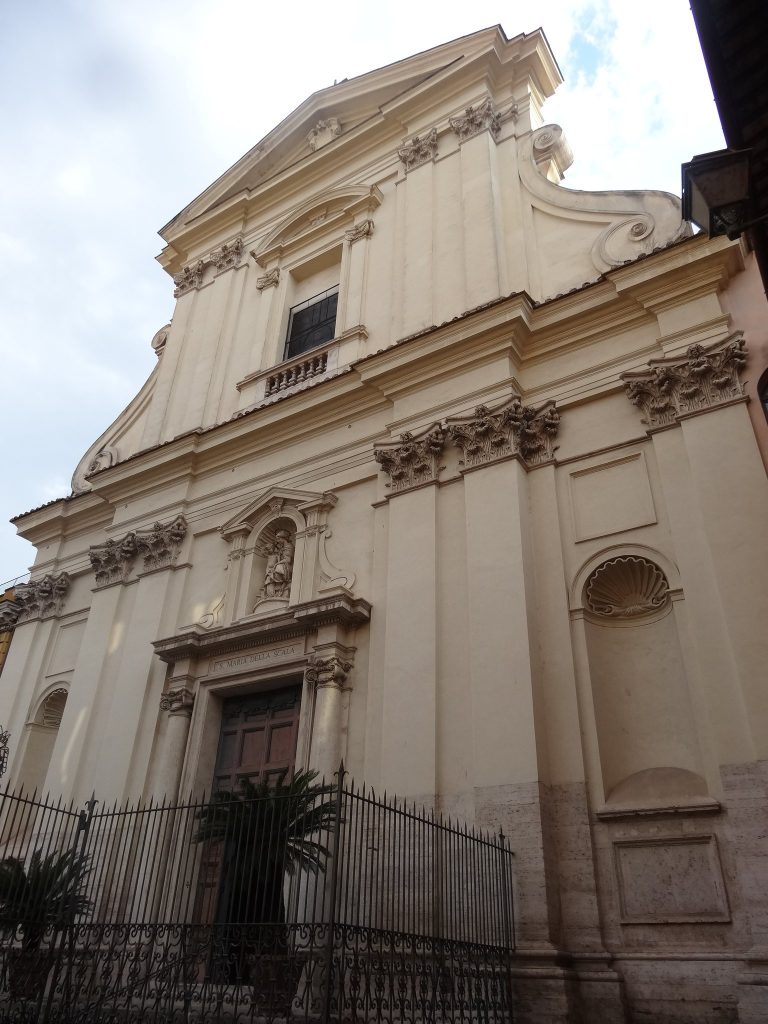
The street-facing facade is single-axis, single-storey, slightly concave, and gabled. Composite pilasters frame the portal, the inscription above it, and the inset window, while the outer pilasters stand behind the inner pair. A projecting cornice supports a low, twice-stepped triangular pediment. The inscription dedicates the church to Almighty God in honour of Pope Saint Silvester and Dorothea, virgin and martyr. Above the entrance, the Franciscan emblem shows two crossed arms with a cross above them, and the same emblem appears in the central floor area beneath the dome.
The earlier church renewed in 1475 had three aisles and measured approximately 10.48 metres in length, 5.56 metres in width, and 7.36 metres in height. The present building replaced that medieval structure between 1750 and 1756. A bell tower stands to the right of the apse, while the small chapel beside the church is dedicated to the Virgin of Sorrows.
Domed Interior and Frescoes
Central Dome and Vaults
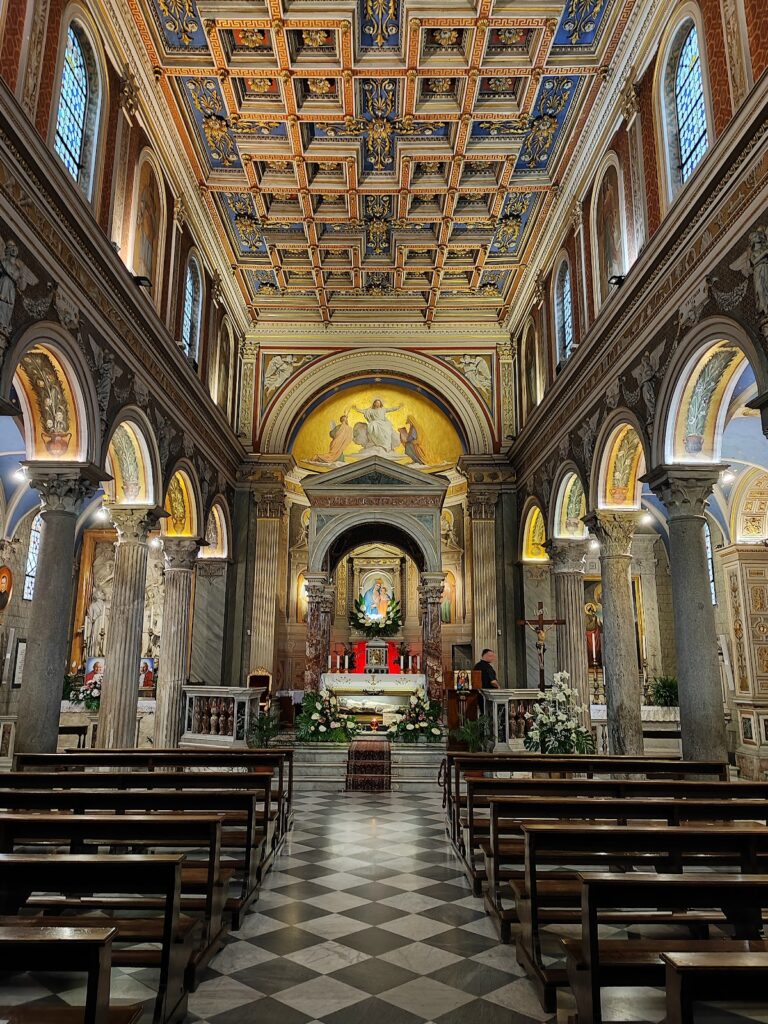
The interior is divided by composite pilasters and transverse arches. A continuous projecting cornice has dentil decoration, and the free wall surfaces carry nineteenth-century painted imitation marble over an interior that was originally white. The central area contains a ribbed, octagonal hanging dome with a lantern, a raised opening or structure that admits light. Four pillars support it, and each pillar contains a small choir gallery.
Barrel vaults, which are continuous tunnel-shaped ceilings, cover the bays of the nave and transept. The domed area contains frescoes of the vision of Saint Anthony, the glory of Saint Francis of Assisi, Saint Francis flying toward Assisi, and the death of Saint Clare. Twentieth-century frescoes by Gaetano Bocchetti fill the nave and transept vaults with scenes from the life of Saint Dorothea and episodes involving Franciscan saints, including Saint Francis, Saint Bonaventure, Saint Clare, Saint Joseph of Copertino, and Saint Anthony of Padua.
Apse and Main Altar
The semicircular apse is a surviving element of the predecessor church and is lit by two rectangular windows. Its marble main altar contains the relics of Saint Dorothea. The large central painting by Michele Bucci shows Saints Dorothea and Silvester venerating the Virgin Mary and incorporates an older image of the Madonna del Divino Amore. Sculpted silver crowns adorn Mary and the infant Jesus. In the apse conch, Gino Terreni painted a further fresco depicting the martyrdom of Saint Dorothea.
Side Altars and Musical Features
Right-Hand Altars
Three side altars stand on the right. The first is dedicated to Saint Joseph Calasanz and contains Gioacchino Martorana’s 1782 painting of Saint Cajetan appearing to Calasanz. The second, in the right transept arm, is dedicated to Saint Anthony of Padua and contains Lorenzo Gramiccia’s 1756 painting of the Virgin appearing to Saint Anthony. The third contains a 1763 Immaculate Conception by the Viennese painter Georg Kaspar Brenner.
Left-Hand Altars
Three corresponding altars stand on the left. The first contains Vincenzo Meucci’s 1753 painting of Saint Joseph of Copertino. The second, in the left transept arm, is dedicated to Saint Francis of Assisi and contains Liborio Marmorelli’s late-eighteenth-century painting The Ecstasy of Saint Francis, donated in 1760 by Cardinal Neri Corsini. The third is dedicated to the Crucifixion and contains Michele Bucci’s painting of the Crucifixion with Saints Rosalia, Margaret of Cortona, Bonaventure, and Nicholas.
Organ and Transept Memorials
Nineteenth-century funerary stelae stand in the left transept arm. Above the entrance, a modern choir loft holds an organ built in 1963 by Fratelli Ruffatti. It has 24 stops, two manuals, and a pedalboard, with electric action for both keys and stops. Its facade consists of principal pipes arranged in a palisade without a case, while the console has two 61-note keyboards and a 32-note concave-radial pedalboard.