San Salvatore in Onda: A Pallottine Church in Rome
Site at a Glance
- Rating
- 4.7
- Popularity
- Very Low
- Country
- Italy
- Primary era
- Modern
- Eras represented
- Classical, Medieval, Modern
- Civilizations
- Italian, Papal States, Roman
- Site type
- Religious
- Remains
- Church
On this page13 sections
History
San Salvatore in Onda is a Roman Catholic church in Rome, Italy, whose construction is dated to the eleventh century and whose nineteenth-century rebuilding gave it a basilical plan. Dedicated to Jesus Christ, it stands in the Rione Regola on Via dei Pettinari and serves as a subsidiary church of Santi Biagio e Carlo ai Catinari. It is also one of the principal churches of the Pallottines, a Catholic religious community founded by Vincenzo Pallotti.
Medieval origins
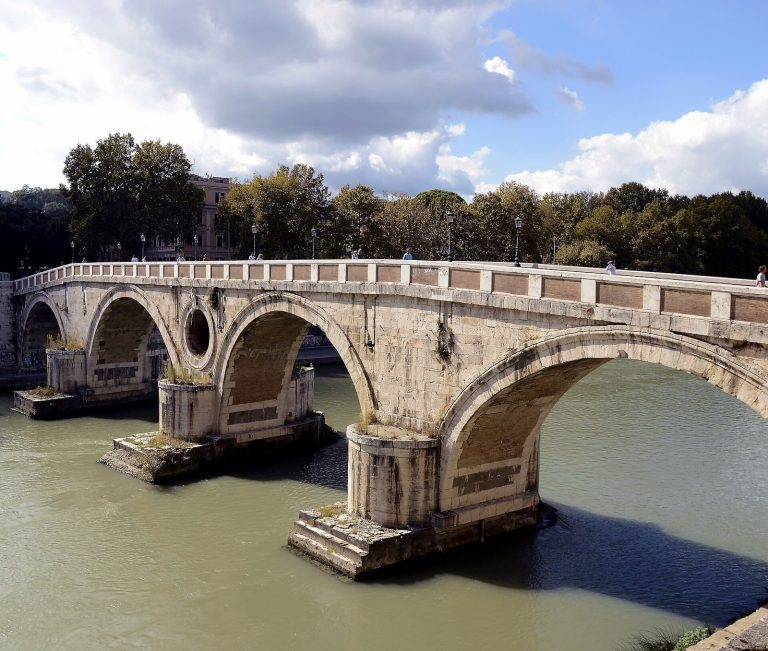
A church stood on the site by the twelfth century. Pope Honorius II mentioned it in a bull of 1127 under the dedication of the Transfiguration of Our Lord Jesus Christ, and another record describes a church erected there by 1260. The name “in Onda” probably refers to flooding from the nearby Tiber, whose overflow once inundated the church and the surrounding district. Via dei Pettinari follows an ancient route between the Pons Aurelius, a Roman bridge across the Tiber, and the Theatre of Pompey, a major Roman theatrical and monumental complex.
By 1260, the church had been placed under a monastic community associated with Paul of Thebes, traditionally regarded as one of the first Christian hermits. In January 1445, Pope Eugene IV transferred San Salvatore in Onda and its adjoining convent to the Conventual Franciscans, a branch of the Franciscan Order organized around communal convent life. They remained responsible for the church for several centuries. Two Franciscan popes, Sixtus IV, who reigned from 1471 to 1484, and Sixtus V, who reigned from 1585 to 1590, came from the community associated with San Salvatore in Onda.
The Pallottine headquarters
On August 14, 1844, Pope Gregory XVI transferred the church to the new order founded by Vincenzo Pallotti. Known formally as the Society of the Catholic Apostolate, the Pallottines made San Salvatore in Onda and its adjoining buildings their official headquarters from 1846. The complex consequently became closely connected with the community’s religious life and with the people associated with its foundation.
Elisabetta Sanna, born in Condrongianos, Sardinia, on April 23, 1788, came to Rome on pilgrimage in 1830 after being widowed in 1825. She met Vincent Pallotti, became a secular Franciscan tertiary, and later joined the early Pallottine movement. She died in Rome on February 17, 1857, and was buried at San Salvatore in Onda. Pope Francis declared her venerable on January 27, 2014. The church also contains the burial of Saint Vincent Pallotti and remains a Pallottine pilgrimage and institutional center.
Reconstruction and later history
The church underwent repeated alterations during the eighteenth and nineteenth centuries. In 1848, the Roman Republic seized its earlier bells, and two replacements were installed in the campanile in 1850. A major reconstruction began in 1867 under Luca Carimini. The work included raising the floor and reorganizing the interior as a basilica, with the cost met by the brothers Antonio and Pietro Cassetta because the Pallottines could not finance the project. The church reopened on August 6, 1878, during a Mass presided over by Monsignor Francesco di Paola Cassetta.
Pope John Paul II visited San Salvatore in Onda on June 22, 1986. The visit recalled his connection with the adjoining Pallottine generalate, where he had stayed for several weeks while studying in Rome during the 1940s.
Remains
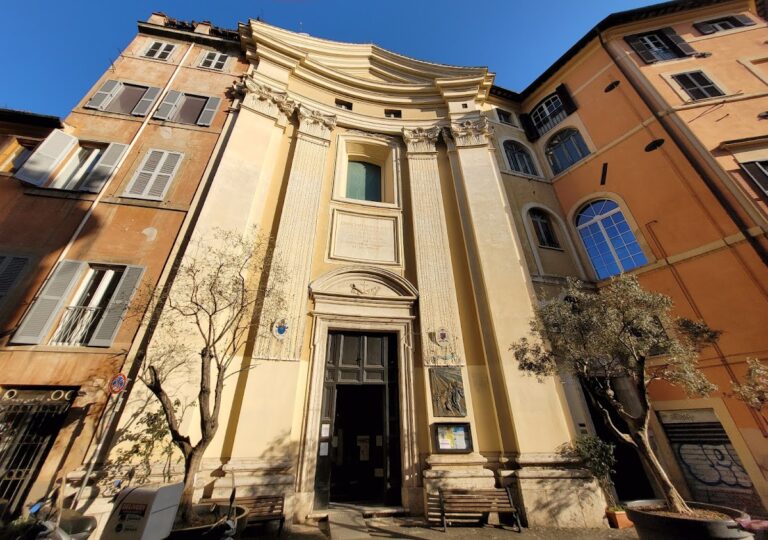
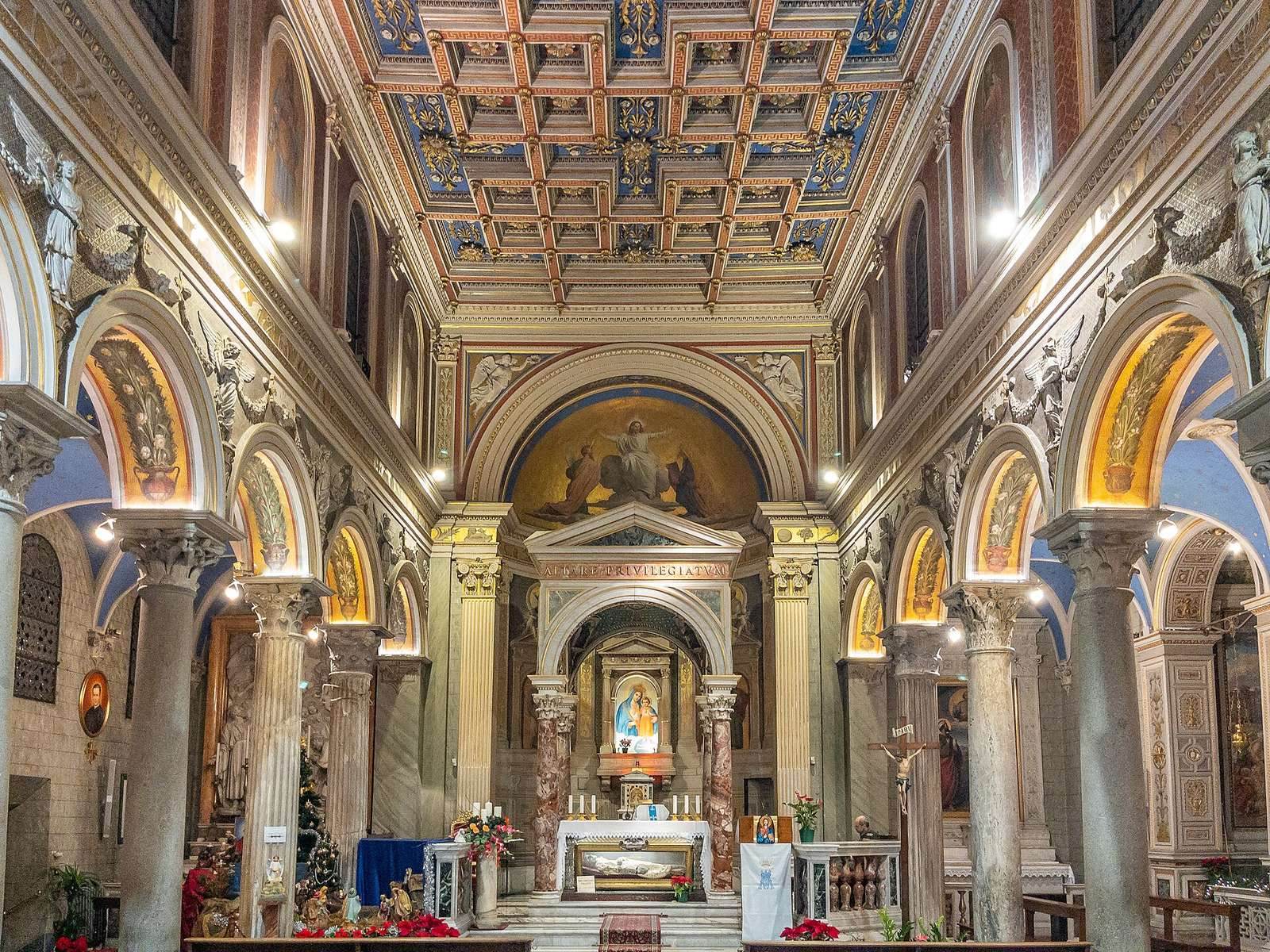
The church faces Via dei Pettinari, with its facade opening directly onto the street. Inside, twelve pillars divide the space into a central nave and two side aisles, expressing the basilical arrangement adopted during the nineteenth-century reconstruction. Beneath the presbytery, an earlier underground sequence preserves an older chapel and a crypt, while Roman-period storage spaces extend below the level of the modern city.
Church interior
Nave and aisles
The twelve pillars organize the interior into a broad central nave and two side aisles. This arrangement belongs to the nineteenth-century rebuilding directed by Luca Carimini and gives the church its basilical form. The Stations of the Cross were made by Domenico Cassarotti, and the organ was built by Pietro Pantanella.
Apse decoration
The apse contains Filippo Prosperi’s fresco of the Transfiguration, reflecting the church’s original dedication. Prosperi also painted saints and Old Testament patriarchs in gold between the windows. These figures occupy eight sections divided by pilasters set against a dark-red wall. At the center stands an 1878 fresco of the Virgin and Child by Cesare Mariani, which replaced an earlier image of the Queen of the Apostles by Serafino Cesaretti.
Virgo Potens chapel
The chapel of Virgo Potens, a Latin title meaning “Powerful Virgin” for the Virgin Mary, opens from the right-hand aisle. The Cassetta family erected it during the nineteenth century. Its altar holds an image of Virgo Potens donated by Elisabetta Sanna, who was buried within the chapel.
Main altar sarcophagus
A sarcophagus made by Arnoldo Brandizzi lies beneath the main altar. Since 1950, it has contained the body of Saint Vincent Pallotti, giving the altar a direct physical connection with the founder of the Pallottine community.
Underground remains
Early crypt
The crypt beneath the presbytery probably dates from the eighth century. It incorporates the earlier chapel associated with the church and forms part of the site’s surviving sequence below the present interior.
Roman-period storage spaces
Below the crypt are underground cellars, wine stores, and storerooms dating from the Roman period. They lie beneath the level of the modern city and preserve evidence of the site’s earlier use before the medieval church developed above them.