Palazzo Corsini: A Late-Baroque Palace and National Art Gallery in Rome


Site at a Glance
- Rating
- 4.4
- Popularity
- Medium
- Country
- Italy
- Primary era
- Early Modern
- External website
- Open
- Eras represented
- Medieval, Early Modern
- Civilizations
- Papal States
- Site type
- Domestic
- Remains
- Elite Residence
On this page8 sections
History
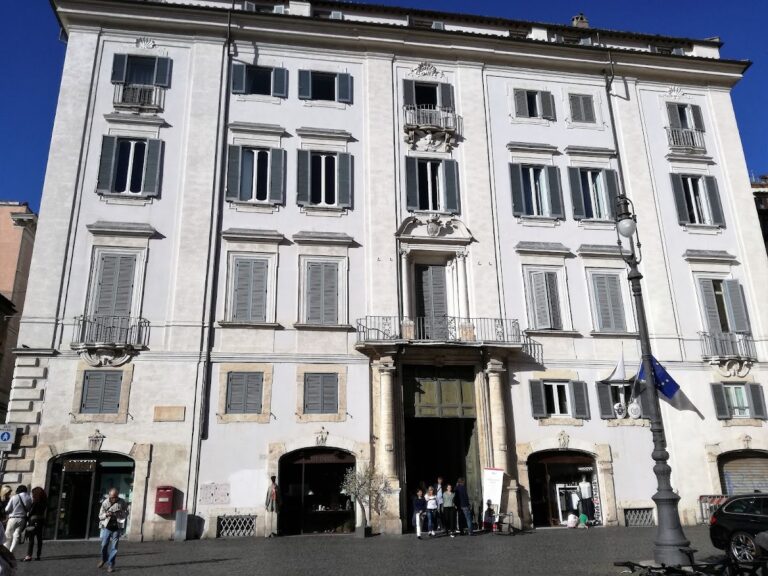
Palazzo Corsini is a late-Baroque palace in Rome, Italy, built for the Corsini family between 1730 and 1740 on the site of an earlier fifteenth-century villa belonging to the Riario family. The surviving building reflects the development of the site from an aristocratic villa into a major Roman palace and later an institution housing both historic collections and scientific offices.
The Riario Villa and Christina of Sweden
The earlier villa was associated with Girolamo Riario della Rovere, a fifteenth-century Italian cardinal and papal relative who was the nephew of Pope Sixtus IV. From 1659 to 1689, it became the Roman residence of Christina, former queen of Sweden. She had abdicated, converted to Catholicism, and moved to Rome. Under her patronage, the villa hosted the first meetings of the Accademia dell’Arcadia, a literary academy founded in Rome.
The site continued to change before the construction of the present palace. In 1686, its facade was rebuilt by the Florentine architect Ferdinando Tacca in a design compared with the facade of Palazzo Pitti in Florence. This work formed part of the building’s earlier development rather than representing the wholly new palace later commissioned by the Corsini family.
The Corsini Palace
In 1736, Florentine Cardinal Neri Maria Corsini acquired the villa and the surrounding land. He was the nephew of Pope Clement XII and commissioned the late-Baroque palace that survives today, designed by Ferdinando Fuga. The building is often called Palazzo Corsini alla Lungara after a member of the Corsini family acceded to the papacy. The name distinguishes it from other palaces associated with different branches of the Florentine Corsini family, including Palazzo Corsini al Parione in Florence.
During the Napoleonic occupation of Rome, the palace housed Joseph Bonaparte, Napoleon Bonaparte’s elder brother and a member of the Bonaparte dynasty. In 1883, the state acquired the palace and the Corsini family collection together, while the works remained displayed in their original setting. The collection is fideicommissary, meaning that it was intended to remain together as an inalienable family collection rather than being freely divided or sold. From the second half of the twentieth century, the Italian government pursued the restoration of historic family collections to their original buildings.
Palazzo Corsini now contains offices of the Accademia dei Lincei, Italy’s national academy of sciences, and the Galleria Corsini. The gallery forms part of Rome’s national collections of antique art together with institutions including Palazzo Barberini and the Galleria Borghese.
Remains
Palazzo Corsini is a late-Baroque building in Rome’s Trastevere district, beside Villa Farnesina. Its present form elaborates on the earlier Riario villa, combining an eighteenth-century palace with decorated interiors, an art gallery, and gardens rising toward Janiculum Hill.
Palace and Gallery
Palace Interiors
The palace interiors are enriched with frescoes and stucco reliefs. Stucco is a moldable plaster-based material used for architectural reliefs and ornamental surface decoration. The eighteenth-century Florentine decorators included A. D. Gabbiani and A. Gherardini, whose work contributes to the building’s interior decoration.
Galleria Corsini
The Galleria Nazionale d’Arte Antica in Palazzo Corsini, commonly called the Galleria Corsini, occupies one floor of the palace and functions as an art museum. Its holdings range mainly from the early Renaissance to the late eighteenth century and include religious and historical works, landscapes, and genre paintings, a form of art depicting scenes from everyday life.
Most of the gallery’s major works were donated by the Corsini family. Cardinal Neri Maria Corsini began the collection in the seventeenth century, and it was enlarged with works from other family members and from the collections of Pope Clement XII and his nephew. Artists represented in the holdings include Fra Angelico, Jacopo Bassano, the Carracci, Caravaggio, Anthony van Dyck, Francesco Francia, the Gentileschi family, Luca Giordano, Guercino, Angelica Kauffman, Lanfranco, Carlo Maratta, Bartolomé Murillo, Mattia Preti, and Guido Reni.
Gardens
The palace gardens extend upward toward Janiculum Hill. They form part of the Orto Botanico dell’Università di Roma “La Sapienza,” the botanical garden of the University of Rome Sapienza, linking the historic palace grounds with a larger botanical landscape.
Nearby sites