Santa Maria Annunciata, Bienno: A Fifteenth-Century Community Church in Italy


Site at a Glance
- Rating
- 4.7
- Popularity
- Low
- Country
- Italy
- Primary era
- Medieval
- External website
- Open
- Eras represented
- Medieval, Early Modern
- Civilizations
- Venetian
- Site type
- Religious
- Remains
- Church
On this page13 sections
History
Santa Maria Annunciata, Bienno, is a fifteenth-century Roman Catholic church in Italy, built and owned by the community of Bienno. The church stands in the area known during the Middle Ages as in ortis, and its foundations cover an archaeological layer dating from the Roman period. Its Gothic-like architectural elements and extensive religious paintings reflect the history of Bienno and the artistic culture of Valcamonica.
Community Foundation
The church was erected by the organized civic community of Bienno, known as the vicinia, rather than by a private patron. After the community recovered from the Curia of Brescia the right to administer the sacraments, its representatives commissioned the Brescian painter Girolamo Romani, known as Romanino, to decorate the church with a major cycle devoted to the Virgin Annunciate.
Romanino and the Sixteenth Century
Romanino painted the presbytery frescoes between 1537 and 1541. Girolamo Romani was a sixteenth-century painter from Brescia associated with important religious fresco cycles in Lombardy. The work at Bienno represents his final phase in Valcamonica, following his projects at Pisogne and Breno.
Several local families also commissioned frescoes inside the church. Santa Maria Annunciata remains a Roman Catholic church in the Diocese of Brescia and is classified as a national monument.
Later Alterations
The presbytery frescoes were later affected by the installation of a large altarpiece from the seventeenth century. The central altar now carries a 1634 Annunciation altarpiece by Giovanni Mauro della Rovere, known as Fiammenghino, an early-seventeenth-century Italian painter whose work included religious altarpieces. The installation mutilated part of the earlier painted cycle on the rear wall.
Remains
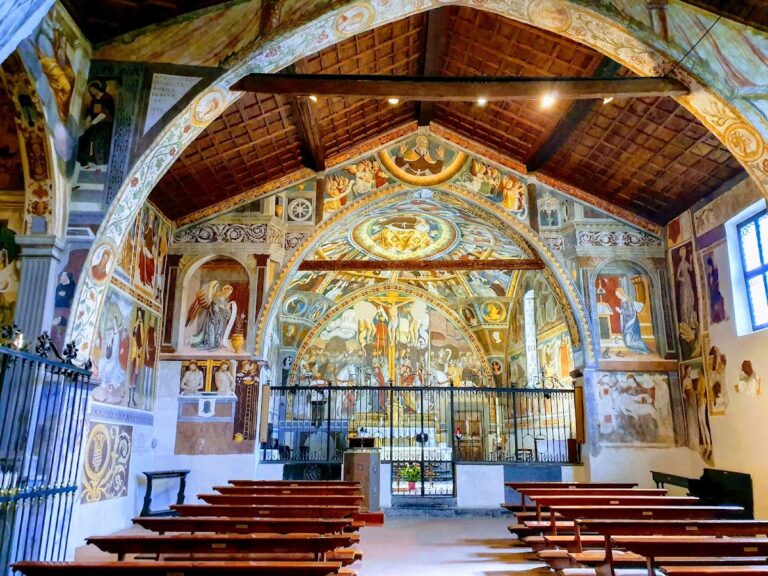
The church has a northeast-facing facade with a red sandstone oculus and a two-colour portal in a Gothic-like style. The southeast exterior is covered with frescoes of numerous saints, including a monumental Saint Christopher. A second Gothic-like portal with a trefoil design was closed and damaged when a new entrance was opened to its right. Inside the entrance, a staircase on the right leads to the upper level, which formerly housed the choir.
Nave Frescoes
Saint Francis Cycle
On the right wall, in the third bay before the altar, scenes from the life of Saint Francis are attributed to Giovanni Pietro da Cemmo and his assistants. Giovanni Pietro da Cemmo was active in the Brescia and Valcamonica area during the late fifteenth and early sixteenth centuries. The central portion of this cycle is damaged.
Triumph of Death
Below the Saint Francis scenes is a late-fifteenth-century Triumph of Death. Seven people representing different social categories carry gifts while a skeletal figure strikes them indiscriminately with arrows.
Devotional Images
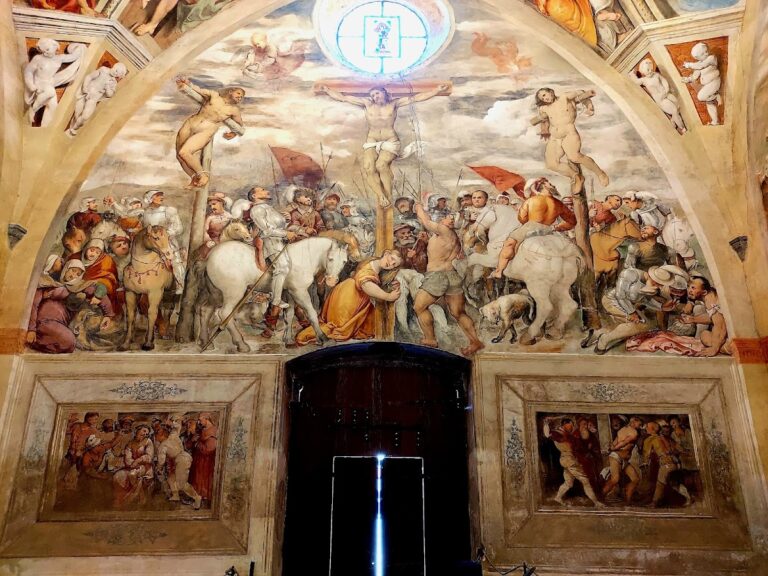
Other interior frescoes show the Madonna enthroned with the Child, scenes of the Crucifixion, and repeated representations of Simon of Trent with pincers and tongs associated with his martyrdom. Simon of Trent was a fifteenth-century child whose alleged martyrdom gave rise to a local cult. The painted figures also include Saints John, Sebastian, Roch, Lucy, and Apollonia.
Presbytery Frescoes
The presbytery, the part of the church reserved for the altar and clergy, is separated from the rest of the building by an arch decorated with ten Sibyls by Giovanni Pietro da Cemmo. Sibyls are female prophetic figures from classical and Christian traditions, represented here as witnesses to or foreshadowers of sacred events.
Marriage of the Virgin
Romanino’s frescoes survive in the presbytery. On the right wall, the Marriage of the Virgin is arranged in two registers. The lower register presents the sacred ceremony, while the upper one uses painted, three-dimensional architectural forms filled with spectators. The ceremony takes place inside a four-sided portico of Ionic columns hung with vegetal festoons, above which a balcony projects with further onlookers.
At the center, Saint Joseph, the High Priest, and Mary exchange rings in a pyramidal arrangement. Mary wears a long blue mantle, and a varied crowd surrounds the ceremony. On the groom’s left, suitors in feathered hats break barren rods. A girl in white offers roses, while a small girl in a blue dress and cap stands among the assembled figures.
Presentation of Mary at the Temple
On the left wall, the Presentation of Mary at the Temple is organized around a steep central staircase. The High Priest waits at the top as the young Mary climbs the steps. Anna and Joachim watch from below with the women and men attending the ceremony. Anna and Joachim are, in Christian tradition, the parents of the Virgin Mary. Behind Joachim stands a richly dressed shepherd carrying a sacrificial lamb, while a child in red holds a rabbit.
Fragments of the Rear Wall
The original program was intended to cover all three walls of the presbytery. The cycle on the rear wall was mutilated when the large seventeenth-century altarpiece was installed. Fragments beside the altarpiece are generally identified as scenes from the meeting of Anna and Joachim or from Joachim being expelled from the Temple, although their precise subject remains uncertain.
The surviving central section used the same visual division as the other scenes, with an architectural setting for the episodes of Anna and Joachim and an upper loggia, an open gallery or elevated architectural space, for spectators. Joachim appears in a fur-trimmed brocade garment, while Anna stands behind him between the portico arches. A priest appears to be engaged in an animated discussion with Joachim.