Saint Anne church in Mołtajny: A Brick Gothic Parish Church in Poland


Site at a Glance
- Rating
- 4.7
- Popularity
- Very Low
- Country
- Poland
- Primary era
- Medieval
- Eras represented
- Medieval, Early Modern, Modern
- Civilizations
- Crusader, Kingdom of Prussia, Teutonic Order
- Site type
- Religious
- Remains
- Church
On this page7 sections
History
Saint Anne church in Mołtajny, Poland, is a late-fourteenth-century Brick Gothic church first mentioned in 1384. Its foundation predates the Reformation, the sixteenth-century movement that reshaped Western Christianity and church organisation across much of northern Europe.
Medieval parish
Before the Reformation, the church belonged to the supervisory district of the archpriest of Schippenbeil. A pre-Reformation parish priest named Balthasar Lößenstein was serving there in 1486, placing the church within the established religious structure of the period.
Lutheran parish in East Prussia
With the Reformation in East Prussia, Saint Anne church became Protestant. Until 1945, it served as the central church of the Molthainen or Molteinen Lutheran parish. The parish formed part of the Gerdauen church district, the East Prussian ecclesiastical province, and the Evangelical Church of the Old Prussian Union.
Molthainen was a patronal parish, meaning that a lay patron held formal rights and responsibilities connected with the church and its clergy. The patron was the landowner of Arklitten. In the 1920s, this was Count von und zum Egloffstein, who lived in Kromlau near Weißwasser in Upper Lusatia. In 1925, the parish had 1,950 members distributed among almost 20 villages, settlements, and residential places. Evangelical pastors served the church from the Reformation until the late 1930s.
Post-1945 religious transformation
The flight and expulsion of the local population ended the former evangelical parish’s work after 1945. Evangelical Christians who remained in the area became part of the parish in Barciany, a filial congregation of the Kętrzyn parish in the Masuria Diocese of the Evangelical-Augsburg Church in Poland.
Before 1945, the relatively small Catholic population around Molthainen belonged to Saint Bruno’s Church in Insterburg, then within the Diocese of Ermland. After many Polish inhabitants were resettled in the village, the Catholic population grew and took over the former evangelical church. It became a Roman Catholic parish church dedicated to Saint Anne. The parish later received a filial church at Aptynty and now belongs to the Kętrzyn II deanery in the Archdiocese of Ermland. Its interior was altered to meet Catholic liturgical requirements. A painting of Saint Anne was reportedly kept in the church tower until 1730.
The surviving parish registers preserve evidence of the earlier community. Baptismal registers cover 1660–1723 and 1764–1874, marriage registers cover 1645–1729, 1734–1767, and 1800–1874, and burial registers cover 1645–1821 and 1828–1874. These records are held by the Central Office for Genealogy in Leipzig.
Remains
Church exterior
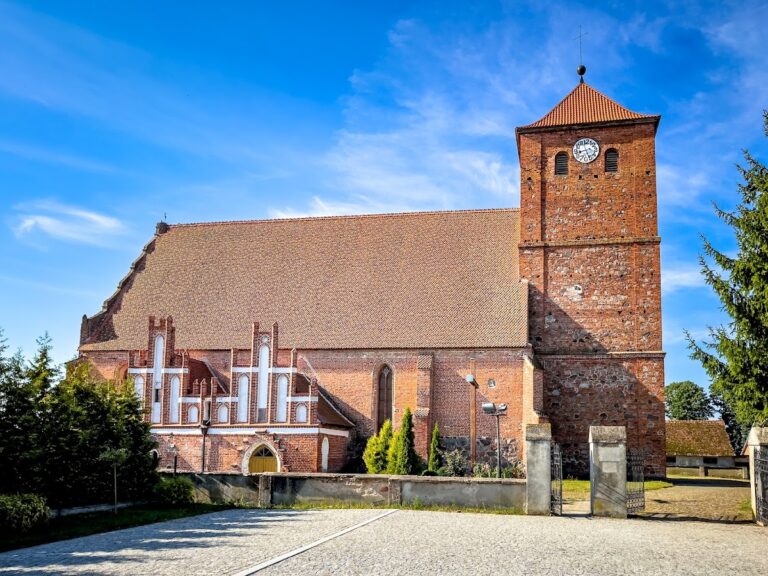
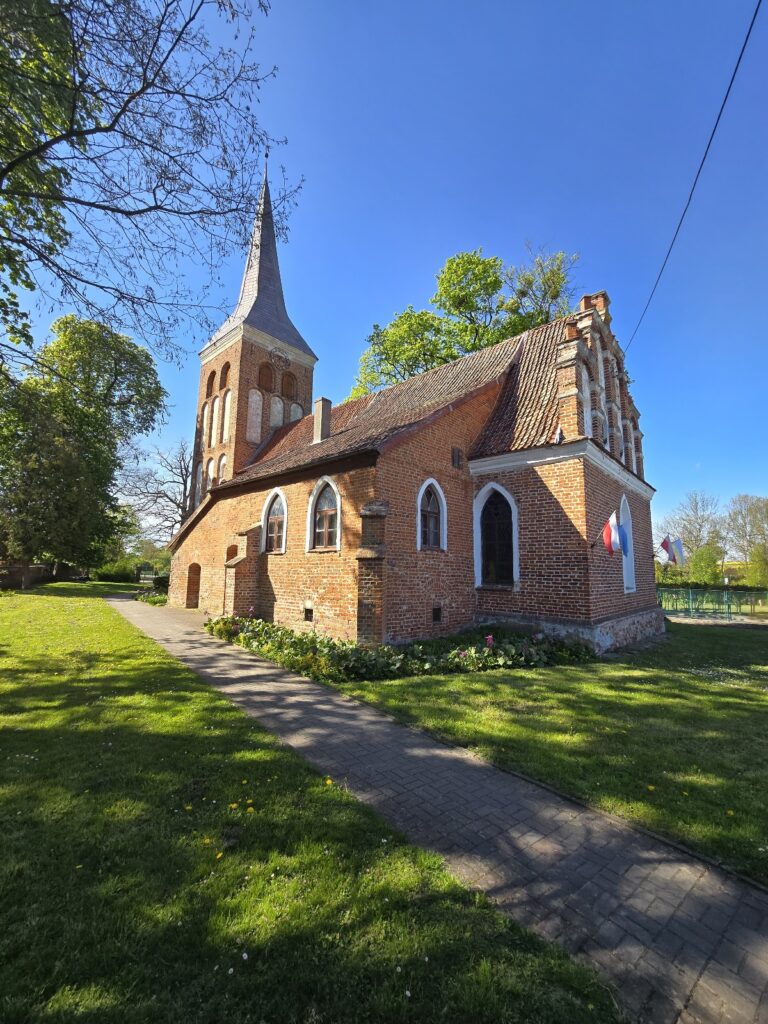
Saint Anne church is a rectangular, plastered building constructed from fieldstone and brick in the Brick Gothic tradition, a form of Gothic architecture that relied mainly on brick and was widespread in the Baltic and northern European regions. The east end has a stepped gable, while a west tower stands in front of the main body. The tower is richly decorated with blind panels and pinnacles, slender pointed ornaments common on Gothic buildings, and was heightened during the sixteenth century.
A comparatively large sacristy was added around 1500. Its interior has a star vault, a ribbed ceiling whose intersecting ribs form a star-like pattern. The porch probably dates from before 1400 and contains a wooden barrel-vaulted ceiling.
Interior furnishings
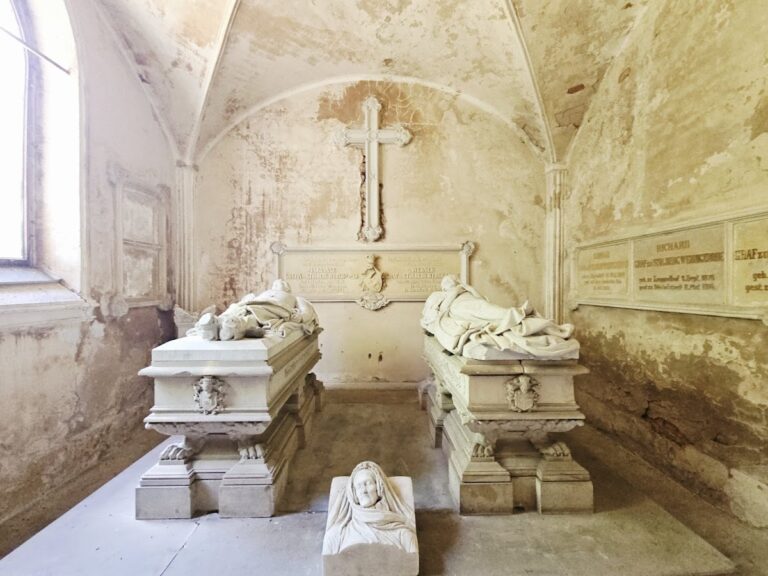
The interior contains galleries and is covered by a wooden ceiling. The pulpit and altar were made in 1782 and arranged as an ensemble, with the pulpit positioned above the altar. Both have simple forms and are traditionally regarded as a donation by the landowner and patron Albrecht von und zum Egloffstein and his family from Arklitten.
The pews date from the sixteenth century and were repainted in 1750. A large brass chandelier was made in the late seventeenth century. The organ, built in 1782 by Christoph Heinrich Obuch of Mohrungen, stands on the west gallery. It has one manual, a pedal, and 14 stops.
The church originally had three bells. One of them carried an inscription stating that it was cast in 1500.