Chiesa di San Marco (Bergamo): A Roman Catholic Church in Italy


Site at a Glance
- Rating
- 4.5
- Popularity
- Low
- Country
- Italy
- Primary era
- Early Modern
- External website
- Open
- Eras represented
- Early Modern, Modern
- Civilizations
- Italian, Venetian
- Site type
- Religious
- Remains
- Church
On this page9 sections
History
Chiesa di San Marco is a Roman Catholic church in Bergamo, Italy, begun in 1572 and formally dedicated to the Virgin Mary and Saint Mark the Evangelist. It is commonly known as the Church of Saint Mark because of its connection with the Hospital of San Marco, a major charitable institution established in the lower city.
The Hospital of San Marco
The hospital was founded in 1458 through the initiative of Giovanni Barozzi, bishop of Bergamo, and the city’s civic council. Their aim was to bring eleven small hospitals together in a single institution in the lower city. The dedication to the Virgin Mary and Saint Mark the Evangelist also honored the Republic of Venice, which ruled Bergamo during this period.
The new hospital replaced a more dispersed system of charitable care. In 1460, abandoned children were still being housed at the former hospital in the Antescolis district. Since 1170, that institution had been managed by the Crocigeri of Borgo San Leonardo under a privilege granted by Guala, bishop of Bergamo. The transfer of religious personnel to the new hospital complex was ordered by Pope Pius II on 24 September 1459.
Construction and early use
The hospital’s building followed a sixteenth-century design by Pietro Isabello. Its foundation stone was laid on 12 June 1474 on the former fairground of Sant’Alessandro, although warfare repeatedly interrupted the work. The church itself was begun nearly a century later, in 1572. Its facade was completed only in 1710, according to a design by Giovanni Ruggeri.
For several years the church served mainly for funeral services for hospital residents and abandoned children. A small funerary oratory was built nearby in 1610. Regular liturgical celebrations began after the older Church of Sant’Antonio was destroyed.
Connection with Sant’Antonio
Chiesa di San Marco stood near the older Church of Sant’Antonio Abate, also known as Sant’Antonio in Prato or Sant’Antonio di Vienne. The church was sold to the nuns of Santa Lucia, but it continued to give its name to the surrounding district. The statue dedicated to Saint Anthony remained an object of devotion, and the forecourt traditionally hosted the Biligocc chestnut celebration on 17 January, the feast of Saint Anthony.
Twentieth-century changes
The Hospital of San Marco was destroyed in 1937 and replaced by the Ospedali Riuniti di Bergamo. The church nevertheless retained physical links with the former complex. During the twentieth century it underwent maintenance and consolidation, including the raising of its bell tower, the repaving of the forecourt, and renewal of the presbytery. It remains a place of worship in the Diocese of Bergamo.
Remains
Chiesa di San Marco stands on the piazzetta di San Marco, whose surface is paved with river cobbles divided by strips of Zandobbio marble. Some sections of the paving are laid diagonally. The church has an eastward orientation and presents a single-nave plan arranged as a Latin cross, with a shorter transept crossing the main axis.
Facade and former hospital side
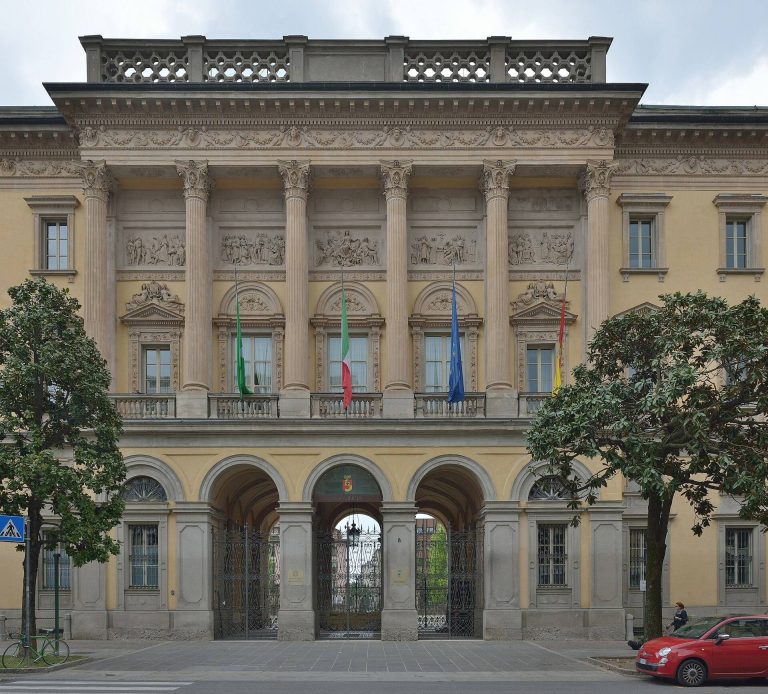
The facade is formed in two orders of Zandobbio marble. The lower order uses the Doric system, while the upper follows the Ionic system. Four pilasters and paired pilaster strips divide the elevation into three sections. In the centre, the pilasters incorporate columns with bases and capitals. The main portal is reached by steps and crowned by a shaped pediment. The lateral sections contain rectangular openings framed in marble, with crowning elements and drip moldings. Each opening has its own smaller flight of steps, and both formerly served as side entrances to the nave.
Two bas-reliefs above the lower order show religious scenes. On the right, the Virgin Mary appears to a priest; on the left, Christ appears to Saint Francis. An entablature and cornice separate the lower and upper orders. The upper level continues the pilasters and central columns and contains a large window with an arched lintel, together with two oval openings at the sides. The facade ends in another entablature and cornice beneath a large curved central pediment.
Statues of Saints Peter, Paul, Anthony Abbot, and Alexander stand above the facade pilasters, while a larger statue of the Immaculate Virgin occupies the centre. Giovanni Antonio Sanz made these works. The bronze portal, installed in 1959, was made by Piero Brolis from a design by Luigi Angelini. Its high-relief decoration presents Eucharistic episodes and figures.
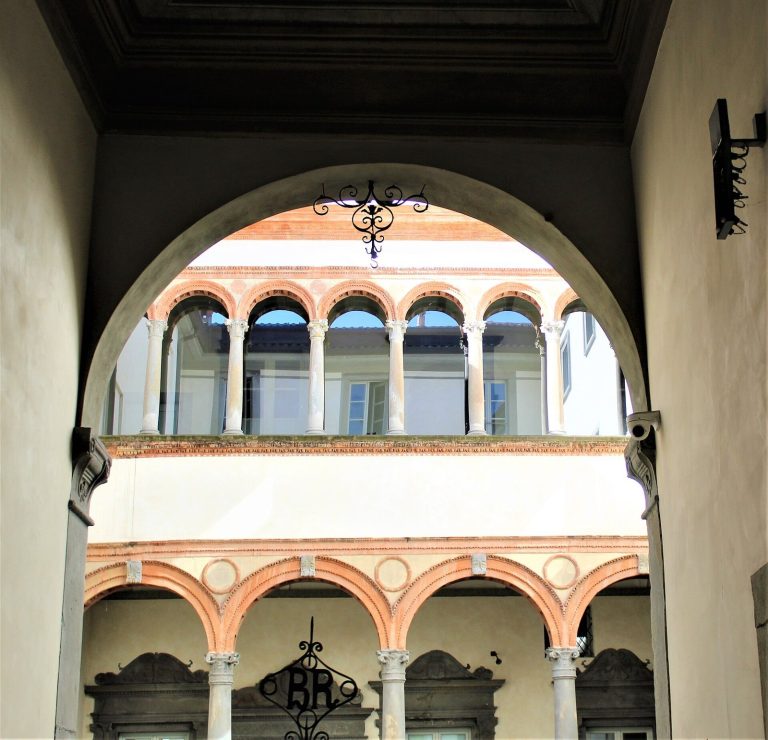
The south side incorporates ten arches belonging to the former hospital architecture. Pietro Isabello designed the original hospital elements, which were reconstructed after the hospital was destroyed and Palazzo San Marco was built. Palazzo San Marco was designed by Dante Fornoni.
Nave and transept chapels
The interior has one nave on a Latin-cross plan. The nave becomes narrower at the octagonal dome, which is pierced by four windows. Carlo Innocenzo Carloni painted the nave walls and vault in 1747 with scenes connected to the Eucharist. The transept contains two chapels. The chapel on the right is dedicated to the Crucifix, while the corresponding chapel is dedicated to the Virgin Mary.
The Marian chapel contains Giambettino Cignaroli’s Madonna and Child with Saints Alexander and Mark the Evangelist. It also preserves a large image of Saint Christopher from the original church. These works remain within the church’s interior alongside the later decorative program of the nave.
Presbytery and altar
Gian Paolo Cavagna painted the apse. The presbytery, the area around the main altar reserved for the clergy, is raised two steps above the nave. It has a rectangular plan and a barrel vault, and ends in a flat apse containing the wooden choir.
The main altar dates from 1941 to 1943 and was designed by Luigi Angelini. Camillo Remuzzi and Sons of Bergamo supplied the marble and carried out its construction. The two praying angels are by Gianni Remuzzi, while Giovanni Avogadri made the Eucharistic throne.