Georgenkirche: Rötha’s Romanesque and Baroque Town Church


Site at a Glance
- Rating
- 4.6
- Popularity
- Very Low
- Country
- Germany
- Primary era
- Medieval
- External website
- Open
- Eras represented
- Medieval, Early Modern, Modern
- Civilizations
- German, Holy Roman Empire
- Site type
- Religious
- Remains
- Church
On this page21 sections
History
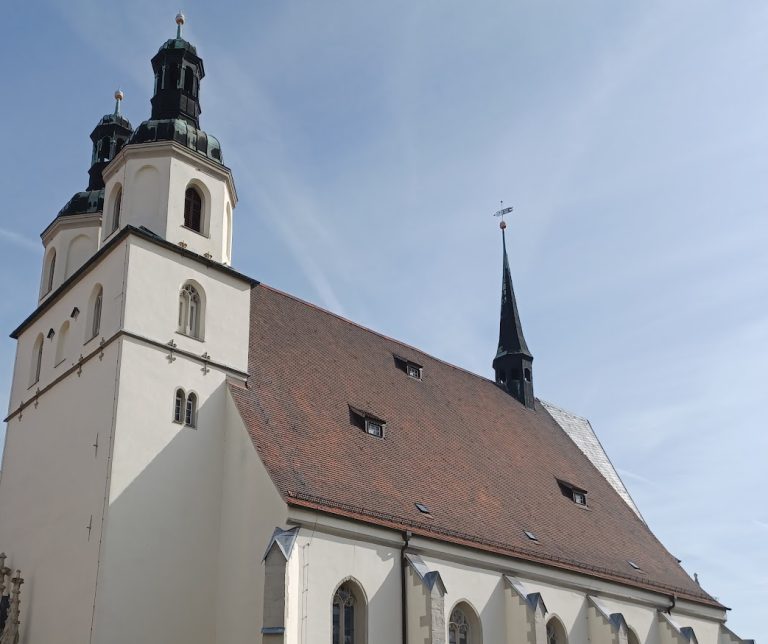
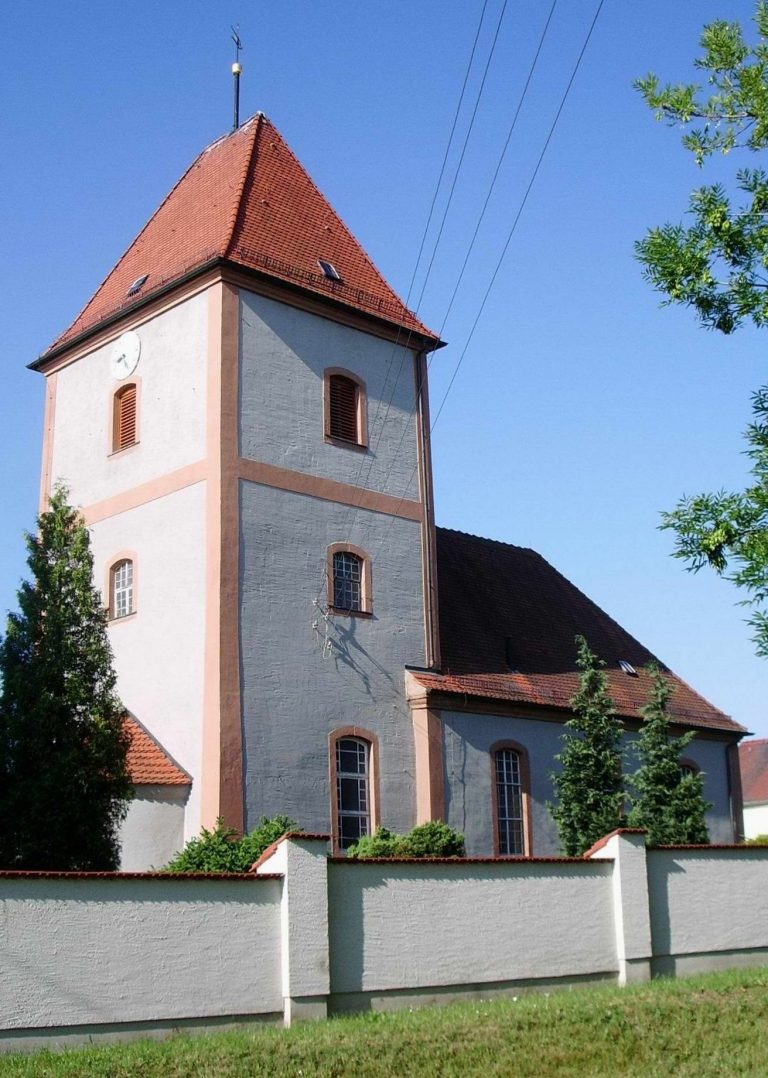
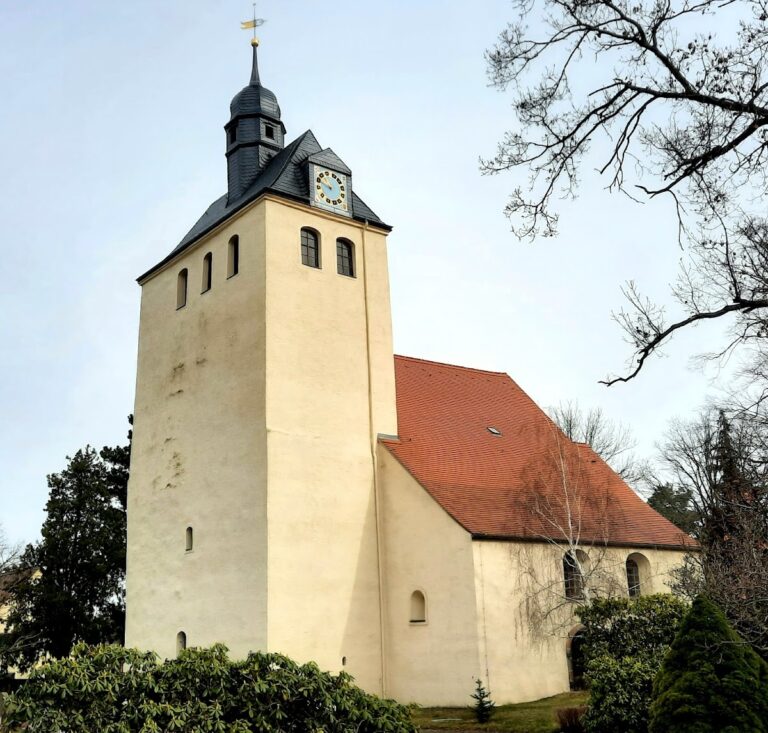
Georgenkirche is the town church of Rötha, Germany, originating around 1140 as a Romanesque pillar basilica. Its long development brought together Romanesque masonry, a Late Gothic choir, Baroque alterations, and the historic organ built by Gottfried Silbermann. The church belongs to the parish of Leipzig Neuseenland within the Leipziger Land church district of the Evangelical Lutheran State Church of Saxony.
Romanesque foundations and Late Gothic rebuilding
The earliest church was built with heavy masonry and round-arched Romanesque forms. Parts of its outer walls and the supports of the nave survive, as does the western building that was planned with two towers. Only the northern tower was completed. In 1510, the probably dilapidated Romanesque choir was demolished and replaced by a Late Gothic choir of three bays, approximately three times the size of its predecessor.
The same year saw the creation of the church’s Triumph Cross. Its 2.20-metre corpus later deteriorated in the attic before being restored in 2013 and rehung inside the church. The three bronze bells, cast in 1516, 1518, and 1592, survived both world wars.
Seventeenth-century transformation
Around 1620, the patron Carl Freiherr von Friesen donated the altar, and the pulpit also dates from that year. In 1682, the nave was converted into a hall with a flat ceiling. Its windows were rebuilt in a Gothicizing style, substantially changing the interior lighting. At the same time, the Romanesque square tower received an octagonal Baroque upper section, while the portals were given Baroque designs.
The Silbermann organ
Christian August Freiherr von Friesen commissioned an organ from Gottfried Silbermann in 1716. Silbermann completed the instrument in 1721 on the recently finished western gallery. Johann Kuhnau, Thomaskantor in Leipzig, and Gottfried Ernst Bestel, the Altenburg court organist, examined it after completion. The organ remains one of the church’s defining historical features.
Modern restoration and heritage status
Theodor Quentin directed a renovation in 1896–1897. The choir additions were renewed, a panelled flat ceiling was installed, and the pews were replaced. During the interior renovation of 1970, the original choir paintings were uncovered again. The roof was re-covered in 2004, the Triumph Cross was restored in 2013, and the facade was restored in 2017.
Georgenkirche is protected as a monument. Together with Rötha’s Marienkirche and its Silbermann organ, it is regarded as one of the most important cultural monuments in the southern Leipzig region.
Remains
The surviving church combines a Romanesque western structure and tower with a two-bay nave, a substantially enlarged Late Gothic choir, Baroque additions, and later restored furnishings. Its roofs, galleries, vaulting, memorials, altar, baptismal font, paintings, bells, and organ preserve evidence of the building’s successive phases.
Exterior and structural remains
The west gable is constructed from ashlar and brick masonry. It contains the main portal and Romanesque decoration in the form of broad corner pilaster strips, a tripartite round-arched window with spiral columns, and friezes of arches.
Romanesque tower and Baroque crown
The Romanesque portion of the tower has double arcades with engaged columns, further arch friezes, and a German-band decorative course. Above the square lower section rises an octagonal Baroque stage with a finely curved dome, lantern, and onion-shaped finial.
Roofs and roof turret
The nave and choir roofs are covered in black material with two red ornamental borders. Toward the west, the nave has a kinked half-hipped roof. A square roof turret rises from the eastern end of the choir ridge and finishes in an octagonal spire that almost reaches the height of the main tower.
Nave and choir
Nave and galleries
The two-bay nave has side aisles separated by broad pointed arches. Galleries occupy the north and west sides, with the western gallery supporting the Silbermann organ.
Late Gothic choir
The choir is as wide as the central nave and ends in a five-eighths termination, a polygonal ending formed from five sides of an imagined eight-sided figure. Its star vault rests on heraldic consoles.
Altar and memorial furnishings
Altar of Carl von Friesen
The altar has a wooden columned structure decorated with coats of arms and crowned by an equestrian figure of Saint George. Its upper section presents the Resurrection of Christ, the Last Judgment, and the Ascension, while the predella, the lower section of the altar, shows the Last Supper. The central Crucifixion scene includes Carl von Friesen’s family at the foot of the cross and is attributed to the Dutch painter Johann de Perre. The altar also serves as the epitaph, or memorial monument, of Carl von Friesen, who lived from 1551 to 1599, and his wife Rahel, who died in 1619.
Family monuments and pulpit
The choir contains funerary monuments to members of the von Friesen family dating from the sixteenth to the eighteenth century. The pulpit is richly decorated by Central German standards.
Luther portrait and pastor’s gravestone
To the right of the chancel arch, which separates the nave from the choir, is a portrait of Martin Luther, the theologian and reformer whose teachings initiated the Protestant Reformation. Beneath it lies the 1546 gravestone of Georg Ebert, Rötha’s first Protestant pastor, with a distinctive inscription.
Christian August von Friesen’s epitaph
Behind the chancel arch on the left stands the Baroque epitaph of Christian August von Friesen, a chamberlain and military commander in the service of the Saxon crown.
Font, grave slabs, and organ
Baptismal font and transferred memorials
The Late Gothic baptismal font is made of Rochlitz porphyry tuff. Its nineteenth-century baptismal bowl and the font came from the church at Kreudnitz, which was destroyed by lignite open-cast mining. Grave slabs of the von Breitenbuch family were transferred from the demolished church at Cröbern.
Silbermann organ
The largely original Silbermann organ has 23 stops, or selectable organ sounds, distributed across two manuals and a pedal. Johann Gottlieb Ehregott Stephani, an organ builder at Leipzig University, added the pedal coupler in 1796. The Eule firm of Bautzen restored the instrument in 1935 and again in 1979–1980.
The organ has a slider coupling between the second and first manuals and a pedal coupler from the first manual. Its secondary register is a tremulant, a device that creates a wavering sound. The instrument uses Chorton, a historical organ-pitch standard, with a′ at 464.9 Hz, and it has been tuned in equal temperament since 1832.
Triumph Cross and choir paintings
The restored 1510 Triumph Cross, with its 2.20-metre corpus, is displayed inside the church. The original choir paintings can also be seen again after their exposure during the 1970 renovation.