Church of the Holy Spirit: A Medieval Lutheran Parish Church in Tallinn


Site at a Glance
- Rating
- 4.6
- Popularity
- Low
- Country
- Estonia
- Primary era
- Medieval
- External website
- Open
- Eras represented
- Medieval, Early Modern, Modern
- Civilizations
- Crusader, Danish, Livonian Order
- Site type
- Religious
- Remains
- Church
On this page14 sections
History
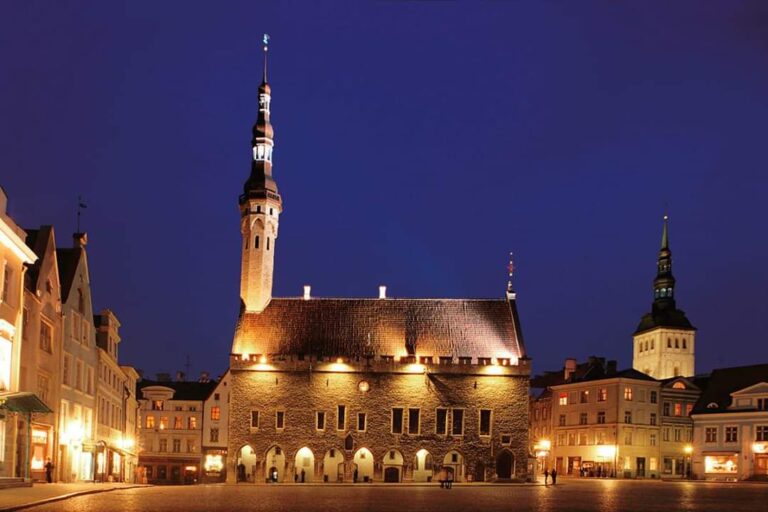
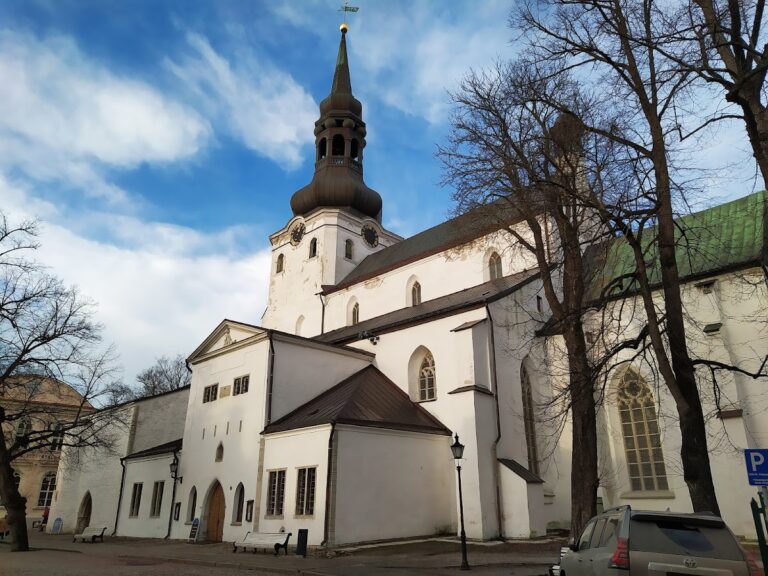
The Church of the Holy Spirit is a medieval Lutheran parish church in Tallinn, Estonia, built in the Gothic period and completed in 1380. It stands in the historic Old Town behind Town Hall Square, below Toompea, and began as part of an almshouse complex serving elderly and infirm people.
Medieval origins and construction
Construction probably began during the first half of the thirteenth century, and the church was first mentioned in writing in 1319. Its earliest surviving part is the choir, the section traditionally associated with the altar and clergy. A two-aisled nave, divided into two long spaces by supports, was added in the late thirteenth or early fourteenth century. The building was completed in 1380.
The church originally formed part of a larger charitable complex. Entrances led to it from the north and from the almshouse courtyard on the south. Its unusual orientation away from the east may have resulted from the need to fit the existing buildings and street layout of medieval Tallinn.
Reformation and Lutheran worship
The original Catholic institution later became a Lutheran church. Lutheranism is the Protestant tradition associated with Martin Luther’s teachings. The Church of the Holy Spirit was the first church in Estonia to hold services in Estonian. Estonian-language sermons began there in 1531, and extracts from a Lutheran catechism were printed there in Estonian in 1535.
Johann Koell, a pastor of the church, translated Simon Wanradt’s Low German catechism into Estonian in 1535. Balthasar Russow, a sixteenth-century pastor and chronicler, also served the church, while Georg Müller became known for his Estonian-language sermons. The Tallinn city council regularly attended Mass at the church before meetings in the Town Hall.
Tower fires and later history
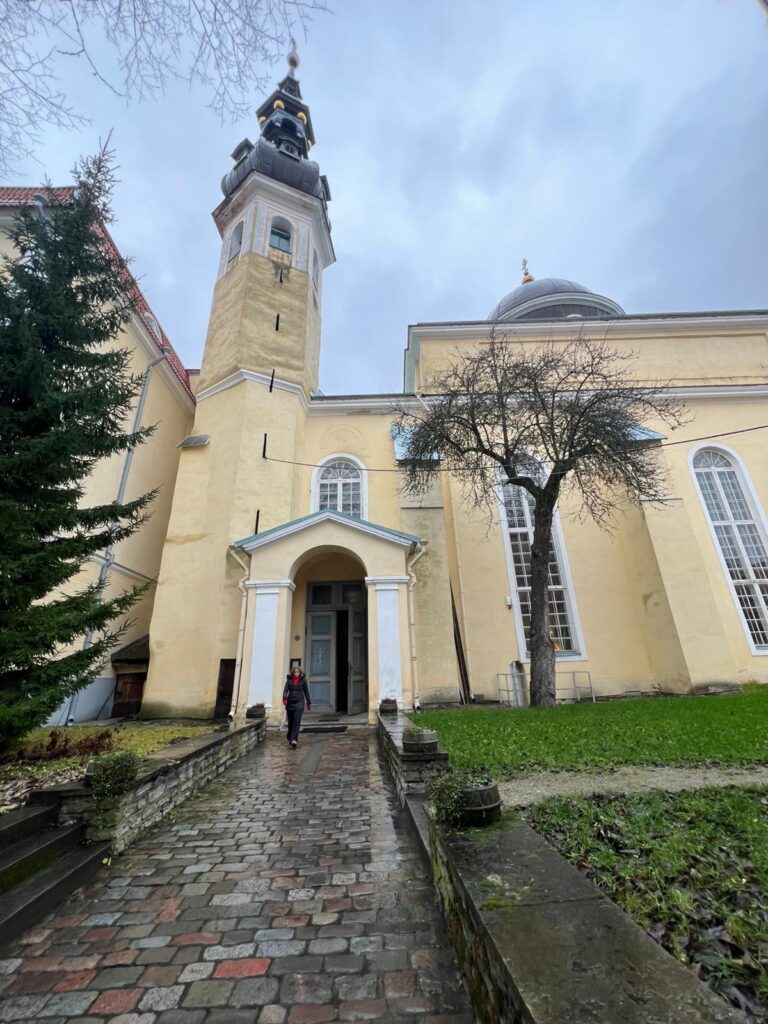
A Renaissance tower replaced an earlier tower after a lightning strike. Its later form dates from 1630, and its spire was renewed in 1688. Fires in 1684 and 2002 led to further reconstruction. A nineteenth-century proposal to enlarge and rebuild the church was not carried out; instead, Tallinn’s St. John’s Church was constructed between 1862 and 1867.
The tower spire burned again in 2002 and was restored in 2003 according to its original design. The church entered Estonia’s Register of Cultural Monuments in 1995 as both an architectural and historical monument. It also forms part of Tallinn’s Old Town, inscribed on the UNESCO World Heritage List in 1997. The building remains in active use by a Lutheran parish within the Estonian Evangelical Lutheran Church.
Remains
The Church of the Holy Spirit has a simple whitewashed exterior with crow-stepped gables, whose edges rise in steps rather than a continuous slope. Its plan is a hall church with an unusual two-aisled nave and a choir set asymmetrically to the north. The western end is marked by a slender, projecting octagonal tower associated with the architectural tradition of the Teutonic Order. Its minaret-like body carries a reconstructed Renaissance spire.
Exterior and structural features
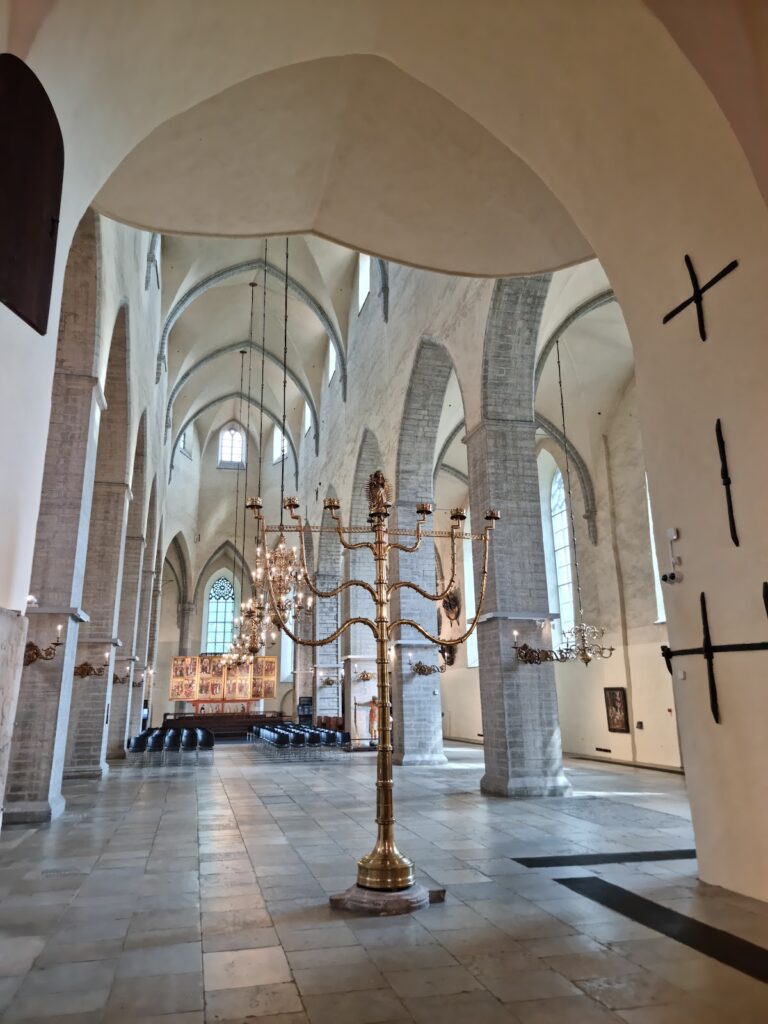
The church has relatively few large Gothic windows, each framed by finely carved stone dressings. Gothic architecture is a medieval style characterized by pointed arches, ribbed vaults, large windows, and elaborate stonework. The original wooden ceiling was replaced in 1360 by the present vaulting, during a phase that also added the tower and the large windows. The nave contains ten bays of cross-rib vaulting, a ceiling system in which intersecting ribs form the structural framework.
Clock
On the northern exterior wall is a finely carved Baroque clock made by Christian Ackermann in 1684. It is described as Tallinn’s oldest clock. Its painted decoration includes sun rays and the four Evangelists.
Bell
The tower contains Tallinn’s oldest church bell, cast in 1433 by Merten Seifert. Its Middle Low German inscription says that it strikes equally for maid and servant, lady and lord. The bell was severely damaged in the 2002 fire that burned the tower spire.
Altars and interior furnishings
Altars
The church contains a late-Gothic carved altar dated 1513 and depicting the Apostle Andrew, together with a separate folding altar from 1483. The main folding altarpiece, a decorated structure placed behind or above an altar, was made by Bernt Notke in 1483 for the Tallinn city council. Its central panel depicts Pentecost, the Christian feast commemorating the descent of the Holy Spirit upon the apostles, and includes a small Tallinn city coat of arms.
Pulpit and lighting
A Renaissance pulpit dates from 1597. The interior also contains a late-Gothic crucifix, Renaissance and Baroque chandeliers and wall lights, and painted Baroque epitaphs.
Galleries and paintings
The galleries are richly decorated with seventeenth-century allegorical woodcarvings attributed to Elert Thiele. They contain Tallinn’s only cycle of gallery paintings, comprising 60 images of biblical scenes, apostles, and Evangelists. Forty-three of the paintings were made after models by Matthäus Merian.
Commemorative plaque
A plaque beside the altar commemorates British sailors who died during British naval operations in the Baltic in 1918 and 1919.
Organ
The present organ was built in Tallinn in 1929 by August Terkmann and restored and reconstructed by Hardo Kriisa between 1985 and 1990. It has 66 stops, meaning selectable ranks or groups of pipes, four manuals, and a pedal keyboard played by the feet. The choir organ behind the altar can be played from the fourth manual. Its actions are pneumatic, except for the electrically operated actions of the fourth manual.