Church of Saint James the Greater (Louchov): A Fortified Roman Catholic Church in Czechia


Site at a Glance
- Rating
- 4.2
- Popularity
- Very Low
- Country
- Czechia
- Primary era
- Medieval
- Eras represented
- Medieval, Early Modern
- Civilizations
- Habsburg, Holy Roman Empire, Kingdom of Bohemia
- Site type
- Religious
- Remains
- Fortified Church
On this page10 sections
History
Medieval foundation and monastic ownership
The Church of Saint James the Greater in Louchov, Czechia, is a Roman Catholic church built in the second half of the thirteenth century, probably toward the end of the 1260s. Its construction followed King Přemysl Otakar II’s grant of the Louchov estate and the village of Vernéřov to the Saxon Cistercian monastery at Grünhain. Architectural-historical research also places the building generally in the second half of the thirteenth century.
Louchov remained under the monastery’s control until the first half of the sixteenth century, when the monastery ceased to exist. The Cistercians had already pledged the village and its church to the Lords of Šumburk during the first half of the fourteenth century. The church stood beside an important trade route that probably continued to be used there until the middle of that century.
The first written reference to the parish church dates from 1352. At that time, it was described as very poor and exempt from the papal tithe. In 1446, the Lords of Šumburk sold Louchov, together with half of the town of Přísečnice, to the Hasištejnský family of Lobkowicz. During the division of the family property in 1490, Louchov passed to Bohuslav Hasištejnský of Lobkowicz, a Bohemian nobleman known as a humanist and writer.
Rebuilding and changes in church administration
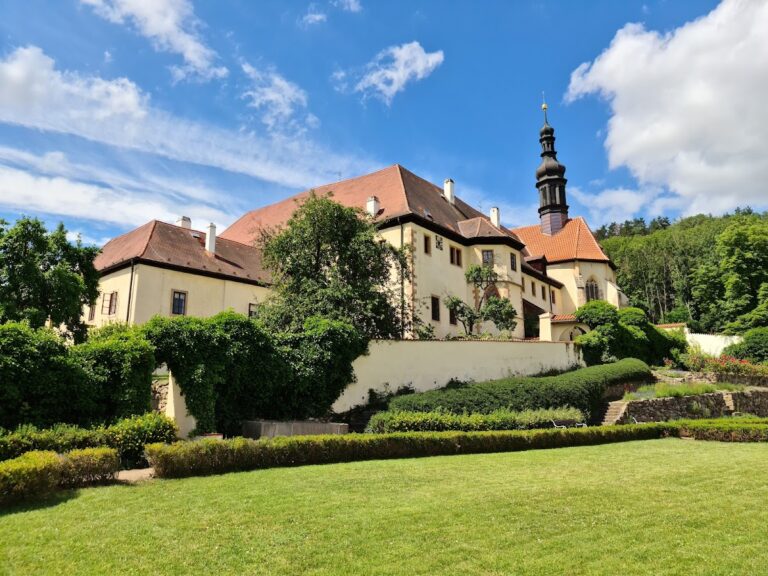
The church was rebuilt in the late Gothic period, probably including the construction of its massive enclosing wall. Surviving defensive elements and this strong boundary place the building among fortified churches, which combined religious use with protection during times of danger. During the Baroque period, the nave was extended and the interior was modified in 1720.
Protestantism spread through the Ore Mountains from the sixteenth century, and the local parish was dissolved in 1623. A Catholic local chaplaincy was established in 1794 during the church reforms of Joseph II, the Habsburg ruler and Holy Roman Emperor whose policies reshaped church administration. The parish itself was restored in 1853. The church later became a filial church of the Klášterec nad Ohří parish, while it belonged to the Louchov parish until 31 December 2012. It belongs to the Czech ecclesiastical province and the Diocese of Litoměřice.
Recent deterioration and protection
The church and its cemetery enclosure stand at a crossroads in the southern part of Louchov. After years of neglected maintenance, the building deteriorated severely. Its roof collapsed in 2011, while the plaster was damaged and cracks developed in the masonry. In 2020, the church was owned by Aleš Olbram Hoffmann. The church is protected as a cultural monument.
Remains
Church building
The church is a single-nave structure on a rectangular plan, built of quarry masonry. Its character combines transitional, Gothic, and Baroque elements, and the altar is oriented toward the east. The nave measures 12.3 by 6.3 metres internally and has a beam ceiling. Remains of two wooden choir lofts survive in the western part of the nave and along its north wall.
A slightly trapezoidal presbytery, the part of the church reserved for the clergy and altar, closes the building on the east. It has a barrel vault, a continuous curved ceiling, and a Gothic pointed-arch window in the east wall. A barrel-vaulted sacristy, a room for liturgical objects and vestments, is attached to the presbytery’s north side. Entry is through a portal in the south wall, beside which the remains of a vestibule survive.
Enclosure and commemorative remains
Fortified enclosure
The massive wall surrounding the church and cemetery, together with the surviving defensive features, preserves the building’s late-medieval fortified character. These elements formed the physical boundary around the church and are part of the evidence for its defensive use.
Lobkowicz memorial
The church contains a tomb or cenotaph, a commemorative monument for someone buried elsewhere, associated with Mikuláš I Chudý of Lobkowicz, founder of the Lobkowicz family, and with Bohuslav Hasištejnský of Lobkowicz. Both men were originally buried in the Church of Saint Nicholas at Přísečnice, about five kilometres away. That church was later demolished, and its site was submerged beneath the Přísečnice Reservoir. The two churches were described as very similar and were owned by the two Lobkowicz figures.
Former furnishings
The church’s former equipment included a wood carving of the Holy Sepulchre made by Ernst Hollitzer. This work belonged to the church’s earlier furnishings, alongside the architectural features that survive in the building.