Holtrop Church: A Romanesque Village Church in Germany


Site at a Glance
- Rating
- 4.7
- Popularity
- Very Low
- Country
- Germany
- Primary era
- Medieval
- External website
- Open
- Eras represented
- Medieval, Early Modern, Modern
- Civilizations
- Unclassified
- Site type
- Religious
- Remains
- Church
On this page14 sections
History
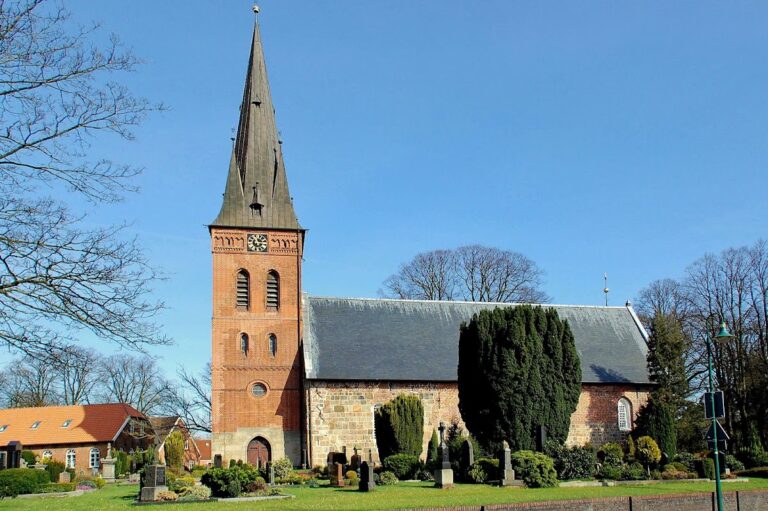
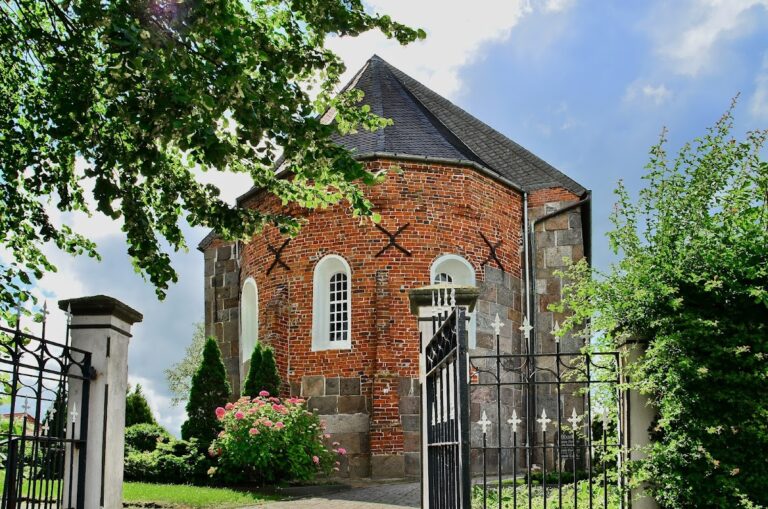
Holtrop Church is an Evangelical Lutheran church in Germany, located in Holtrop, Großefehn, in East Frisia. Built in the middle of the thirteenth century as a Romanesque hall church, a simple aisle-free church with a rectangular hall, it is among the larger village churches of East Frisia. During the Middle Ages, it belonged to the provostry of Leer within the Diocese of Münster.
Medieval Development
The church was originally dedicated to Saint George, a Christian martyr traditionally associated with the legend of a dragon-slaying knight. This dedication, preserved in North German form as Sankt Jürgen, was rediscovered in the church archives in 2005. Following a formal service that year, the church was rededicated to the saint and became known as Sankt Jürgen.
The original semicircular apse was removed for structural reasons in either the late thirteenth or late fourteenth century. Afterward, the east end was formed as a straight termination supported by two buttresses. In the late fourteenth century, the choir bay received vaulting and the choir screen was installed.
Later Alterations and Conservation
During the nineteenth century, the church walls were raised and the present pointed-arch frieze was added. A Neo-Gothic porch at the west entrance, which functions as a wind lobby, also dates from this period.
The organ was placed on the choir screen in 1772, and the triumphal cross group was moved to the north wall. During the church and organ renovation of 1972, the organ was transferred to the west gallery, while the cross group was returned to the choir screen after about two centuries. Restoration in the early 1970s also revealed a late-Gothic fresco on the north wall. The church is protected as a built monument in Lower Saxony.
Holtrop Church serves the Evangelical Lutheran parish of Akelsbarg, Felde, Wrisse, and Holtrop, which has approximately 2,000 members. The parish also maintains a Bible garden.
Remains
Holtrop Church has a rectangular brick hall measuring approximately 32.3 by 11.3 metres. Its long exterior walls retain traces of former pilasters, which divided the elevations into three fields. The east end is straight, with two later buttresses marking the structural change made after the removal of the original apse. Inside, the church preserves elements of its medieval vaulted arrangement alongside later woodwork, furnishings, paintings, and an eighteenth-century organ.
Medieval Structure and Choir
Walls, Openings, and Vaulting
The former round-arched portals are blocked, while a small, high-set round-arched window survives in the north wall. The larger windows, together with their recessed reveals, were inserted later. The nave was originally divided into three vaulted bays, of which the springing points remain. A transverse arch in the choir separates two elongated vaults. The present interior is covered by a wooden mirror ceiling, a flat ceiling with a broad central field.
Choir Screen and Viewing Slits
The choir screen, a partition between the choir and the main congregational space, stands in front of the east choir. Its three large round arches are walled at the rear, except for the central passage. Side altars formerly stood beneath the outer arches, and the base of the northern altar has been identified. Two narrow viewing slits in the rear wall allowed people outside the priest’s choir to observe the liturgy at the high altar.
Painted and Carved Furnishings
Altarpiece and Altar
The seventeenth-century altarpiece came from the Cröpelin school of Esens and was restored in 2001. Its three vertically arranged paintings show the Last Supper, the Crucifixion, and the Resurrection. Vine-scroll ornament, strapwork, and twisted columns decorate the retable. Openings beneath a segmental arch in the altar block formerly served as pre-Reformation credence niches, recesses for vessels used in the Eucharistic liturgy.
A simple brick mensa, the altar table or upper slab used for the service, was installed in front of the choir screen during the 1970s. The baptismal font also dates from that period.
Pulpit and Crucifixion Group
The pulpit and altarpiece have stylistic similarities and date from the same seventeenth-century period. The pulpit basket has rich strapwork, and its heptagonal sounding board, a canopy above the pulpit, reflects late Renaissance design. Paintings of Christ and the four Evangelists appear between Ionic corner columns on the basket.
The choir screen carries a life-sized fifteenth-century Crucifixion group. It shows Christ on the cross with his mother and the Apostle John. Two small wingless angels hold chalices beneath Christ’s wounds, referring to the Eucharist. A third angel, probably placed lower on the composition, is lost. The cross bears the symbols of the four Evangelists.
North-Wall Fresco
A late-Gothic fresco on the north wall depicts the Last Judgment. It dates from the second half of the fifteenth century and was revealed during restoration work in the early 1970s.
Bell Tower and Organ
Bell Tower
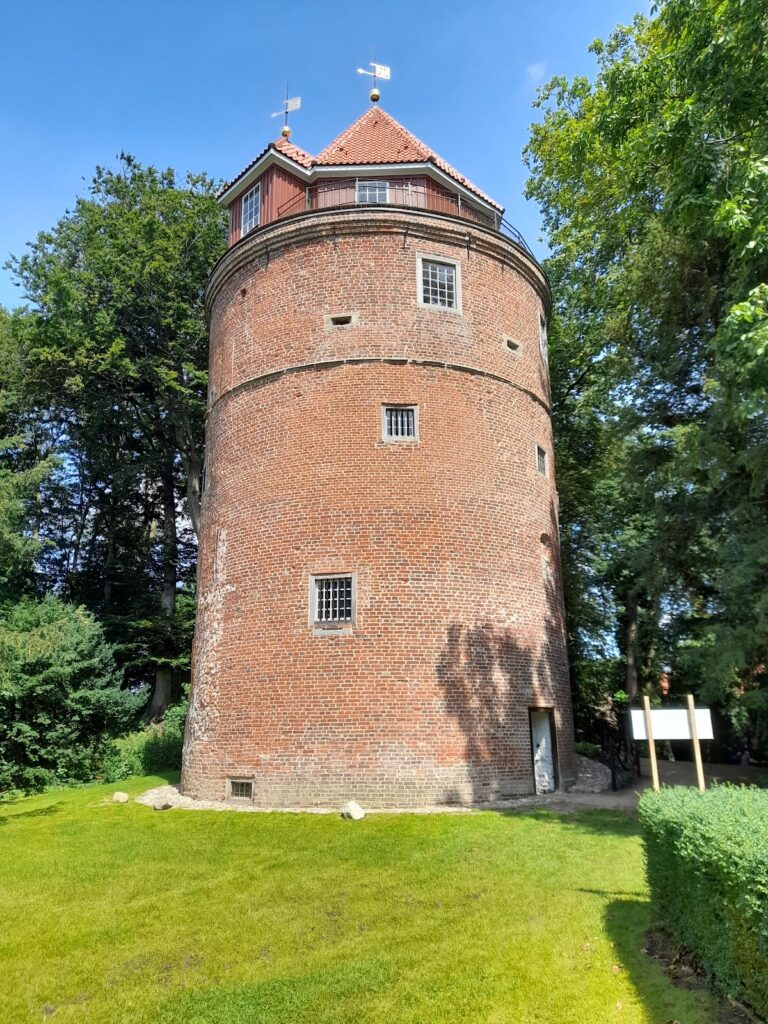
The free-standing bell tower stands south of the church. It is a leaning parallel-wall tower, formed by two parallel masonry walls supporting the bell structure, and houses three bells.
Historic Organ
Hinrich Justus Müller built the historic organ in 1772. It has one manual and stands on the west gallery. The seven-axis case has an outward-stepped arrangement, two levels of flat panels, richly moulded cornices, and scrolling carving around three wooden dummy pipes on each side. Two trumpet-playing angels crown the case, whose surface has a walnut-grain painted finish.
The Rohlfs brothers repaired the organ in 1883. In 1933, P. Furtwängler and Hammer added a 16-foot Subbass to the pedal and replaced the Dulcian with an 8-foot flute. Rudolf von Beckerath Orgelbau reversed these alterations during a comprehensive restoration in 1976 and 1977. The two original reed stops, independently controlled sets of pipes that produce sound through vibrating tongues, were reconstructed in 2000. The instrument now has eight stops and follows its original specification.