Aegidienkirche Heilbad Heiligenstadt: A Medieval Roman Catholic Filial Church
Site at a Glance
- Rating
- 4.7
- Popularity
- Very Low
- Country
- Germany
- Primary era
- Medieval
- Eras represented
- Medieval, Early Modern, Modern
- Civilizations
- Holy Roman Empire
- Site type
- Religious
- Remains
- Church
On this page10 sections
History
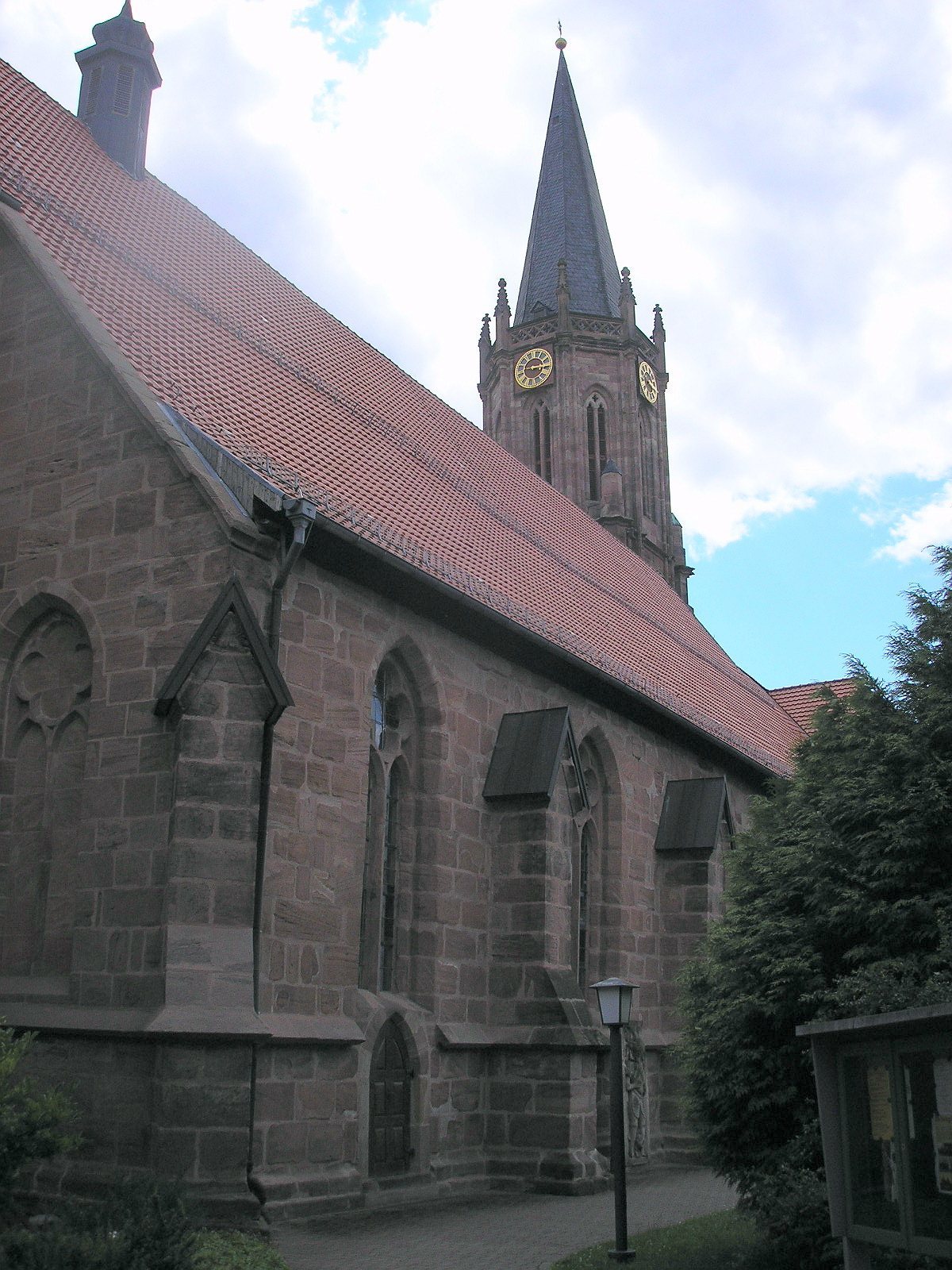
Aegidienkirche Heilbad Heiligenstadt is a Roman Catholic filial church in Germany, institutionally attached to St. Mary’s Parish rather than serving as its principal church. Dedicated to Saint Giles, also called Aegidius, it is popularly known as the Neustadt Church. The sandstone church belongs to the medieval period and was completed by 1370 in the form of a pseudo-basilica, with a raised central nave but no separate upper window zone above the side-aisle roofs.
Medieval Heiligenstadt and the Neustadt
Heiligenstadt was an important residence of the archbishops of Mainz, senior ecclesiastical rulers whose presence also gave the town a place within the political structures of the region. At least 18 German bishops stayed there between 990 and 1300. The episcopal consecrations of Gerdag of Hildesheim in 990, Burchard I of Worms in 1000, and Burchard I of Halberstadt in 1036 reinforced Heiligenstadt’s importance alongside Erfurt.
During the twelfth century, a market settlement and St. Mary’s parish church developed below the Stiftsberg. As the town gained inhabitants and new occupational groups, the Neustadt was established south of the old town between 1223 and 1227. St. Aegidien Church was founded as part of this expansion, in an area where Slavic settlers probably lived around Windische Gasse.
The new church’s establishment caused a dispute. In 1239, the provost of the Collegiate Church of St. Martin complained that it reduced his institution’s income. The collegiate foundation had previously held the patronage of St. Mary’s across the whole town, while Archbishop Siegfried II of Mainz had reserved patronage of the new church for himself.
Fire, rebuilding, and structural change
The first church was built of half-timbering and was destroyed in the town fire of 1333. A sandstone successor was then planned with two towers. The building was completed by 1370, although the towers were not initially finished. A town plan from 1655 still shows both towers, each ending in a saddle roof.
The towers later proved unstable because their foundations were inadequate. As construction rose, the increasing load caused the outer walls to lean outward. Both towers were demolished in 1748 because of their deteriorated condition. The present south tower was reconstructed in 1851.
Relics, religious communities, and later conservation
After 1800, the relics of Aureus, the town’s Mainz martyr-bishop, and his deacon Justinus were transferred to St. Aegidien. The two men are regarded as Heiligenstadt’s city patrons, and their relics are now incorporated into the celebration altar, the altar used for the Eucharistic liturgy.
Around 1850, four Heiligenstadt teachers founded a boarding school to prepare young women for the teachers’ examination. The initiative developed into the German branch of the Order of Saint Mary of Postel, also called the Heiligenstadt Sisters.
In the late 1990s, careful conservation addressed both the church’s exterior and interior. The work preserved the appearance of the masonry joints, restored the function of the eaves zones and cornices, and protected buttresses with copper caps where conserving the stone was no longer feasible. The interior was completely repainted, the existing pew cheeks were retained, the organ was overhauled, and the windows were replaced with designs selected from submissions by seven artists.
Remains
Aegidienkirche survives as a sandstone pseudo-basilica organized around a higher central nave and lower side aisles. Its medieval plan included two towers, but the present exterior reflects the demolition of both medieval towers in 1748 and the reconstruction of the south tower in 1851. The church also contains later furnishings, including a Baroque high altar, a Neo-Gothic organ, and a six-bell bronze peal.
Church furnishings and musical interior
Baroque high altar
The Baroque high altar was made between 1689 and 1691. It originally stood in the Collegiate Church of St. Servatius in Quedlinburg, whose congregation was expelled by the SS, the Nazi organization involved in political repression, policing, and wartime administration, in 1938. The altar was moved to Aegidienkirche before the end of the Second World War and has stood there since 1944.
Celebration altar
The celebration altar contains the relics of Aureus and Justinus. Their incorporation into the altar gives the church’s central place of Eucharistic worship a direct connection with the two patrons of Heiligenstadt.
Organ
The organ has a Neo-Gothic case and was built in 1908 by the Klais firm of Bonn. In 1940, Anton Feith of Paderborn added a positive division in the gallery parapet and changed the instrument to electro-pneumatic action. The positive division was later removed from the parapet and installed behind the main organ, after which the instrument was rebuilt by Karl Brode of Heilbad Heiligenstadt.
The organ now has 43 stops, the controls selecting different sets of pipes, distributed across three manuals and a pedal, the foot-operated keyboard. Its normal couplers are II/I, III/I, III/II, I/P, II/P, and III/P. It also has super-octave couplers III/I, III/P, and III/III, a crescendo roller, and a swell pedal for the third manual. The church tower contains a six-bell bronze peal.
Maria-Hilf Chapel
The Maria-Hilf Chapel stands east of Aegidienkirche, at the transition toward the market square. It is said to have existed as early as 1405 and was renewed and substantially altered during the 1860s. An older inscription, translated as “Our best help, Mary, dwells here; to you, O Virgin, help us all, we sigh,” was probably removed during that work.