Kumehnen Church: A Medieval Lutheran Church in Kumachevo, Russia


Site at a Glance
- Rating
- 4.6
- Popularity
- Low
- Country
- Russia
- Primary era
- Medieval
- External website
- Open
- Eras represented
- Medieval, Early Modern
- Civilizations
- Teutonic Order
- Site type
- Religious
- Remains
- Church
On this page13 sections
History
Kumehnen Church is a medieval Evangelical Lutheran church in Kumachevo, Russia, whose nave was built around 1390 in the low Gothic brick tradition. The church originated during the founding period of the village under Heinrich II Kuwal, Bishop of Samland from 1387 to 1395. Its narrow rectangular choir probably began earlier as a chapel, making it the oldest part of the building.
Medieval foundation and parish life
The village, formerly known as Kumehnen, belonged to Fischhausen District in the Königsberg administrative region of East Prussia and is now within Zelenogradsk District. Its parish was established before the Reformation, a movement that divided Western Christianity in the sixteenth century and brought Lutheran worship to much of northern Europe. In the fourteenth century, the parish was served by the priest of Medenau, and the Reformation reached the area relatively early.
Until 1945, the parish belonged to the Fischhausen church district of the East Prussian ecclesiastical province of the Church of the Old Prussian Union. In 1925 it had 2,328 registered members and covered more than twenty villages. Surviving parish registers are held in the Evangelical Central Archive in Berlin-Kreuzberg.
Alterations and wartime damage
The church changed substantially over the centuries. Its original five-bay star vault, a ribbed vault whose intersecting ribs form a star pattern, collapsed in 1640. A flat, elliptically curved wooden ceiling replaced it, and a gallery was installed along the north wall in 1643. Biblical scenes were painted on the wooden ceiling in 1704. A fifteenth-century sacristy, an ancillary room for liturgical objects and vestments, was also added to the church.
Heavy fighting took place around nearby Galtgarben during the Second World War, but the church remained almost undamaged. Artillery struck the tower in 1945. After the war, the tower was dismantled during the 1950s, while the church was converted into a warehouse. The building then deteriorated gradually.
Abandonment and preservation efforts
By 1989, the west side of the tower base had collapsed, while the east side of the upper structure remained. The church became an abandoned ruin, and its furnishings were destroyed. A preservation association was founded in 2000 to prevent complete decay. Manfred Thon prepared a stabilization plan in February 2005, and in 2009 the building entered a large-scale restoration program organized by heritage authorities, with financial support proposed.
Restoration and future use remained unresolved because the preservation association, the Russian Orthodox Church as the building’s new owner, and local authorities could not agree on how the work should proceed. The association later ceased its activities. Kumehnen Church is recognized as a regional cultural-heritage monument of the Russian Federation.
Remains
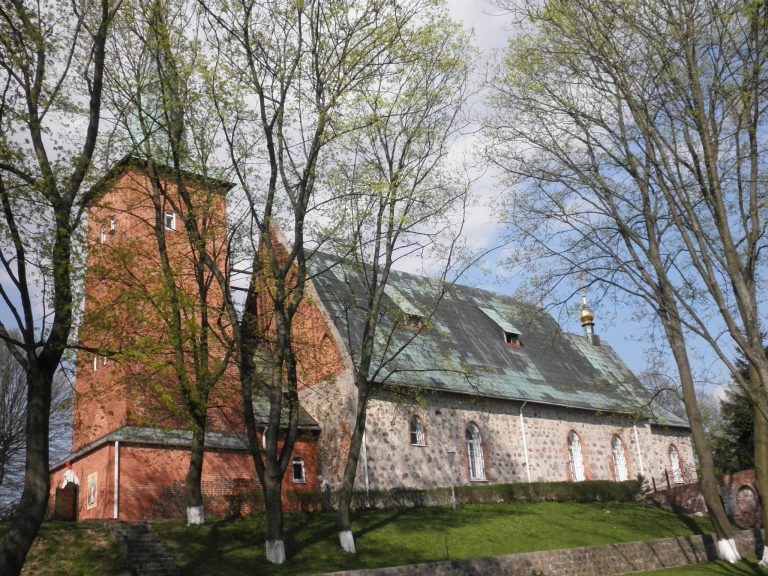
Kumehnen Church stands in the central part of the historic Samland region, the peninsula and coastal area surrounding present-day Kaliningrad. It is a low Gothic brick building on a fieldstone foundation. The nave combines fieldstone and brick, and the lower part of the tower was built with the same materials. The surviving structure preserves evidence of medieval construction, later changes to the interior, and prolonged deterioration.
Main church building
Nave and choir
The nave originally contained five vaulted bays. Its star vault collapsed in 1640, leaving the building with the later wooden ceiling, which was decorated with biblical scenes in 1704. One nave bay has since collapsed, and the nave roof is extensively deteriorated. The narrow choir ends in a rectangle and probably represents the earlier chapel from which the church developed. Its roof has collapsed.
The south facade and the choir walls are articulated with pointed-arch blind arcades, a series of recessed arches applied to a wall without openings. These features express the church’s Gothic character through brick construction and surface relief. A gallery installed along the north wall in 1643 forms part of the building’s later interior arrangement.
Tower
The tower was raised by one brick-built story before the end of the fifteenth century. Artillery damage in 1945 was followed by its dismantling during the 1950s. The west side of the lower structure had collapsed by 1989, while the east side of the upper structure remained.
Sacristy
A barrel-vaulted sacristy was added during the fifteenth century. Its function was connected with the storage of liturgical objects and vestments, and its construction represents an expansion of the medieval church beyond the original nave and choir.
Interior furnishings and artistic remains
Medieval furnishings
The church formerly held a granite baptismal font dating from the period of the Teutonic Order, a medieval religious-military institution that established and administered settlements and ecclesiastical institutions across much of Prussia. Other surviving evidence of the medieval interior includes a fifteenth-century baptismal bowl, Gothic carved seating, and medieval doors with elaborate carving and prominent locks. Remains of medieval wall paintings were found beneath later whitewash.
Baroque altar and pulpit
The wall altar was designed in 1676 by Johann Pfeffer, a sculptor active in Königsberg. Its decoration includes columns, auricular ornament, a Baroque style of lobed, ear-like forms, and other carved elements. The pulpit and a wooden baptismal chamber were made at the end of the seventeenth century.
Organs and bells
Johann Josua Mosengel built an organ for the church between 1695 and 1697. It originally had one manual and no pedal, with a pedal added in 1715. In 1884 the instrument was replaced by a work made by Max Terletzki of Königsberg, while the existing case was retained.
Three bells belonged to the church. Two were cast in Königsberg around the middle of the eighteenth century, while the oldest dated from the period of the Teutonic Order.