Church of Saint Nicholas of Bari (Lanciano): A Roman Catholic Church in Italy


Site at a Glance
- Rating
- 4.5
- Popularity
- Very Low
- Country
- Italy
- Primary era
- Medieval
- External website
- Open
- Eras represented
- Medieval, Early Modern, Modern
- Civilizations
- Italian, Kingdom of Naples, Kingdom of Sicily, Kingdom of the Two Sicilies
- Site type
- Religious
- Remains
- Church
On this page17 sections
History
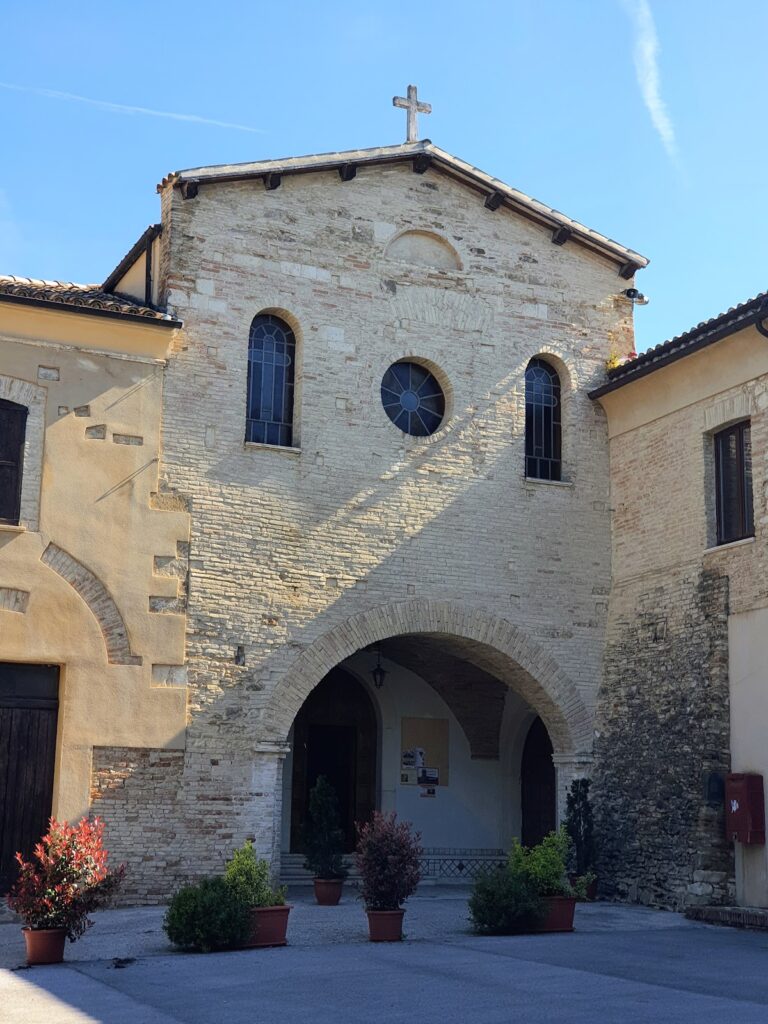
The Church of Saint Nicholas of Bari is a Roman Catholic church in Lanciano, Italy, dedicated to Saint Nicholas of Bari, the late-antique bishop more widely known in English as Nicholas of Myra. Located in the Sacca district and belonging to the Roman rite, it stands under the Archdiocese of Lanciano-Ortona. The church was built on the remains of the former Church of San Pellegrino, destroyed by fire in 1226, and its completion is traditionally placed in either 1242 or 1292. It is consequently one of the oldest churches in the district.
Medieval foundation and parish history
The new church inherited a religious setting shaped by the earlier San Pellegrino building. Its statue of Saint Nicholas probably came from that preceding place of worship. San Nicola became a parish in 1319, giving the church an established role in the religious organization of Lanciano. Its original decoration followed the Italian Gothic style, while the bell tower belongs to a later Gothic phase in the fifteenth century.
The underground spaces preserve part of this medieval history. A room beneath the bell tower was formerly used as a burial crypt, and the Chapel of the Holy Cross contains a large subterranean area with traces of the ruins of San Pellegrino. During restoration work in the 1990s, parish priest Don Leo Di Felice found a fourteenth-century cycle of frescoes in the room beneath the tower. The cycle was restored by the Superintendency of L’Aquila.
Baroque expansion and Neoclassical remodelling
During the seventeenth century, Baroque alterations enlarged the original plan and added three naves. By 1868, however, the building was in a precarious state of preservation. Architect and restorer Filippo Sargiacomo then carried out a restoration in the Neoclassical style. The work covered the earlier frescoes, and the extensive stucco decoration made the interior substantially less rich in visual character.
The Neoclassical project had been financed in 1859 by Archbishop Monsignor De Vincentiis. The main altar was completed in 1910 at the initiative of the parish priest, Don Filippo De Cecco. Later additions included polychrome stained-glass windows made in 1999 by Michele Cianfrone of Lanciano at the request of Monsignor Enzio d’Antonio for the Jubilee of 2000.
Rediscovery and preservation
Don Leo Di Felice organized a parish museum in the underground rooms in 2000. Its collection, including objects associated with the church and fragments from San Pellegrino, is currently held temporarily at the Diocesan Museum of Lanciano. The rediscovered frescoes remain visible from inside the church, linking the present building with the medieval religious complex beneath it.
Remains
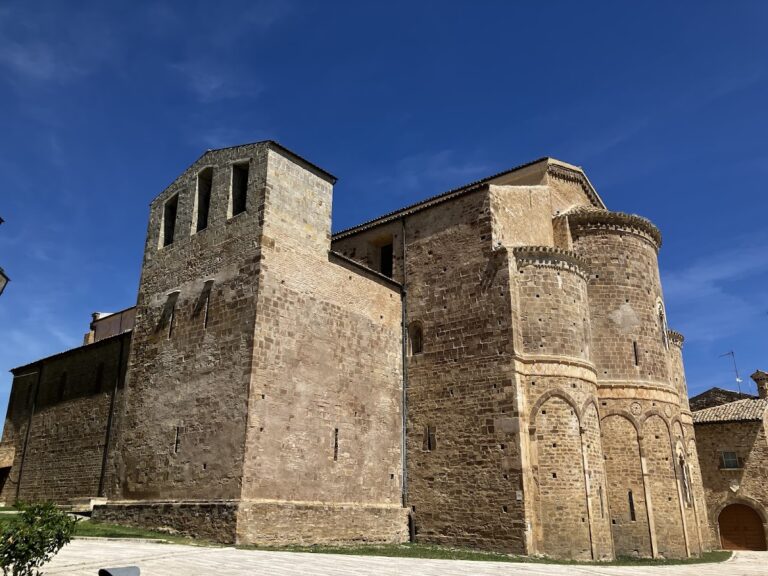
The church has a rectangular plan and a façade facing Via Garibaldi. Its exterior combines two principal phases: the lower part of the elevation retains Gothic character, while the upper section is distinctly Neoclassical. The surviving arrangement therefore makes the building’s medieval origins and later remodelling readable in its exterior fabric.
Façade, entrance, and bell tower
Gothic portal and façade
The Gothic portal has an ogival opening, meaning a pointed arch, framed by a polystyle tympanum with several moulded layers. A statue of Saint Nicholas stands above the entrance. It is accompanied by the coat of arms of the municipality of Lanciano and that of the Ricci family, which held the patronage of several chapels.
Original doorway and tower
The original entrance lies in the small open space before the bell tower. It consists of a small doorway topped by a semicircular lunette, the curved area above an opening. Beside it rises the substantial late-Gothic bell tower of the fifteenth century. Its bifora windows, each divided into two lights by a central support, include one opening that was enlarged completely to accommodate the largest bell. On the lower level, only one of the original bifora windows remains open, while the others have been blocked. Four angular dentils crown the summit.
Chapel of San Rocco
The tiny Chapel of San Rocco stands beside the church at the far end of the adjoining area.
Interior arrangement and furnishings
Naves and vaults
The interior is divided into three naves and four regular vaulted bays. The right aisle has groin vaults, formed by the intersection of two barrel vaults, while the left aisle has sail vaults. The two side aisles are asymmetrical because their perimeter walls follow the hill’s topography. The left aisle becomes wider from the entrance toward the presbytery, while the right aisle narrows in the same direction.
The central nave and the communicating arches of the side aisles rest on a complex masonry system set on a single parallelepiped-shaped base. Pairs of Corinthian pilasters rise in the central nave and presbytery, while pairs of Doric columns frame the lateral arches. The central nave has no niches or altars.
Presbytery and main altar
The presbytery was originally intended to have a semi-dome with a lantern above it. This design was replaced by a dome resting on spherical pendentives, curved structural surfaces that support a dome over a square or polygonal space. Geometric and floral motifs decorate the pendentives.
The main altar takes the form of a Neoclassical niche resembling a small aedicule, framed by pairs of columns. Inside it stands a Lecce-stone statue of Saint Nicholas saving children from drowning. Near the presbytery, the canons’ choir contains two paintings by Innocenzo Giammaria dated 1936. They depict miracles from the life of Saint Nicholas.
Side altars and baptismal font
The side altars include chapels dedicated to Saint Joseph with the Child, the Sacred Heart, and the Sepulchres. The left terminal altar is dedicated to an icon of the Madonna and Child popularly called “Our Mother,” associated with the corresponding cult of Bivongi. The present image is a copy of an original that was irreparably ruined through neglect.
The church also preserves a valuable octagonal wooden baptismal font painted with the Baptism of Christ. A contemporary font is held in the Diocesan Museum of Lanciano.
Underground rooms and medieval frescoes
True Cross cycle
The fourteenth-century fresco cycle occupies the room beneath the bell tower, a former burial crypt visible from the church interior. Its narratives were inspired by the Golden Legend, a medieval collection of saints’ lives and religious stories compiled by Jacopo da Varagine. The cycle concerns the True Cross, the cross traditionally believed to have been used in the crucifixion of Jesus, and includes the Death of Adam, Solomon Having the Tree Cut, the Queen of Sheba and the Sacred Wood, the Battle of the Milvian Bridge, and the Torture of the Jew.
In the Death of Adam, the aged Adam dies while the Tree of Sin grows from his mouth. Before his death, he sends Seth to Paradise for the oil of mercy from the Archangel Michael. Michael instead gives Seth a branch of the Tree of Life, which Seth places in Adam’s mouth after his death. The image presents Adam as a sign of the broken covenant between God and humanity, while anticipating Christ’s sacrifice as the sign of a new covenant.
The scene of Solomon Having the Tree Cut shows King Solomon directing work on Adam’s tree while a sacred building rises in the background. Although represented as a Christian church, the building is identified with Solomon’s Temple. When the wood could not be shaped properly, Solomon ordered the trunk to be thrown into a river.
The Queen of Sheba and the Sacred Wood shows the queen kneeling before the wood in adoration, accompanied by court ladies and travelling to Solomon to hear his wisdom. The episode anticipates the later making of the Cross for Christ’s execution. It also shows the Temple of Venus, represented as a Christian church, on the place where the Cross was buried.
Battle and martyrdom scenes
The Battle of the Milvian Bridge combines Constantine’s battle with an episode associated with the Byzantine emperor Heraclius I during his conflict with Persia. The Battle of the Milvian Bridge was Constantine’s victory over Maxentius in 312, traditionally linked to his vision of the Cross before the fighting. In the fresco, Constantine prays toward the sky, where a divine hand and the sign of the Cross guide him toward victory. His wife appears before the enemy army. The scene also recalls the recovery of the Cross after it was carried away in 616 during the conflict with Persia.
On the vault to the left of the bell-tower niche is the Torture of the Jew. Helena, Constantine’s mother, travels to Jerusalem to recover Christ’s Cross and encounters a Jew who knows where the relics are hidden but refuses to speak. He is tortured, and the fresco focuses on his suffering face through a strongly macabre treatment. The interpretation that the scene warned Baltic populations living in parts of medieval Lanciano remains hypothetical.
Other fragments show Saint Simon and the Holy Cross. Their lighter, more detailed handling differs from that of the Gothic painter responsible for the main cycle and has an almost Renaissance character.
Ecclesiastical collection
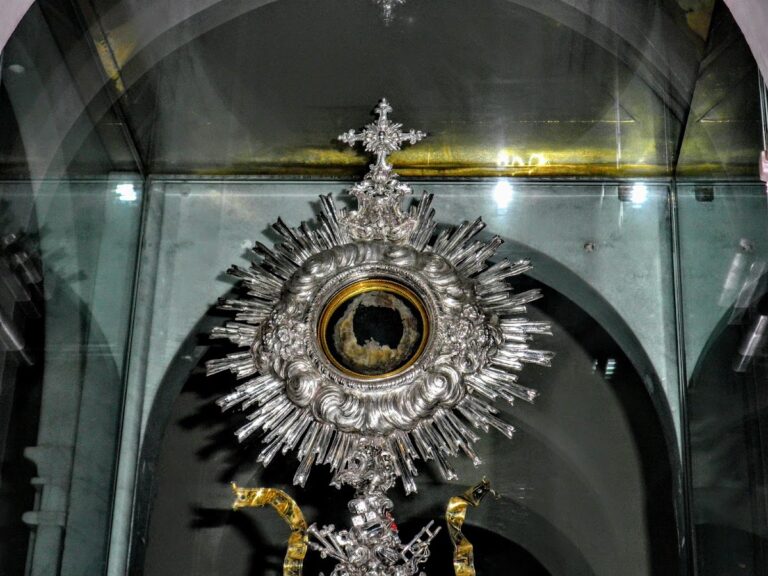
The parish museum collection includes a gilded-silver and enamel reliquary in the form of a small temple, made by Nicola De Franca of the Guardiagrele school. A reliquary is a container for a sacred relic, and this one preserves the mandible of Saint Blaise, a Christian bishop and martyr traditionally associated with protection of the throat.
The collection also contains two paintings copied from works by Francesco De Mura, depicting the Deposition from the Cross and the Pietà. Other objects include liturgical vestments, chalices, ciboria for holding consecrated hosts, crowns belonging to the Immaculate Madonna, processional crosses, and fragments from San Pellegrino. Among those fragments are late-Romanesque foliate capitals made from Majella stone and a sixteenth-century basin decorated with mascarons. The collection is temporarily deposited at the Diocesan Museum of Lanciano.