St. John’s Church: A Medieval Church in Britsum, Netherlands


Site at a Glance
- Rating
- 4.3
- Popularity
- Very Low
- Country
- Netherlands
- Primary era
- Medieval
- External website
- Open
- Eras represented
- Medieval, Modern
- Civilizations
- Dutch, Holy Roman Empire
- Site type
- Religious
- Remains
- Church
On this page12 sections
History
Medieval Origins
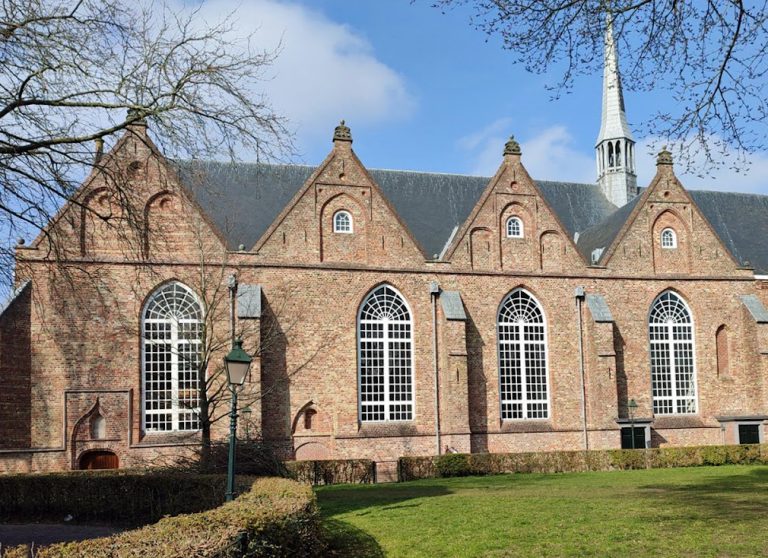
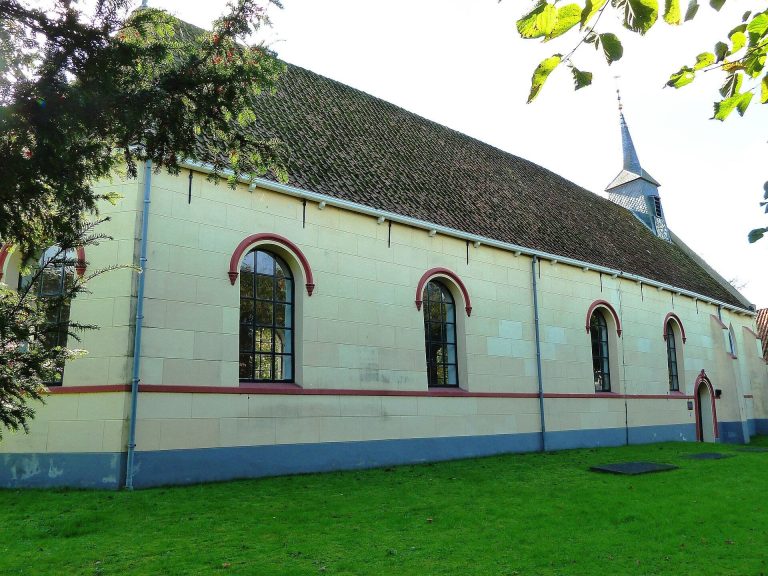
St. John’s Church is a medieval church in Britsum, Netherlands, dedicated to the Apostle John. It originated as a Catholic church. Its nave dates from the thirteenth century, while the built-in western tower, or westwork, dates from the twelfth century. A westwork is the western entrance and tower complex of a church, often containing additional rooms or a chapel.
The church stands on the Jabikspaad, a pilgrimage route through Friesland toward Overijssel. Its position on this route connects the building with the religious landscape of the northern Netherlands, while its long use reflects the changing history of Christian worship in the region.
Alterations and Preservation
The tower was modernized in 1896 in a neoclassical style. In 1875, the entire church was encased in Groningen red brick, and tie beams were inserted into the single-nave building to reinforce its walls. These interventions altered and strengthened the medieval structure while retaining its earlier core.
St. John’s Church is a Rijksmonument, a nationally protected monument, under monument number 24525. Restoration work took place in 1993 and 1999. The restoration of 1998 to 1999 also brought wall paintings to light, adding important evidence about the church’s medieval interior decoration.
Objects and Recent History
Two bells were historically associated with the tower. Johannes made one in 1507, and Jurjen Balthasar cast the other in 1664. Both were looted during the Second World War, a global conflict from 1939 to 1945, but they were recovered in Wilhelmshaven in 1946 and returned to Britsum.
The seventeenth-century tower clock was replaced by an electric clock approximately ten years before 2024. In 2024, the older clock was completely restored so that it could again be demonstrated, and a third bell was cast by a master from Westerwolde.
A 1667 pulpit Bible, fitted with silver donated by Jhr. Gemme Laes van Burmania and his second wife, Foek van Eysinga, was stolen in 2001. It was rediscovered fifteen years later and returned to the Stichting Alde Fryske Tsjerken, a foundation dedicated to preserving historic churches in Friesland. The Bible is currently lent to the Fries Museum, where it is displayed.
Otto Bekius was buried in the churchyard in October 2014. He had been a resistance fighter operating in Rotterdam during the Second World War and was a direct descendant of the church’s minister Benjamin Bekius. His will provided for a donation to the Stichting Alde Fryske Tsjerken for the preservation of the church.
The church also displays a copy of François Bekius, de duivel-dominee uit de Friesche wouden, a 1941 book by G. P. Cannegieter about one of Otto Bekius’s notable ancestors. Otto Bekius arranged for a memorial to be made during his lifetime, with instructions that his name should be added after his death. That memorial remains in the church.
Remains
Building and Tower
Church and Choir
The church occupies a terp, an artificially raised settlement mound built to keep buildings above wet or flood-prone ground. It is a single-nave building with a five-sided closed choir. The nave is covered by four Romano-Gothic dome vaults made from tuff stone. Romano-Gothic architecture combines Romanesque and Gothic features, while tuff is a volcanic stone used here in the vault construction.
Western Tower
The built-in western tower forms a westwork with an integrated tower chapel. The chapel was used, among other purposes, for children’s baptism. The tower has a recessed or constricted spire and contains the seventeenth-century clockwork. Its three bells comprise the historic bells from 1507 and 1664 and the third bell cast in 2024.
Wall Paintings and Interior Furnishings
Wall Paintings
The wall paintings revealed during the 1998 to 1999 restoration were executed in fresco, a technique in which pigment is applied to wet plaster. Five scenes portray the Passion of Christ, the Christian account of his arrest, trial, suffering, and Crucifixion: the Last Supper, the arrest of Christ, Christ before Pilate, the carrying of the cross, and the Crucifixion. Other paintings include the Virgin Mary with the Child and the Crowning with Thorns in the choir.
Pulpit and Family Pews
A hexagonal oak pulpit stands against the south wall and dates from the third quarter of the seventeenth century. Two canopied family pews provide reserved seating associated with prominent families. The Van Burmania pew dates from about 1670, and the Van Wyckel pew from about 1700. The interior also contains the cornice and superstructure of the eastern family pew and a wooden book bearing a commandment.
Organ and Burials
Willem Hardorff of Leeuwarden made the organ in 1862, and it was completely restored in 2018. Burial vaults dating from 1639 belong to members of the Burmania, Eijsenga, and Hinckenborg families. The Hinckenborg family is identified as the ancestry of Menno van Coehoorn, a Dutch military engineer and fortress designer of the seventeenth and early eighteenth centuries.
Several names are inscribed on the tombstone floor, including that of Benjamin Bekius, who served as the church’s preacher. The church also contains his gravestone and a memorial to the Bekius family. Otto Bekius’s gravestone stands in the adjacent churchyard.