Church of Our Lady: Bruges’ Gothic Parish Church and Ducal Tombs


Site at a Glance
- Rating
- 4.6
- Popularity
- High
- Country
- Belgium
- Primary era
- Medieval
- External website
- Open
- Eras represented
- Medieval, Early Modern, Modern
- Civilizations
- County of Flanders
- Site type
- Religious
- Remains
- Church
On this page20 sections
History
The Church of Our Lady is a Roman Catholic parish church in Bruges, Belgium, whose present Gothic building began in the early thirteenth century. One of the city’s oldest places of worship, it is dedicated to Mary and belongs to the Diocese of Bruges. Its long development brought together successive medieval building phases, Burgundian dynastic connections, and later Baroque and Gothic Revival changes.
Early foundations and parish development
A tradition places the church’s foundation in 741 and attributes it to Boniface, a Christian missionary and saint. That attribution is considered doubtful, and the earliest associated patronymic instead refers to his companion Hilarius. The first building securely connected with the site was a Carolingian chapel dating from about 875. It was probably founded as a daughter church of St Martin’s Church in Sijsele, which belonged to the Cathedral of Utrecht.
In 1116 the chapel became independent from Sijsele and became the principal church of a separate parish. The change probably led to rebuilding and enlargement under Charles the Good. The first church tower collapsed in 1163, after which it was reconstructed approximately between 1270 and 1340. Its spire was added in the fifteenth century and rebuilt during the nineteenth century.
Medieval construction
Construction of the present church proceeded in several stages. The nave was built between 1210 and 1230. A second phase extended to about 1335 and produced the choir and transept. A north aisle was added in 1345, while the south aisle was built between 1450 and 1474. The sacristy and chapels were completed by 1480. These successive works explain the building’s combination of Scheldt Gothic, French Gothic, Brabantine Gothic, and later Gothic Revival elements.
The church became a collegiate church governed by a provost and a chapter of canons, a body of clergy serving the institution, and retained that status until the end of the ancien régime. It later became a decanal church and continues as a parish church. Since the beginning of the twenty-first century it has formed part of the Sint-Donatianus parish federation. Since the 1980s it has also welcomed visitors, while its museum section has belonged to Musea Brugge since 2019.
Burgundian associations and burials
The church’s connection with the Burgundian court is especially clear in its royal burials and commemorative monuments. Mary of Burgundy, daughter of Charles the Bold, died in Bruges in 1482 and was buried here. Her son Philip the Handsome, a Habsburg ruler who became king of Castile and the father of Emperor Charles V, is represented by a separate container holding his heart. His remaining body is buried in the Royal Chapel of Granada in Spain.
Only the tomb monument of Mary’s father, Charles the Bold, is present in the church. His remains were transferred from France to Bruges by his grandson, Emperor Charles V, and were probably buried in the now-vanished St Donatian’s Cathedral on the Burg. His body was never recovered. In 1979 archaeological research in the choir identified Mary of Burgundy’s remains and also uncovered sixteen painted, brick-built graves dating from the thirteenth to the fifteenth centuries. Three of those graves were transferred to the Pieter Lanchals Chapel.
The chapter of the Order of the Golden Fleece met in the church in 1468. This prestigious chivalric order was founded in the fifteenth-century Burgundian Netherlands. Thirty shields of its knights hang above the choir stalls, including those of Charles the Bold and his brother-in-law Edward IV of England.
Art, conflict, and later memory
Michelangelo’s Madonna and Child reached Bruges through the city’s merchant community. Jan van Moeskroen, also identified as Giovanni di Moscerone, purchased the early sixteenth-century sculpture in Italy and donated it to the church in 1514. French occupying forces removed it in 1794, and German occupying forces removed it again in 1944. It was recovered and returned to Bruges on both occasions.
The church also preserves the memory of Pieter Lanchals, Bruges’ bailiff. Citizens of Bruges executed and beheaded him because of his loyalty to Burgundy and Maximilian of Austria. His head was displayed at the Ghent Gate, while part of his funerary monument survives in the church. A nineteenth-century legend connects the Lanchals Chapel with an alleged obligation imposed by Emperor Maximilian I, requiring Bruges to maintain fifty-two long-necked birds, traditionally identified as swans, in the city’s canals.
The church was protected as heritage in Flanders on 25 March 1938. Later architectural reconstruction involved Karel De Wulf, Louis Delacenserie, Jean-Brunon Rudd, Jozef Viérin, and Luc Viérin. Archaeological investigation, conservation, and the integration of the museum section have continued the building’s modern historical life.
Remains
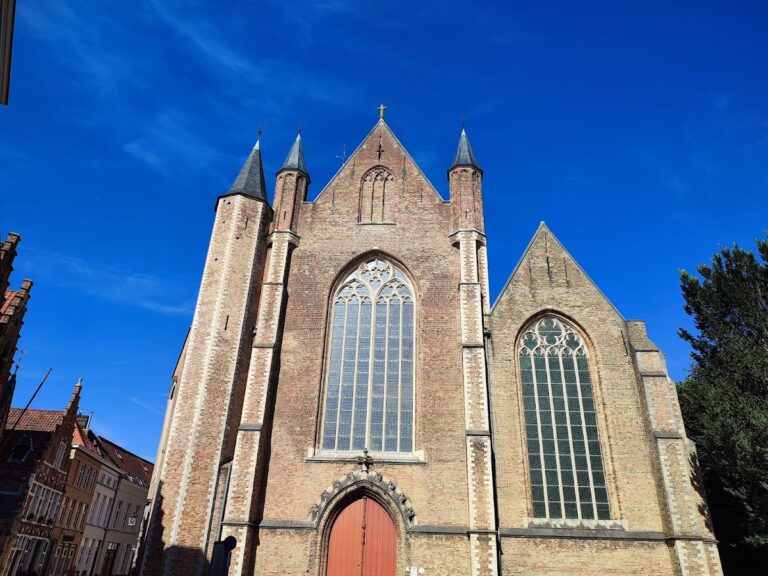
The Church of Our Lady is a five-aisled basilica with a transept, a passage around the choir, radiating chapels, and a sacristy. A three-part rood screen, a partition separating the nave from the choir, divides the central space into the high choir and the nave. The church is predominantly brick-built, although the oldest part, the central nave, uses Tournai stone. Its surviving fabric therefore brings together local coastal construction with several regional forms of Gothic architecture.
Medieval structure and tower
Nave and west front
The nave has cross-vaults and black-and-white tiled flooring. The west façade and the front of the church show Scheldt Gothic, a regional style associated with the Scheldt basin. Their features include two slender stair turrets and the use of bluestone. The stair turrets date from about 1280, while the central nave belongs to the earliest major phase of the present church, built between 1210 and 1230.
Choir, apse, and aisles
The choir and apse were built between 1270 and 1280 in classical French Gothic forms executed in brick. Exterior flying buttresses from the 1270s and 1280s support this part of the building. The north outer aisle, added in 1345, and the south outer aisle, built between 1450 and 1474, represent Brabantine Gothic, a later form that developed in the Duchy of Brabant and incorporated northern French influences. The Paradise Portal, built around 1465, belongs to this later architectural group.
Tower and spire
The tower rises 115.6 metres and is built entirely of brick, a material characteristic of coastal Gothic architecture. It is the tallest structure in Bruges and is among the world’s tallest brick church towers. The tower’s fabric reflects more than one Gothic phase. Its original medieval reconstruction took place approximately between 1270 and 1340, the spire was added in the fifteenth century, and the spire was rebuilt in the nineteenth century.
Chapels and burial structures
Gruuthuse chapels
The Gruuthuse Chapel was created in 1472 for the neighbouring Gruuthuse residence. It provides a direct connection from the palace to the church choir. A second chapel, created in 1482 for Lodewijk van Gruuthuse, a fifteenth-century Bruges nobleman associated with Gruuthuse Palace, served as his private place of worship. The chapels preserve the close architectural relationship between aristocratic residence and church interior.
Ducal tombs
The choir contains the tomb monuments of Mary of Burgundy and Charles the Bold. Both figures are shown crowned and reclining with folded hands on polished black stone sarcophagi, which are stone coffins or coffin-like monuments. Mary’s monument is the older and was designed by Jan Borman. Her face was modelled with exceptional delicacy from her death mask, while her crown, hands, and flowing mantle are finely rendered. A lion and a dog at her feet symbolize masculine strength and feminine fidelity.
Charles the Bold’s monument, made about half a century later, combines Gothic and Renaissance features. His figure wears detailed armour and the decoration of the Order of the Golden Fleece. Both monuments have commemorative plaques on their fronts and enamelled ancestral coats of arms on their sides. Their figures are made of gilded bronze set on polished black stone.
Burial evidence
Mary’s tomb contains a visible lead coffin holding her bones. An inscription identifies a separate small lead container holding Philip the Handsome’s heart. Glass over the tomb openings permits the painted wall decoration inside the burial structures to be viewed from above. The church also contains painted graves from the thirteenth to the fifteenth centuries, including the three transferred to the Pieter Lanchals Chapel. Mary Lovel, an English founder of the convent at Antwerp, was buried near the high altar in 1628 after dying in Bruges while attempting to establish another convent there.
Altarpiece and paintings
High altar
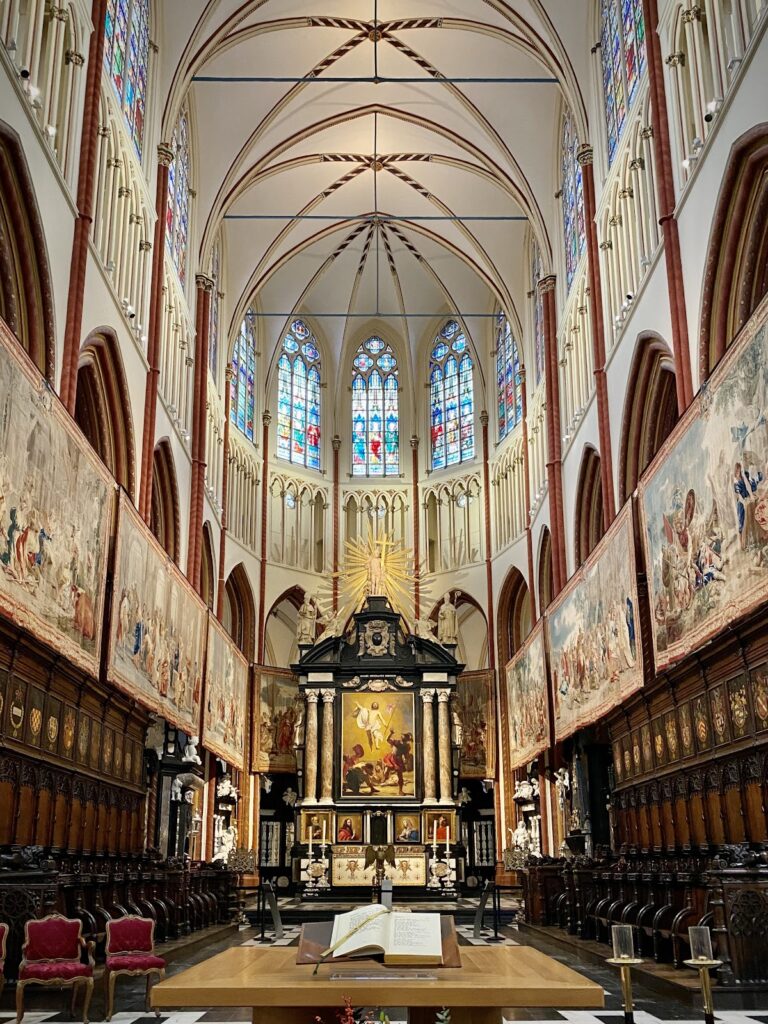
The high altar is surmounted by Bernard van Orley’s Passion triptych. A triptych is a three-part artwork, normally consisting of a central panel and two wings. The central scene of this work represents the Crucifixion. Van Orley was a Netherlandish painter who served as court painter to Margaret of Austria. Three richly painted graves were exposed beneath the altar and below the tomb monuments.
Michelangelo’s sculpture
The church’s principal art treasure is Michelangelo’s white-marble Madonna and Child, made around 1503 to 1506 and generally dated to about 1504. It was probably intended originally for Siena Cathedral. Bruges merchants Jan and Alexander Mouscron purchased it, and it was donated to the church in 1514. The sculpture stands in the Cappella sacra, a large Baroque chapel in the south aisle. The Mouscron family tomb lies before the altar beneath the sculpture, while Françoise de Haveskercke is buried beside her husband in the nearby black Haveskercke family tomb.
Other paintings
The church contains paintings from the fifteenth to the eighteenth centuries. They include The Calling of Saint Matthew by Jacob van Oost, from about 1640; The Adoration of the Christ Child by the Saints by Gaspar de Crayer, dated 1662; The Adoration of the Magi by Gerard Seghers, dated 1630; and an associated Madonna and Child by Anton Claeissins from the fourth quarter of the sixteenth century. Other works include Frans Francken’s Christ before Simon the Pharisee from 1628, Claeissins’s Give to the Poor from 1590, P. Bernaerdt’s Our Lady, Refuge of Sinners from 1660, ten Passion paintings by Jan Garemyn from 1775 to 1777, and Garemyn’s Three Saints from about 1763.
Further paintings include The Disciples at Emmaus, attributed to Hendrick ter Brugghen; Jacob van Oost’s The Coronation of Saint Rosalia from 1646, Our Lady Surrounded by Saints, with Eligius of Noyon from 1763, and Elijah from 1648; Pieter Pourbus’s The Last Supper from 1562; Adriaen Isenbrant’s Our Lady of the Seven Sorrows from about 1520; and Louis de Deyster’s Esther before Ahasuerus from 1695. The collection also includes a Bernard van Orley Passion triptych from 1534, an interior view by H. van Minderhout from the second half of the seventeenth century, works attributed to the Cologne school, and an anonymous Descent from the Cross from the fourth quarter of the fifteenth century.
Other works include The Transfiguration on Mount Tabor by Gerard David, dated between the fourth quarter of the fourteenth and the first quarter of the fifteenth century; paintings by Pieter Pourbus from 1573 and 1574; a seventeenth-century Child Adored by Saints influenced by Caravaggio; Gaspar de Crayer’s The Vision of Thomas Aquinas from 1644; and fifteenth-century wall-painting fragments showing Christ and the Samaritan Woman. A fragment depicting Louis IX of France dates from about 1350.
Sculpture, monuments, and furnishings
Sculptural furnishings include a reliquary shrine of Saint John Nepomuk from the second half of the eighteenth century. A reliquary shrine is a container made to preserve or display relics. Other sculptures include the Twelve Apostles from 1618, a Pietà group from the second half of the seventeenth century, Our Lady of Peace from the second half of the fifteenth century, and two Angels of Adoration by P. Pepers from 1779. Pepers also made a Madonna dated 1768 and The Three Sisters from 1763.
Funerary and commemorative monuments include those of J. Van den Velde; L. de Baenst and M. Boulangier; L. de Baenst and C. Losschaert; J. Van den Velde and A. van de Gheenste; and the Lord of Haveskerke. Their dates range from the fifteenth to the sixteenth century. Part of Pieter Lanchals’s monument, dating from the fourth quarter of the fifteenth century, is preserved in the Lanchals Chapel.
The Baroque interior includes oak choir stalls from 1722 with statues from the first quarter of the seventeenth century, an oak triumphal cross by J. Aerts from 1594, and an oak communion rail from the second quarter of the eighteenth century. A marble communion rail dates from 1843. The Rococo oak pulpit was designed by Jan Garemyn and executed in 1743, with statues from the first quarter of the seventeenth century by J. Van Hecke, P. Van Walleghem, and P. Scherlaecken.
Additional furnishings include Baroque oak confessionals, among them works by J. Berger and L. Hagheman from 1697, oak choir stalls from 1776, and a wrought-iron Rococo choir screen from about 1742. A second wrought-iron screen stands at the Paradise vestibule and dates from the second quarter of the eighteenth century; both screens are by Kinsoen. The church also contains a choir door by J. Ryckam from 1699 and a Neoclassical choir screen from the fourth quarter of the eighteenth century.
Organs and performance mechanism
The main organ derives from an instrument built in 1721 and 1722 by Corneille Cacheux of Arras. In 1954 Loncke installed a new organ in the historic case, reusing existing pipework. The instrument has thirty-five stops on three manuals and pedal, with electro-pneumatic action. The choir organ was built by Anton Skrabl in 2013 and has thirteen stops on two manuals and pedal.
Above the crossing, a ceiling opening survives with its hoisting mechanism intact. It was used to raise figures representing the Ascension during religious performances. The painted hatch records that Eugenius Goddyn made it in 1762.