Church of Misericordia, San Casciano: A Medieval Church and Baroque Confraternity Seat


Site at a Glance
- Rating
- 4.7
- Popularity
- Very Low
- Country
- Italy
- Primary era
- Medieval
- External website
- Open
- Eras represented
- Medieval, Early Modern
- Civilizations
- Grand Duchy of Tuscany, Republic of Florence
- Site type
- Religious
- Remains
- Church
On this page16 sections
History
The Church of Misericordia, also called Santa Maria del Prato, is a Roman Catholic church in San Casciano in Val di Pesa, Italy, dating from 1304 and later renovated in the Baroque style. It belongs to the Diocese of Florence and became the seat of the Archconfraternity of Mercy, a religious brotherhood organized for charitable and devotional work, in 1631.
Dominican foundation
The church was built at the initiative of the Dominican fathers of Santa Maria Novella. The Dominicans were a Catholic mendicant order founded in the early thirteenth century, known for preaching, theological study, and urban religious foundations. A surviving papal bull authorized the construction. It was written in Florence by Niccolò Albertini, bishop of Ostia and Velletri and a papal legate, meaning a representative of the pope.
Sixteenth- and seventeenth-century changes
The building was substantially altered during the sixteenth century. During the first half of the seventeenth century, it received a Baroque renovation that changed its interior furnishings, added a sacristy behind the presbytery, and blocked a window in the apse, the rounded or polygonal end of the church. The window became visible again during the restoration of 1994.
In 1631, the church became the home of the Archconfraternity of Mercy of San Casciano. This confraternity had a formal charitable and devotional organization associated with assistance to the sick, the dead, and people in need. Wealthy local families later shaped the interior through their patronage. The Bambagini, Ninci, and Borromeo families supported the erection of four altars along the side walls between the seventeenth and eighteenth centuries.
Regulation, war, and restoration
Two stone plaques dated 1624 preserve ordinances issued by the Otto di Balia of Florence, a governing body with judicial and administrative responsibilities. The rules prohibited games and the dumping of refuse beside the church and its convent, imposing rope punishment for violations. The inscriptions offer a direct glimpse of how the religious complex and its immediate surroundings were regulated.
The church suffered severe damage during the Second World War and subsequently required extensive restoration. The postwar work partly recovered its medieval appearance. The later restoration of 1994 also revealed the blocked apsidal window, while restoration of the crucifix attributed to Simone Martini was completed in 2019.
Remains
Exterior and medieval structure
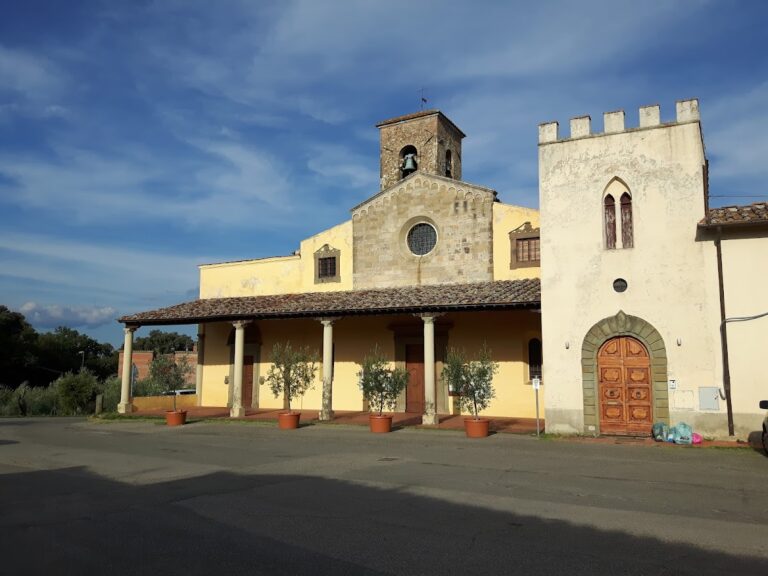
The church has a simple exterior with exposed masonry made from river pebbles arranged in regular horizontal courses. This is a filaretto technique, in which small stones or bricks are laid in orderly layers. Gray Tuscan pietra serena, a sandstone widely used for architectural details and sculpture, frames the portal, forms its upper cornice, and marks the building’s corners.
The present appearance results from restoration. Early twentieth-century photographs show the church covered with plaster and painted in horizontal black-and-white stripes. They also show that the building then lacked both the brick oculus and the canopy above the portal. The wooden entrance door was made by a local craftsman and bears the date 1650. The two 1624 ordinance plaques are set into the visible eastern side of the church.
Interior arrangement
The interior is organized as a single nave beneath an exposed timber-truss roof. A timber-truss roof uses triangular structural frames to support the roof structure. Four seventeenth-century altars line the side walls. At the entrance wall, two seventeenth-century pietra serena aedicules, or small shrine-like architectural frames, surround devotional elements.
The main chapel opens through a pointed triumphal arch, formed by two curves that meet at an apex. Traces of frescoes show that the arch was originally decorated on both sides. The seventeenth-century high altar is also made of pietra serena and incorporates works that were originally created for other locations.
Pulpit and wooden sculpture
Giovanni di Balduccio’s pulpit
The pulpit was made in the first decades of the fourteenth century by Giovanni di Balduccio for the Bonaccorsi family. It is supported by two corbels. The left corbel is a rough pietra serena replacement made by an unknown stonecutter during a restoration, while the right corbel is marble and carries the coat of arms of the patron family. The pulpit bears the maker’s signature.
Its front has two marble panels representing the Annunciation, with the archangel Gabriel on the left and the Virgin on the right. The side panels show Saint Dominic on the right and Saint Peter Martyr on the left. Bands of green marble from Prato frame the panels.
Crucifix from the Convent of the Cross
A wooden Crucifix attributed to the school of Donatello stands at the beginning of the right wall. Donatello was a leading Florentine sculptor of the early Renaissance. The work came from the nearby Convent of the Cross and was installed in the church in 1810.
Paintings and altars
Right-hand altars
The first altar on the right was commissioned by the Bambagini family in 1624. Their coats of arms appear on the column plinths. The family also financed the altar opposite, although not its altarpiece. This altar contains Jacopo Vignali’s signed and dated Circumcision of Jesus, dated 1627. The painting is said to have been commissioned by the Dominican friar Arcangelo Baldini, who later became bishop of Gravina di Puglia.
The next altar contains a Crucifix attributed to Simone Martini, a major Sienese painter of the fourteenth century. It was probably painted before 1321, when a payment is recorded to the artist for a crucifix made for the Chapel of the Nine in the Palazzo Pubblico in Siena. Many critics identify the San Casciano work with that commission, although the circumstances of its arrival at the church are unknown.
The cross remains intact except for a base that was sawn off, probably to permit its placement elsewhere in the church. The lateral figures of the mourners were made by a pupil. Restoration of the Crucifix was completed in 2019.
High altar and sacristy paintings
The high altar displays a Madonna and Child by Ugolino di Nerio, a follower of Duccio di Buoninsegna whose work reflects the features of the Sienese school during the first half of the fourteenth century. Above the doors of the sacristy are Saint Francis and Saint Peter, surviving sections of a dismembered polyptych by Ugolino di Nerio. A polyptych is a multi-panel altarpiece whose separate sections can be dismantled. Beside these panels are seventeenth-century paintings of Saint Thomas Aquinas and Saint Lawrence by Rutilio Manetti.
Left-hand altars
The second altar on the left was built by Camillo Borromeo in 1643. It contains Francesco Furini’s Ecstasy of Saint Charles Borromeo, generally dated to about 1625 to 1630.
The first altar on the left was also built by the Bambagini family in 1624. Its altarpiece is Jacopo Vignali’s Madonna of the Rosary, dated approximately to 1624. Two figures in the painting have been identified, with considerable uncertainty, as Maria Maddalena of Austria, wife of Cosimo II, and her eleven-year-old son Ferdinando II de’ Medici. The absence of grand-ducal crowns and widow’s clothing makes that identification doubtful.
Entrance-wall painting
Near the entrance on the left wall is Fra Paolino da Pistoia’s Madonna Enthroned with Child and Saints Catherine, Peter, Mary Magdalene, and Bartholomew the Apostle. The painting dates to 1518 and was restored at the end of the twentieth century.
Lunette above the portal
Above the entrance portal is a lunette depicting the Virgin and angels. The work belongs to the fifteenth-century Florentine school and was formerly placed beneath the triumphal arch.