Augustinian Monastery in Šternberk: A Moravian Religious and Cultural Center


Site at a Glance
- Rating
- 4.7
- Popularity
- Very Low
- Country
- Czechia
- Primary era
- Early Modern
- Eras represented
- Medieval, Early Modern
- Civilizations
- Habsburg, Holy Roman Empire, Margraviate of Moravia
- Site type
- Religious
- Remains
- Monastery
On this page13 sections
History
The former Augustinian canons’ monastery in Šternberk, Czechia, was founded in 1371 by Albert of Sternberg, a Moravian nobleman and church official who served as archbishop of Magdeburg and advised Emperor Charles IV. Established in his native town within the Margraviate of Moravia and the Diocese of Olomouc, it became the oldest Augustinian canons’ institution in Moravia. Its community combined communal religious life with pastoral work, education, and intellectual activity.
Foundation and early development
Albert founded the monastery on 4 March 1371 with the approval of Bishop John of Neumarkt and the Olomouc cathedral chapter. Its organization followed the model of the Augustinian canons’ monastery at Raudnitz, established in 1333. Fourteen canons came from Raudnitz, led by Wenceslas, Albert’s chaplain, who became the first provost.
The Romanesque Church of Saint George became the community’s collegiate church and received the new dedication of the Annunciation of the Virgin Mary. Work on the convent buildings and the provost’s residence began in 1372 and was finished in the first half of the 1380s. A settlement between Albert and his nephew Peter led to a second foundation charter in 1384. This confirmed the institution and increased the number of canons to twenty-five.
The canons also assumed responsibility for the Šternberk parish, its parish school, and a hospital at the suburban Church of the Purification of the Virgin Mary. Together with the canonry at Prostějov, the monastery became a center of religious renewal associated with devotio moderna, a late medieval movement stressing personal devotion, disciplined religious practice, moral reform, and devotional reading. It also supported culture and learning in central Moravia.
In 1404, Bishop Lacek of Krawarn consecrated the altars of Saint John the Baptist and Saint Catherine. He also granted indulgences to people who visited the church. The monastery maintained prayer confraternities with the canonries of Raudnitz, Jaromir, Sadská, and Landskron, established respectively in 1376, 1382, and 1408 for the latter three foundations.
Destruction and rebuilding
The Hussite Wars, fifteenth-century religious and political conflicts connected with the reform movement inspired by Jan Hus, brought major disruption. Hussite forces captured Šternberk in 1430 and used the town as a base. When troops commanded by Andreas Prokop, a leading Hussite military commander, entered the town, they burned the monastery buildings and collegiate church. The canons fled mainly to Olomouc and gradually returned during the fifteenth century.
Reconstruction took place between 1451 and 1461. A later visitation ordered by Bishop Protasius of Boskowitz and Czernahora found the monastery in good condition and required the canons to continue observing the statutes of Raudnitz. On 24 March 1490, Pope Innocent VIII confirmed the institution’s privilege to use pontificals, the special liturgical insignia and rights granted to the head of a religious community by authorization.
During the Reformation, discipline declined and the community struggled to attract new members. A fire that swept through the town in 1536 severely damaged the church and convent. Jan Wenceslas Berka of Dubá ordered their reconstruction in Renaissance form. In 1570, the marriage of Katharina of Berka and Dubá to Duke Charles II of Münsterberg transferred the town, the Šternberk estate, and the monastery’s patronage to the Münsterberg line.
Conflicts, fires, and institutional change
Charles II supported Lutheran teaching, which brought the canons into conflict with both the duke and the Diocese of Olomouc. The disputes involved religious policy as well as economic interests. In 1621, Provost Matthias Jaretius complained to the Olomouc court chancellor about pressure and financial difficulties imposed on the monastery by the Münsterberg dukes. Through the marriage of Elisabeth Maria of Münsterberg to Silvius Nimrod, the family’s possessions, including the Šternberk estate, later passed to the House of Württemberg in Oels.
The Thirty Years’ War brought repeated raids and troop movements to the region. Another town fire, on 21 June 1626, damaged the monastery, and repairs continued until 1632. The church subsequently received nine new altars, consecrated in stages in 1637, 1669, and 1691. A visitation during the episcopate of Karl II of Liechtenstein-Kastelkorn in 1664 criticized discipline, while a report issued on 29 August 1668 prescribed penalties for disobedience and misconduct and criticized the provost’s conduct.
After 1695, the Šternberk estate and the monastery’s patronage passed to the House of Liechtenstein. In 1728, the community joined the Congregation of the Augustinian Canons of the Lateran, a federation of canon communities associated with common observance and institutional reform.
Baroque transformation and dissolution
A lay Brotherhood of the Holy Trinity operated in the church from 1721 and maintained its church music. After the brotherhood was dissolved, its liturgical music archive survived in 162 volumes of musical notation. By 1737, the monastery complex and part of the church had been renovated in High Baroque form by the Moravian architect Franz Anton Grimm. The painter Johann Christoph Handke and the sculptors Andreas Bleiberger, Filip Sattler, and Jan Kammereith contributed to the decoration, with some of Kammereith’s earliest works made there.
The monastery’s library had existed since the foundation. Albert of Sternberg donated eight rare manuscripts, and a separate library hall with frescoes by Handke was created in 1737. At the time of dissolution, the library held 1,178 volumes, most from the seventeenth and eighteenth centuries. Printed books were partly auctioned and partly transferred through the Olomouc Lyceum to the Olomouc University Library.
The Josephine reforms, introduced under Emperor Joseph II to dissolve religious institutions considered to lack a direct pastoral or socially useful function and redirect their property to state-controlled religious funds, brought the monastery to an end in 1775. The old church was demolished soon afterward, and a replacement church was completed by 1783, incorporating part of the earlier furnishings. Andreas Temper, the last provost, later served as parish priest at the former collegiate church.
The monastery had also temporarily held the estates of Waischowitz with Nesamyslitz, Morschitz, Babitz, Chwalkowitz, Tworowitz, Zierotin, and the independent estate of Kyselowitz. Following the dissolution, these possessions passed to the Religious Fund. The surviving complex is protected as an immovable cultural monument of Šternberk.
Remains
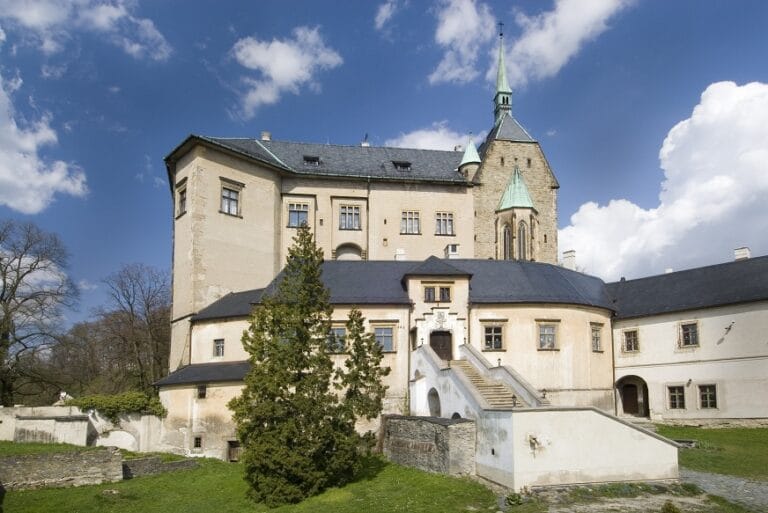
The surviving complex stands on a hill beside the Church of the Annunciation of the Virgin Mary. Its physical components include the convent buildings, a quadrangular cloister, the parish house, a section of the town fortification wall, and the church that replaced the demolished medieval collegiate church. The buildings preserve evidence of successive Gothic, Renaissance, and Baroque phases.
Convent and church complex
Quadrangular cloister and convent
The convent was arranged around a quadrangular cloister, forming the residential and communal core of the canonry. Construction began in 1372 and continued into the first half of the 1380s. After destruction during the Hussite Wars, the convent was rebuilt in Late Gothic form between 1451 and 1461. The 1536 fire led to another reconstruction in Renaissance form, while damage from the 1626 fire was repaired by 1632. A High Baroque renovation by Franz Anton Grimm had transformed the complex by 1737. The protected buildings include the convent premises at Farní 53/7, 54/4, 69/5, and 77/6.
Church of the Annunciation
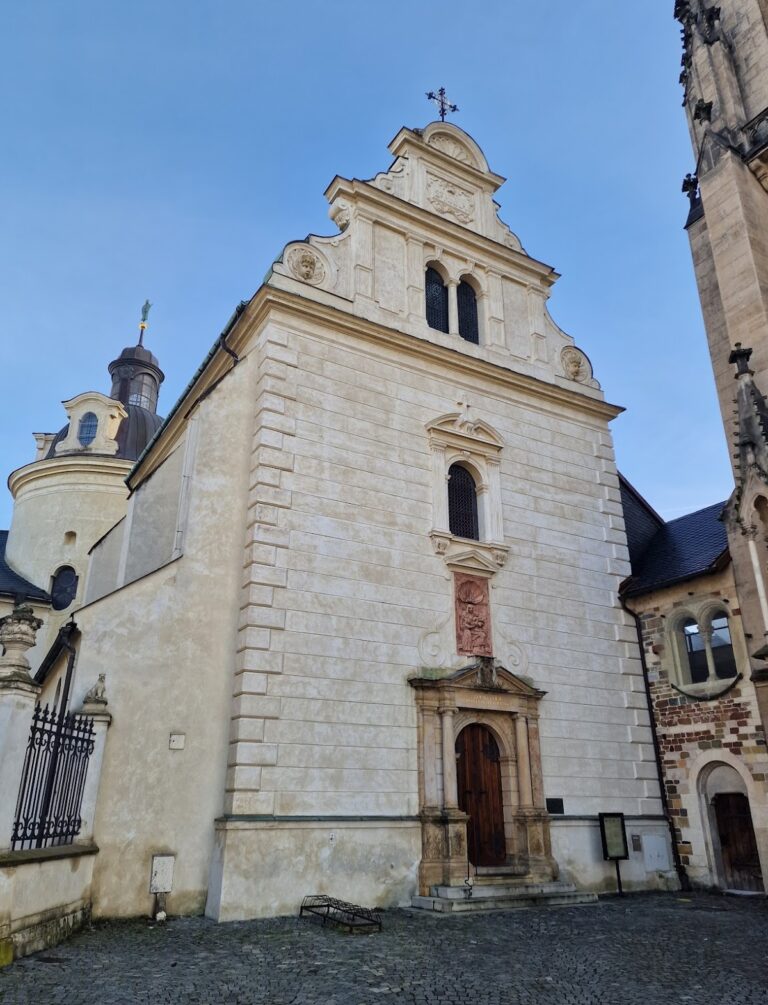
The institution initially occupied the site beside the Romanesque Church of Saint George, founded in the mid-thirteenth century by Zdislav of Sternberg. Under the canons, it became a two-nave collegiate church dedicated to the Annunciation of the Virgin Mary. The church was rebuilt with the convent after the Hussite destruction and again after the Renaissance-era fire. Its altars included those of Saint John the Baptist and Saint Catherine, consecrated in 1404, followed by nine further altars installed between 1637 and 1691.
Part of the church received High Baroque decoration by 1737. Johann Christoph Handke painted a portrait of Albert of Sternberg for the chapter house, while Andreas Bleiberger, Filip Sattler, and Jan Kammereith produced sculptural work. After the medieval church was demolished following the dissolution, a new church was completed by 1783, and elements of the earlier furnishings were moved into it.
Parish house and town wall
The protected area also contains the parish house at Farní 50/3 and a surviving section of the town wall. These elements form part of the preserved relationship between the former canonry, the parish it administered, and the fortified urban setting. The cloister and the listed convent buildings are included within the same protected monument area.
Library and musical heritage
Library hall and manuscripts
The library hall created in 1737 carried fresco decoration by Johann Christoph Handke. The collection grew from the monastery’s foundation and included eight rare manuscripts donated by Albert of Sternberg. Among its notable works were the Sternberg Pontifical, a missal, and the so-called Royal Bible. After the dissolution, these manuscripts were dispersed: the Sternberg Pontifical went to the Strahov Monastery Library in Prague, the missal to the Austrian National Library, and the Royal Bible to the Library of the University of Krakow.
Music archive and printed works
The Brotherhood of the Holy Trinity’s surviving archive consists of 162 volumes of liturgical musical notation. The former library also held printed books, many dating from the seventeenth and eighteenth centuries. The collection included works by Provost Friedrich, who served from 1384 to 1400 and wrote Postillae dictae consolatio spiritus and Abortivus, as well as Georg Handl’s religious songbook Cantional, issued by Provost Johann Rozenplut of Schwarzenbach and printed in Olomouc in 1601.
Nearby sites