Sovinec: A Medieval Castle and Teutonic Order Stronghold in Czechia
Site at a Glance
- Rating
- 4.6
- Popularity
- Medium
- Country
- Czechia
- Primary era
- Early Modern
- External website
- Open
- Eras represented
- Medieval, Early Modern, Modern
- Civilizations
- Holy Roman Empire, Teutonic Order
- Site type
- Military
- Remains
- Castle
On this page10 sections
History
Sovinec is a medieval castle in Czechia, built between 1329 and 1332 by the Moravian noble brothers Vok and Pavel of Sovinec. Its earliest surviving architectural elements are Gothic, and its position on a rocky hill in the Nízký Jeseník range made it a defensible seat. The first written reference to the castle dates to 18 July 1332, when Pavel used the byname of Sovinec. The family was regarded as one of the fifteen oldest Moravian noble lineages.
The medieval Sovinec lords
The brothers had previously held Mutkov Castle near Huzová as feudatories of the Bishopric of Olomouc. From the late fourteenth century, disputes over the family holding affected the castle’s ownership. After disagreements among the heirs of Pavlík of Sovinec, several members of the family held the estate jointly.
During the fifteenth century, Sovinec became an important Hussite stronghold. The Hussites were followers of the religious reform movement associated with Jan Hus, whose supporters fought in Bohemia and Moravia. Sovinec hosted political discussions between Prokop Holý, one of the Hussite army’s principal commanders, and Sigismund Korybut, a candidate for the Bohemian throne.
The lords of Sovinec later supported King George of Poděbrady and his plans to draw Silesia into a wider political project. In August 1474, Matthias Corvinus destroyed the lands of the Sovinec dynasty. By 1490, the estate had been consolidated into a domain containing one town and eighteen villages, extending from the plains near Paseka through the Rýmařov area to Malá Štáhle and Velká Štáhle in the mountains.
Mining, settlement, and Renaissance expansion
The Pňovský branch of the family acquired Sovinec in the late fifteenth century, and Jan II Pňovský had recovered the estate for the family by 1490. The territory was pillaged during the early sixteenth century. A subsequent period of peace brought resettlement, economic growth, and industrial activity.
Gold and silver were sought in the Nízký Jeseník during the sixteenth-century mining boom, including near Ruda and Plinkout. Vok Pňovský and Marie of Austria, the widow of King Louis, took part in mining activities in the region. Mining companies associated with the Augsburg Fugger family also operated there.
Ješek Pňovský inherited an estate burdened by heavy debts and was forced to sell Sovinec to Kryštof of Boskovice and Třebová during the 1540s. Kryštof and his grandson Jan expanded the estate’s mining, colonizing, and industrial interests. Jan sold the domain to Vavřinec Eder of Štiavnice in 1576. Iron-ore production reached its height between the second half of the sixteenth century and the beginning of the seventeenth.
Under Kryštof, the southern and eastern parts of the castle were rebuilt in Renaissance forms. Vavřinec Eder later altered the palace interiors and added a service wing. These changes transformed the earlier medieval stronghold into a larger residential and administrative complex.
The Teutonic Order and the Thirty Years’ War
After Vavřinec Eder’s death, his daughter Anna inherited Sovinec and married Jan the Elder Kobylka of Kobylí. A fervent Evangelical, Jan became one of the thirty Moravian directors who governed during the Estates’ Revolt of 1618–1620, an uprising by the Bohemian and Moravian estates against Habsburg rule. Following the rebels’ defeat at the Battle of White Mountain, he was compelled to sell Sovinec below its value on 18 January 1623.
Karl I, Prince of Liechtenstein, transferred the castle to the Teutonic Order later that year. The Teutonic Order, also called the German Order, was a medieval Catholic religious and military order that held extensive estates in Central Europe. Under its administration, Czech family, settlement, and village names were replaced by German equivalents, and Czech disappeared as the castle’s administrative language.
During the Thirty Years’ War, a European conflict fought from 1618 to 1648 amid religious, dynastic, and political struggles, Danish troops under Ernst von Mansfeld captured Sovinec in 1626. The castle administrator, Georg Wilhelm of Elkershausen, was taken prisoner, while the castle and its surroundings were plundered.
After his release, Georg Wilhelm strengthened the defenses and increased the garrison to about 600 well-trained and well-armed soldiers. Swedish troops commanded by Lennart Torstenson besieged Sovinec in 1643. After roughly three weeks, the defenders capitulated on 6 October. Swedish forces held the strategic position until their withdrawal in 1650, leaving the castle severely damaged.
Reconstruction, decline, and modern upheaval
The Teutonic Order repaired Sovinec and restored its fortifications after the war. Under Johann Caspar von Ampringen, who governed from 1653 to 1664, the castle was reconstructed and maintained as the Order’s principal stronghold. Its military importance declined after the Ottoman threat of the seventeenth century had ended.
During the eighteenth century, administration of the Order’s estates became concentrated in Bruntál, reducing interest in expensive repairs at Sovinec. Lightning caused a fire in 1784. The castle was only partly repaired, and the damaged fortifications were not restored. In 1837, Grand Master Archduke Maximilian Joseph ordered further repairs and established a boys’ seminary there. A forestry school operated at the castle from 1867 until it moved to Hranice near the end of the nineteenth century.
Around 1903, Sovinec was repaired and simply decorated as the Teutonic Order’s summer residence. It then contained a military museum, a lapidarium, and a library of almost 20,000 volumes. Czechoslovakia took control of the castle in 1919, but it was returned to the Teutonic Order in 1924.
During the Nazi occupation, the Order’s property was confiscated in 1939. Sovinec became a prison controlled by a special SS unit, holding French prisoners of war and antifascists from 1940. The castle burned during the first days of May 1945, shortly after liberation. The cause remains uncertain. A local tradition blames celebrating Soviet troops, while retreating German soldiers or other parties may also have been responsible.
Rebuilding began in 1951. From 1960, the Bruntál regional heritage institution, now the Bruntál Museum, administered the castle and repaired collapsed structures. Restoration continued during the second half of the 1990s. By 1991, work had restored the Church of Saint Augustine, the watchtower, the southern wing, the fronts of the entrance gate and the first and third courtyards, as well as several housing units. Sovinec has been protected as a Czech cultural monument since 1963. The Teutonic Order has continued to seek its return, with a proposed restitution intended to preserve its public cultural function and accessibility.
Remains
Hilltop core and medieval gates
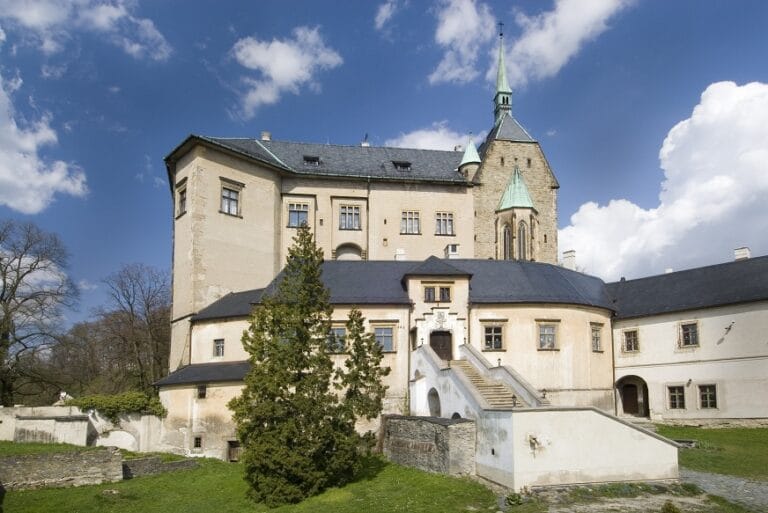
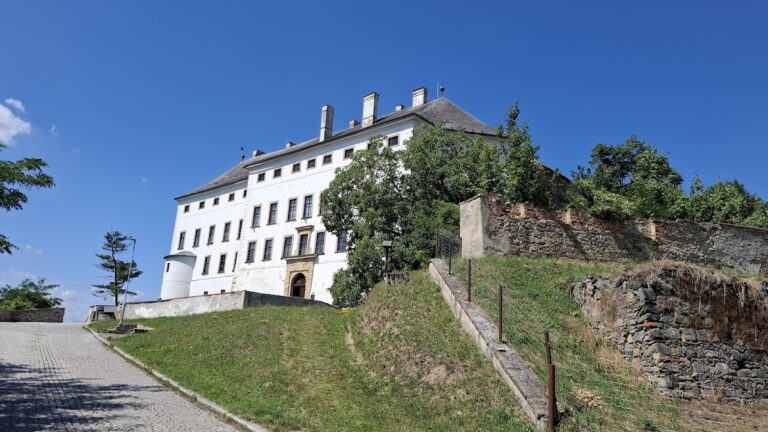
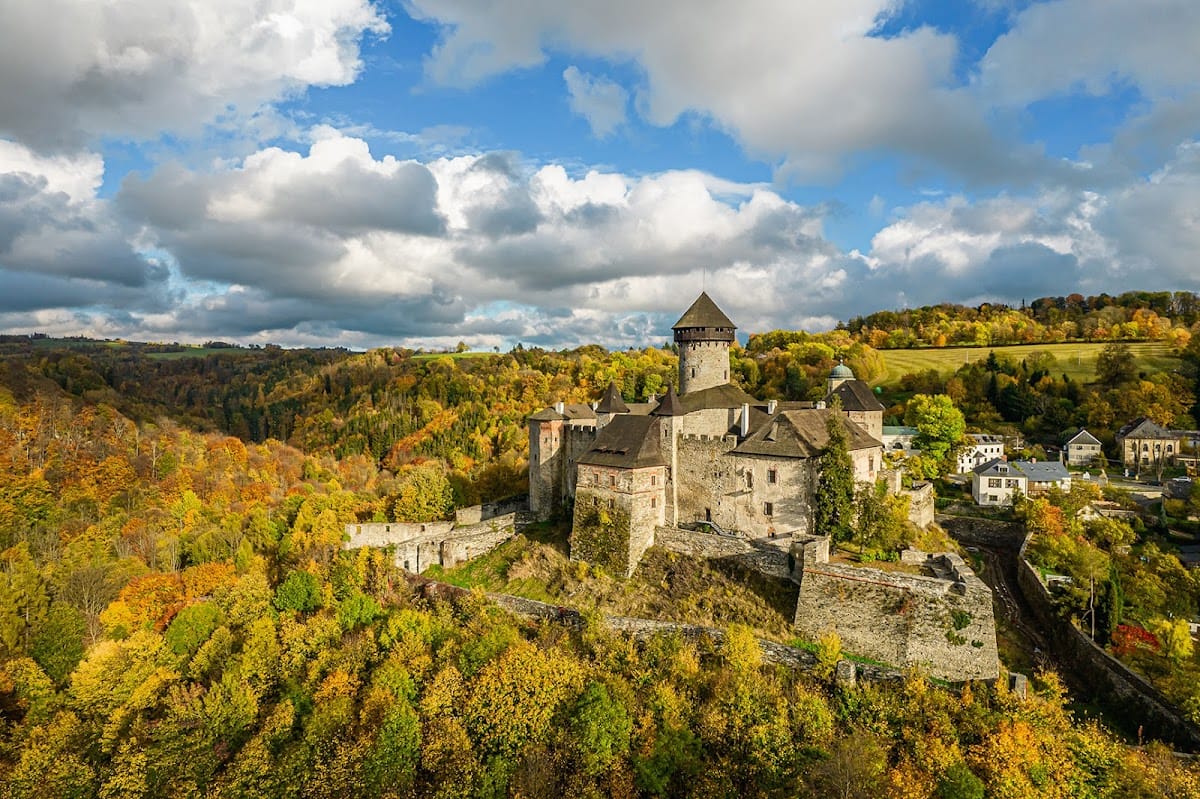
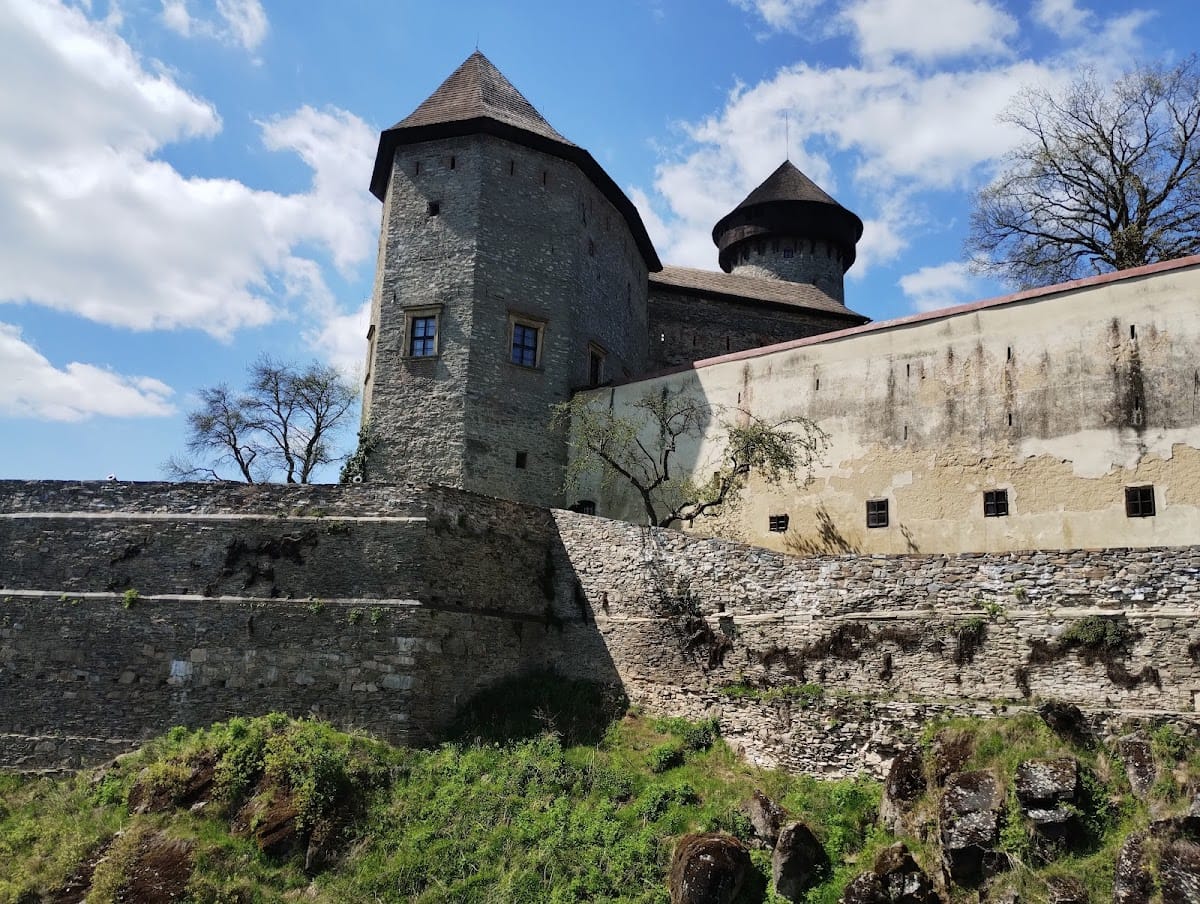
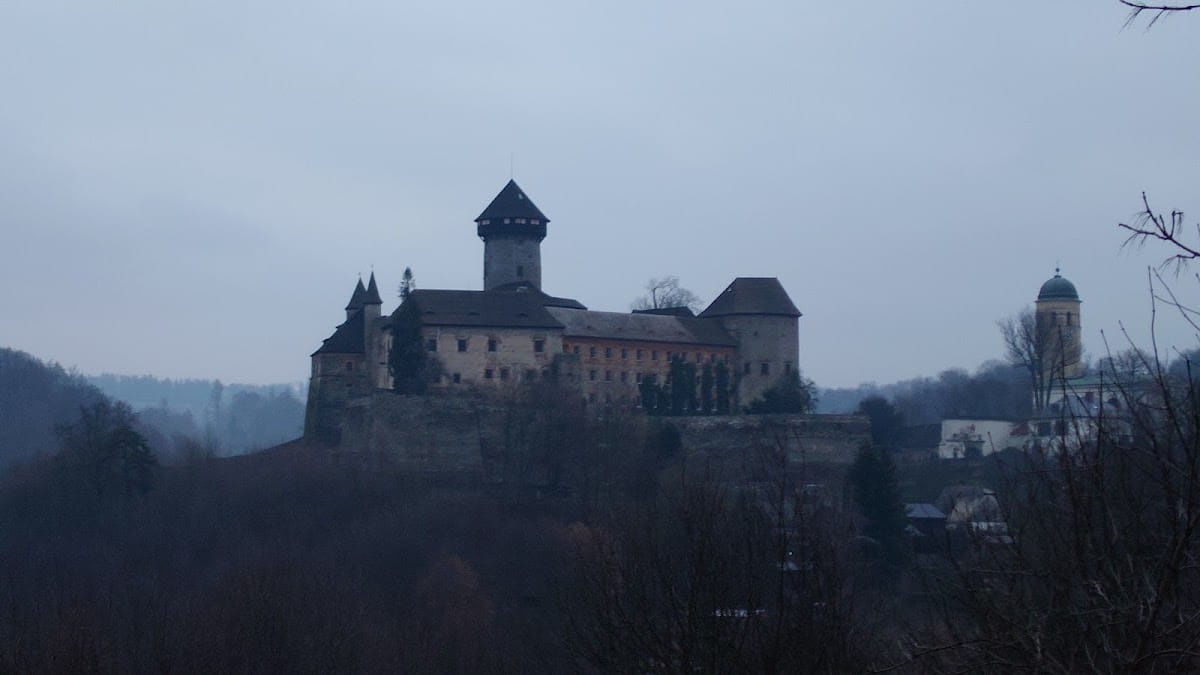
Sovinec occupies a cone-shaped hill and rocky spur above the village of Sovinec, approximately 14 kilometres south of Rýmařov in the Nízký Jeseník range. The earliest core stood on several rocks with steep slopes on every side. The original castle was small, with a long rocky plateau carrying a cylindrical bergfried, the principal defensive tower of a medieval Central European castle. It measured 9.1 metres across, and its walls were nearly 4 metres thick. The tower survives at a reduced height and size because its upper section was lowered after the fire of 1784.
During the late fifteenth and sixteenth centuries, the complex spread across lower rock terraces. Around the turn of the sixteenth century, under Ješek Pňovský, the inner-castle palace was enlarged and economic buildings were erected on both sides of the second courtyard. The oldest Gothic gate into the original castle carries the insignia of the lords of Sovinec. Late Gothic gate wings altered the central core, while another Gothic gate leads toward the inner palace in the fifth courtyard. Carved insignia associated with Ješek and Jan Pňovský survive on surrounding buildings.
Renaissance palaces and service buildings
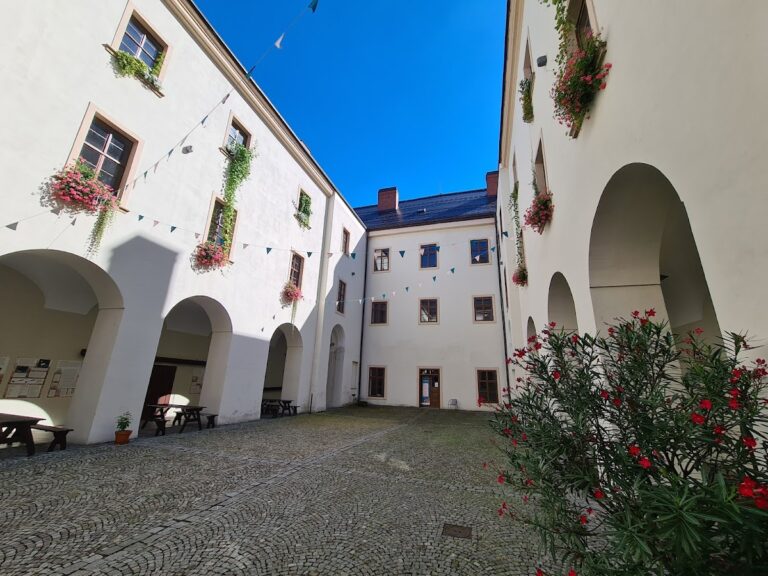
The southern and eastern sections were rebuilt in Renaissance forms during Kryštof of Boskovice’s ownership. The surviving portal of Boskovický Hall belongs to this phase, and the two palaces were constructed during the 1540s and 1550s. The southern palace originally had two storeys. Its lower level contained an armory hall that was later converted into a chapel, while the upper level held residential rooms known as the princely halls.
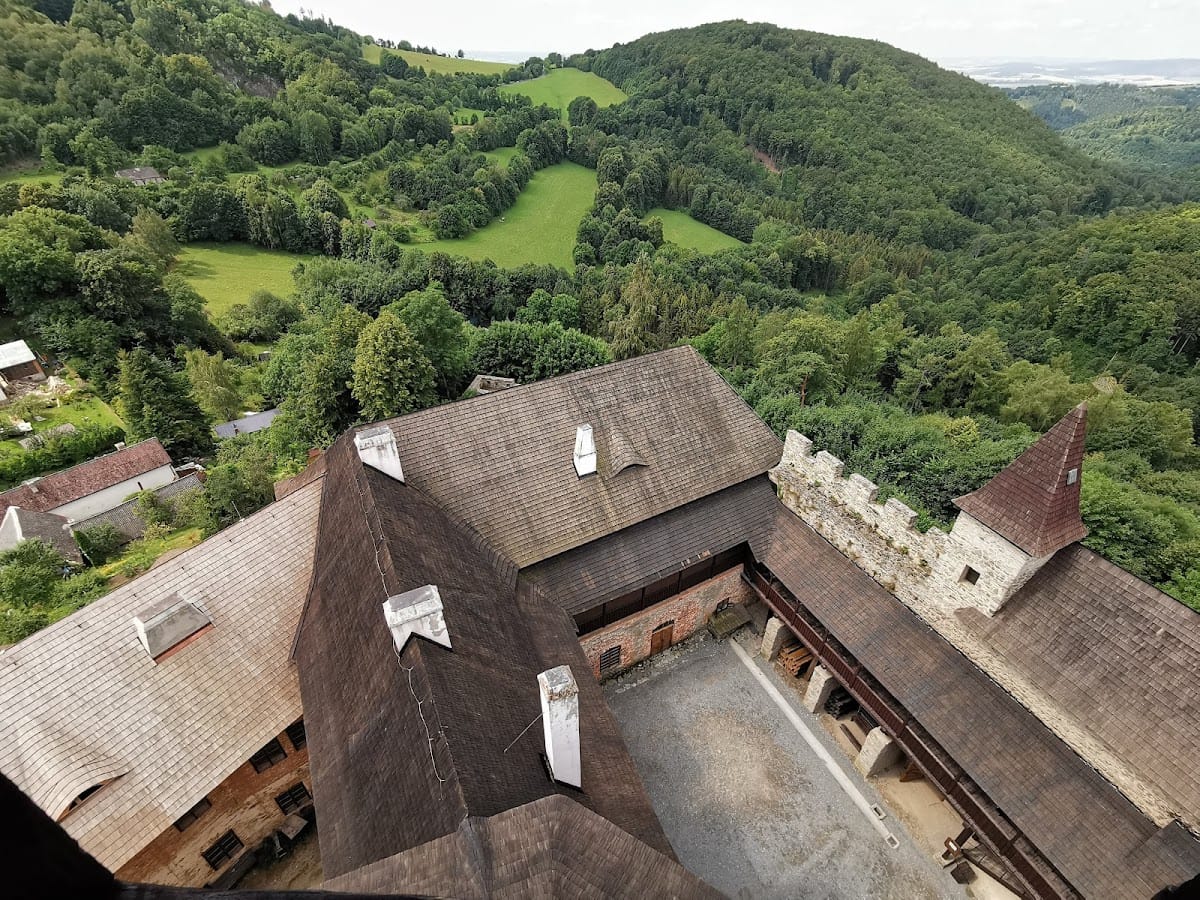
The new section was enclosed by a wall around a large rectangular courtyard. A wooden gallery originally ran around the first-floor perimeter. During the 1580s, Vavřinec Eder altered the palace interiors and added a service wing with two ornamental gates made from Maletín sandstone. A wine cellar was later established in the porter’s lodge, and a modern art gallery occupies part of the castle.
Seventeenth-century defenses
The fortifications were extensively strengthened between 1632 and 1643, in preparation for the military pressures of the Thirty Years’ War. Large internal courtyards were divided into smaller spaces, the outer walls were reinforced with palisades, and a massive iron-plated gate protected the entrance. A substantial eastern tower with projecting bastions was added, and the cellars were enlarged.
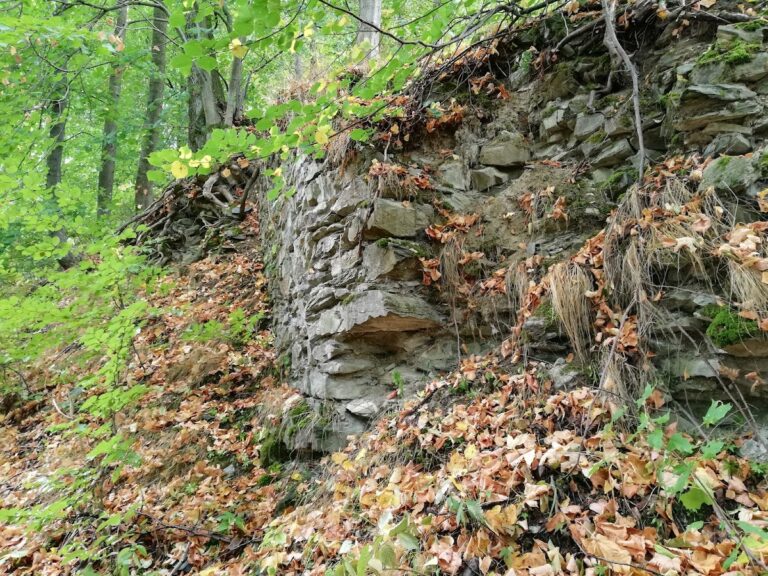
A large round stone tower known as Lichteinsteinka was linked to the castle by an underground passage that remains visible. The wartime defenses survive extensively, preserving the form of a major seventeenth-century fortified complex. Their condition reflects both the damage caused by the Swedish siege and the repairs undertaken by the Teutonic Order afterward.
Church and restored fabric
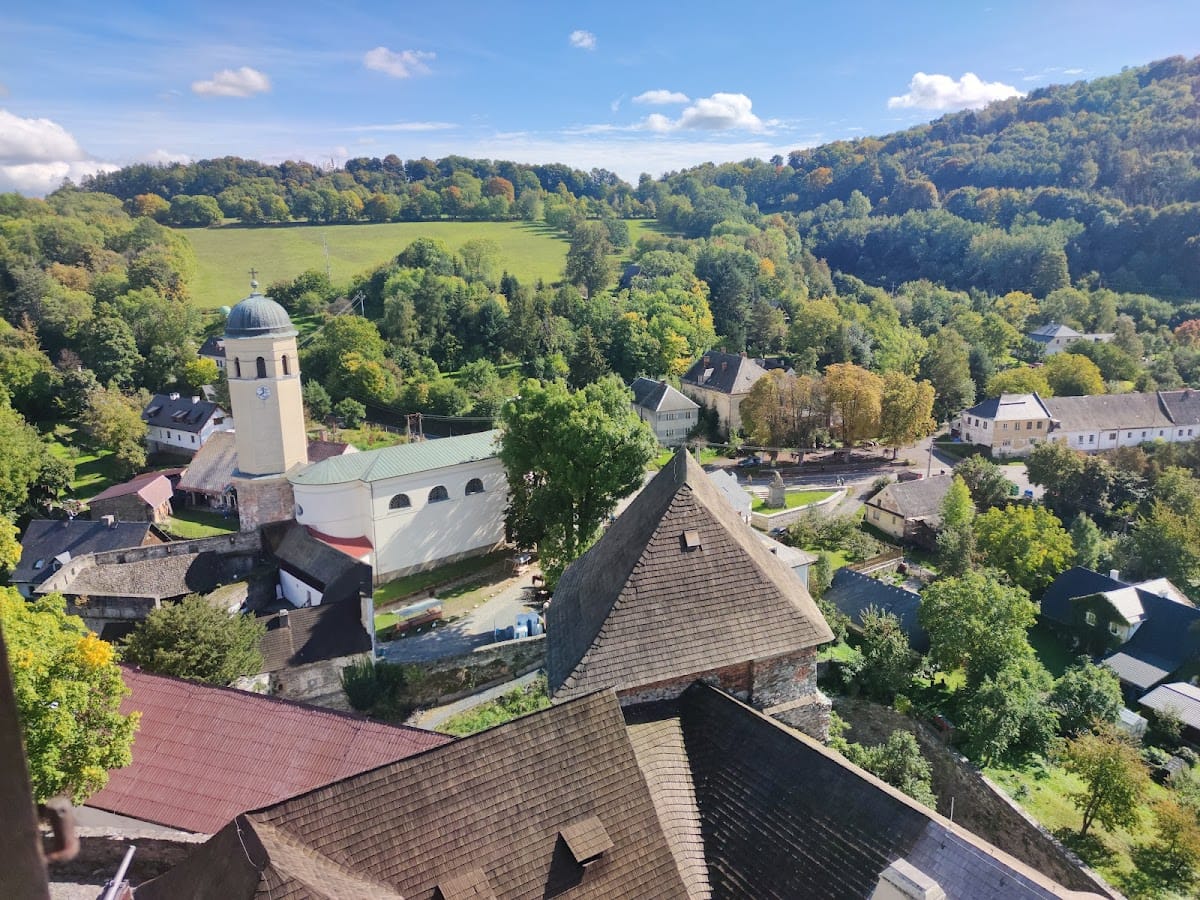
Part of the castle was demolished in 1844 and 1845 to make room for the late Empire-style Church of Saint Augustine in the southeastern part of the complex. Empire style was an early nineteenth-century architectural language derived from the French Empire period, using restrained classical forms and monumental proportions. An octagonal tower built during the Thirty Years’ War to protect the main gate was converted into the church tower. The church is regarded as one of the most valuable Empire-style buildings in Moravia.
The fires of 1784 and 1945 damaged or destroyed parts of the complex. Later restoration repaired the fronts of the entrance gates, the first and third courtyards, the southern wing, the watchtower, and several housing units. The castle-hall interiors remain subject to repair and restoration, while the surviving buildings preserve medieval, Renaissance, seventeenth-century military, and nineteenth-century architectural phases.
Nearby sites