Abbey of Santa Maria a Mare: A Medieval Monastic and Fortified Complex in Italy


Site at a Glance
- Rating
- 4.2
- Popularity
- Very Low
- Country
- Italy
- Primary era
- Medieval
- Eras represented
- Medieval
- Civilizations
- Kingdom of Naples
- Site type
- Religious
- Remains
- Fortified Monastery
On this page9 sections
History
The Abbey of Santa Maria a Mare is a Catholic church, monastery, and abbey on San Nicola Island in Italy. Its surviving church began in the eleventh century in the Adriatic Proto-Romanesque style, which combines transitional medieval forms with Byzantine and Mediterranean influences. The complex became a wealthy religious center, was repeatedly reshaped by changing monastic communities and military authorities, and later formed part of the island’s fortified settlement.
Early traditions and the Benedictine foundation
Traditions place the first church on San Nicola in the third century, or around AD 312. They attribute its foundation to a hermit who reached the island after the Virgin Mary appeared to him and instructed him to build a temple. The hermit is said to have discovered treasure in a burial place traditionally identified as the tomb of Diomedes, the Homeric hero, and to have used it to finance the construction.
A later form of the tradition says that the hermit found precious objects in a cave and sailed to Constantinople, where he obtained building materials and workers. After the chapel was completed, he encouraged devotion to the Virgin among fishermen, merchants, and others who sheltered in the archipelago. Other hermits then joined him. According to the same tradition, about six centuries later, elderly hermits were replaced by Benedictine monks with papal approval. Benedictines follow the monastic tradition founded on the Rule of Saint Benedict.
A Benedictine religious center existed in the Tremiti Islands during the ninth century as a dependency of the Abbey of Monte Cassino. Cardinal Leo Marsicanus recorded that a monk from Monte Cassino named Monecaus served as provost of a cell dedicated to Saint James during the abbacy of Bertharius, who governed Monte Cassino from 856 to 883. The charters cited by Leo have not survived. Relations were probably broken when Saracen forces sacked Monte Cassino in 883 and its monks went into exile for more than half a century.
Dedication, rebuilding, and independence
The monastery was initially dedicated to Saint James the Greater, one of the apostles of Jesus. Its association with the Virgin Mary developed during the early eleventh century. A document from November 1005 names the monastery of Blessed James the Apostle, while a document from 1014 refers to a church of Saint Mary and Saint James. The two dedications continued together in documents from 1026 to 1059. Saint James was omitted from a charter of 1023 and disappears from later records.
The community reached its greatest prosperity in the eleventh century under Abbot Adam. He sought papal recognition of the monastery’s independence from Monte Cassino at the Council of Melfi, expanded its possessions, and rebuilt the church. The rebuilt church was consecrated in 1045 by the bishop of Dragonara.
The monastery hosted Frederick of Lorraine, the future Pope Stephen IX, and Dauferius Epiphani, better known as Desiderius of Monte Cassino and later Pope Victor III. Between 1071 and 1073, Desiderius, supported by Robert Guiscard, the Norman ruler of southern Italy, tried to remove Abbot Ferrus and install Ungrellus. The attempt failed, and in 1081 Desiderius formally acknowledged Santa Maria’s independence.
Monte Cassino nevertheless continued to claim the complex for about a century. Papal privileges listed Tremiti as a Cassinese possession until the time of Pope Anastasius IV, and an imperial privilege issued by Lothair II in 1137 did the same. By the thirteenth century, the abbey held mainland properties from the Biferno area to Trani, together with lands in the Gargano, Terra di Bari, Capitanata, Molise, and Abruzzo. Chronicles connected tensions with Monte Cassino and contacts with Dalmatia, which the Holy See viewed unfavorably, with a decline in moral discipline.
Cistercian and Lateran phases
In 1237, Cardinal Raniero da Viterbo commissioned the bishop of Termoli to replace the Benedictines with Cistercians. The Cistercians were a reform movement within Western Benedictine monasticism. Pope Alexander IV confirmed the abbey’s possessions in a bull dated 22 April 1256.
Charles I of Anjou fortified the complex. In 1334, the Dalmatian corsair Almogavaro and his fleet plundered the abbey and killed its monks. This ended the Cistercian presence in the archipelago. The monks moved to the Abbey of Saint Agatha the Martyr between 1334 and 1343, and the Tremiti abbey was reduced to commendatory status during the same period. A commendatory abbey was administered nominally by an appointed abbot who might not live with or directly govern the monastic community.
In 1412, following apostolic pressure and the direct order of Pope Gregory XII, a community of Canons Regular from Santa Maria di Frigionaia in Lucca settled on San Nicola under Leone da Carrara. The canons, later known as Lateran canons from 1445, restored and enlarged the complex. They were clerics living under a canonical rule associated with the Lateran tradition. The community was governed by a prior, and its leader regained the rank of abbot in 1482.
Fortification, suppression, and later history
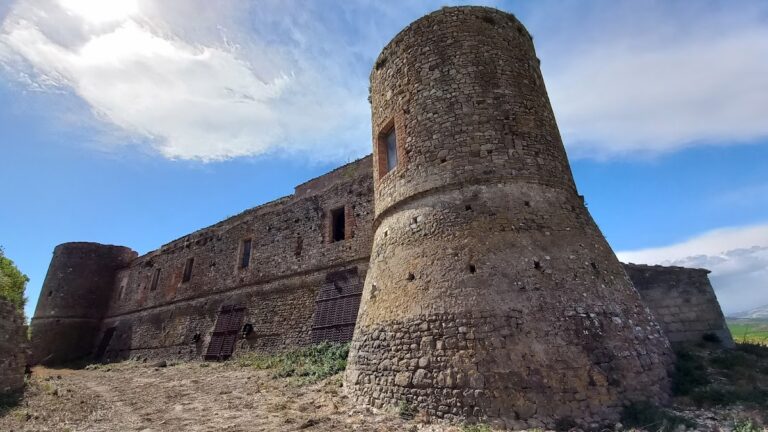
The abbey-fortress resisted an Ottoman fleet commanded by Piyale Pasha in 1566. Piyale Pasha was an Ottoman admiral and statesman. The complex was renovated during the sixteenth century, but declined again in the following century. The Kingdom of Naples occupied the Tremiti Islands in 1674, and the islands became part of the royal domain in 1737.
A royal decree suppressed the abbey in 1782. The following year, Ferdinand IV of Naples established a penal colony in the archipelago. During the Napoleonic period, Murattian forces occupied the islands and took shelter in the fortress of San Nicola, where they successfully resisted attacks by an English fleet. Cannon strikes from those attacks left holes in the abbey’s façade.
After the suppression, the monastic archives were transferred to the Archivio Grande in Naples. A fire destroyed them in 1943 during the Second World War, although the medieval cartulary survived and was published in 1960. A cartulary is a manuscript compilation preserving copies of an institution’s charters and other legal documents concerning its properties and rights.
Remains
Church and fortified complex
Church
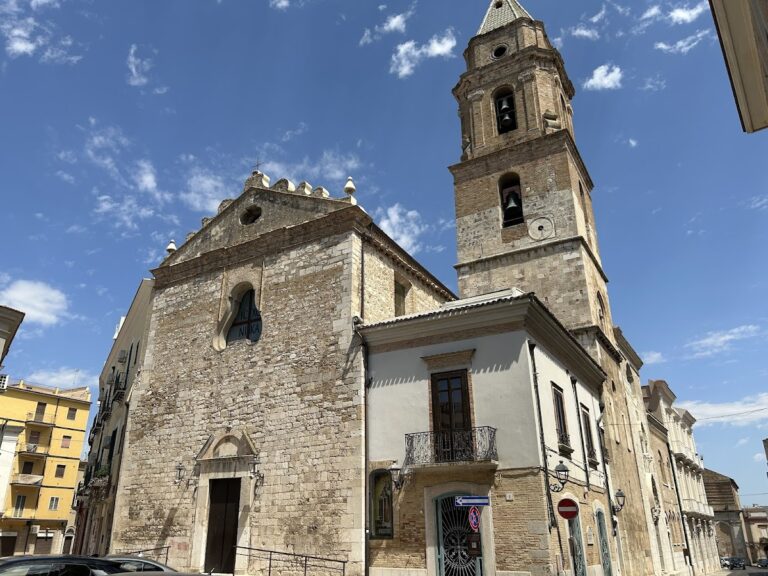
The church stands on San Nicola Island in the Tremiti archipelago, off the Gargano coast in the Adriatic Sea. Construction began in the eleventh century, and the building was completed and consecrated around 1045 during the rebuilding undertaken by Abbot Adam. Its architectural character is Adriatic Proto-Romanesque, a transitional medieval form shaped here by northwestern European traditions together with Byzantine and Mediterranean influences.
Fortress and water installations
The abbey is associated physically with San Nicola’s fortress and can be seen from the nearby island of San Domino. Charles I of Anjou added fortifications to the monastic complex, giving the religious center a military dimension that continued through later conflicts. The Lateran canons enlarged and restored the buildings after 1412 and constructed numerous functioning cisterns as part of the renewed complex.
The façade still bears visible holes caused by cannon fire during the English attacks of the Napoleonic period. These marks preserve evidence of the building’s later military history within the surviving abbey-fortress.