St Mary’s Church, Kersey: A Medieval Parish Church in Suffolk


Site at a Glance
- Rating
- 4.7
- Popularity
- Very Low
- Country
- United Kingdom
- Primary era
- Medieval
- Eras represented
- Medieval, Modern
- Civilizations
- British, English
- Site type
- Religious
- Remains
- Church
On this page8 sections
History
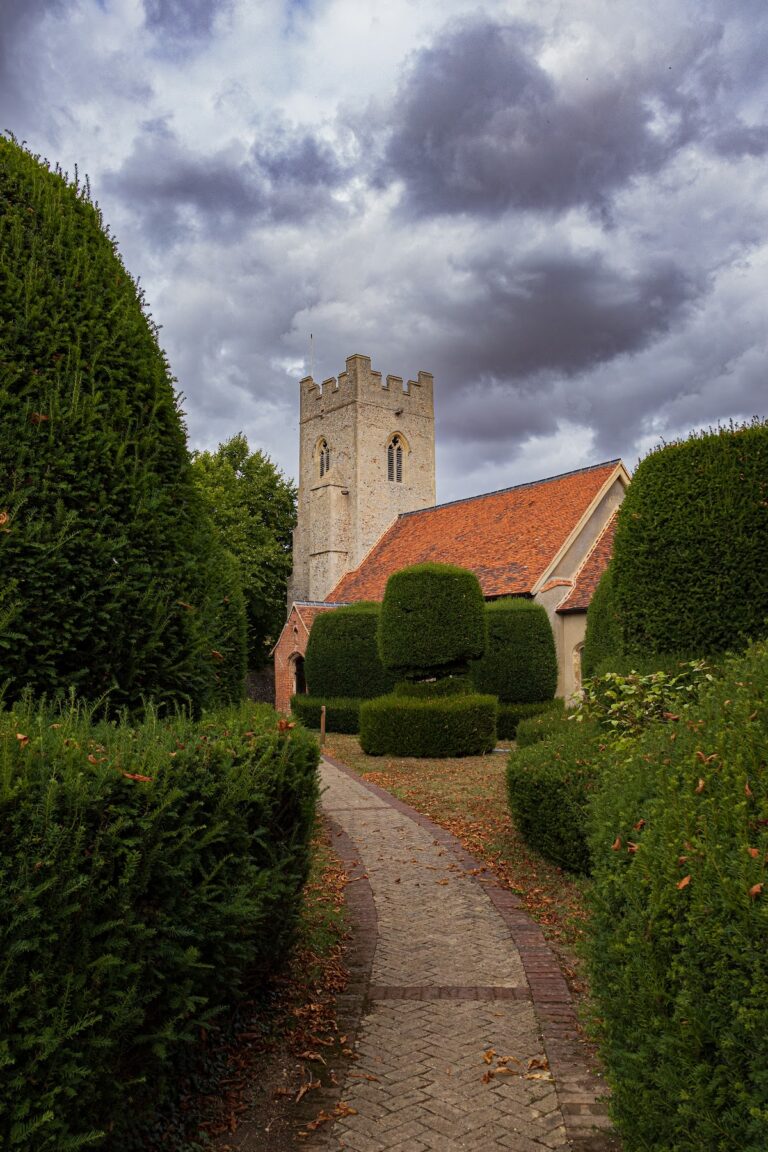
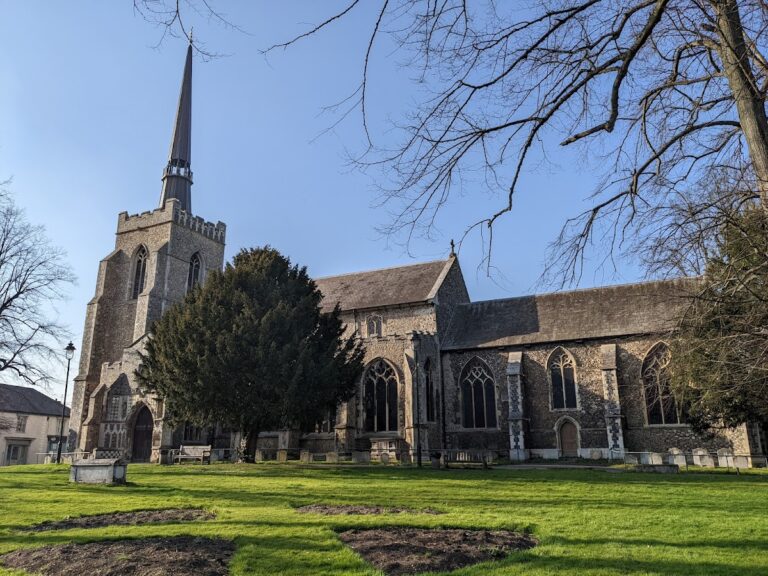
St Mary’s Church, Kersey is a Church of England parish church in Kersey, Suffolk, United Kingdom, with its oldest surviving parts dating from the twelfth century. The medieval church became an important pilgrimage site and is now a Grade I listed building. It belongs to the Diocese of St Edmundsbury and Ipswich, within the Church of England’s system of dioceses, archdeaconries, deaneries, and parishes, and forms part of a benefice, a shared ecclesiastical arrangement, with Aldham, Elmsett, Hintlesham, and Chattisham.
Medieval development and pilgrimage
A major rebuilding campaign appears to have begun with the north aisle. It was connected to the nave by an arcade and completed in 1335, while the foundations of the tower were laid at about the same time. Work on the tower was interrupted by the Black Death, the plague pandemic that reached England in 1348 and 1349 and caused extensive mortality. The tower was finally completed in 1481, followed by the addition of the north and south porches.
During the medieval period, the whole north aisle served as a shrine. It survived the dissolution programme associated with Henry VIII, whose break with the Roman Catholic Church led to the suppression of monasteries and other religious foundations in the sixteenth century. The shrine was destroyed around the time of the Civil War, but its memory continued to shape the church’s later history.
Later rebuilding and wartime history
King’s College, Cambridge, a constituent college of the University of Cambridge, rebuilt the chancel in 1862. A small vestry was added at the northeast corner. These changes formed part of the church’s later architectural development while the medieval tower, nave, aisles, and porches remained central to its character.
During the Second World War, the Royal Air Force placed two searchlights in the churchyard to illuminate the tower as a navigational reference point. A bomber returning from a raid on western Germany was attacked by a Messerschmitt Bf 109, a German fighter aircraft. After sustaining damage, the aircraft used the tower to establish its position before landing at a nearby airfield. The rear gunner, Mick McGoven, died in the fire, while the flight engineer, Leading Aircraftman Dougie Vince, a junior non-commissioned Royal Air Force rank, suffered severe burns to his hand. The incident gave the church the nickname “the Thank God Church.”
The shrine was re-hallowed on 8 March 2020 in the presence of Dougie Vince. The event connected the church’s medieval pilgrimage associations with the remembrance of its wartime story.
Remains
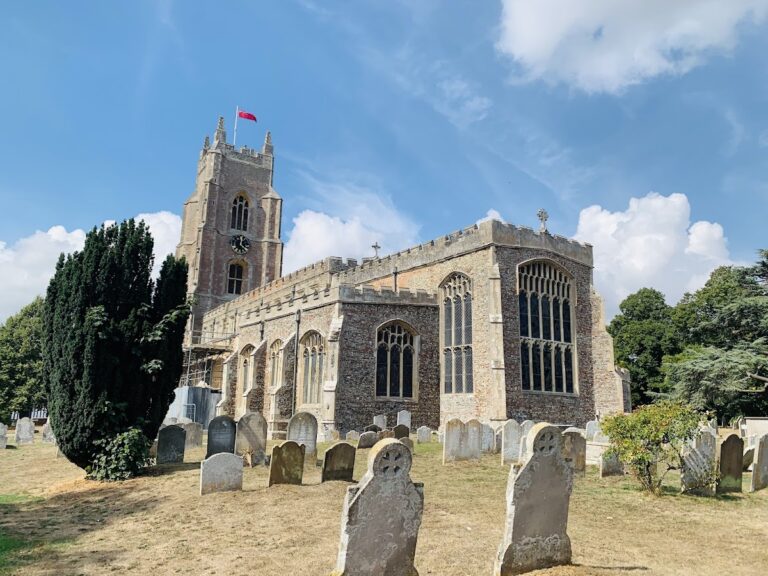
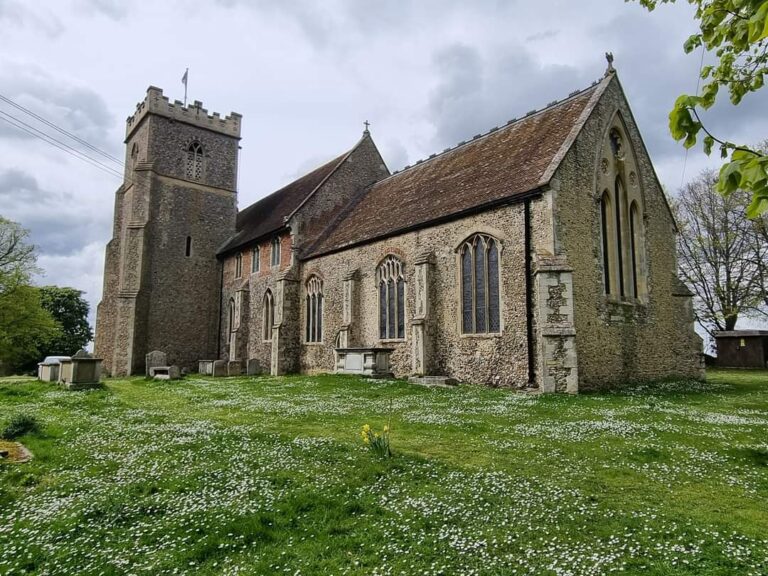
St Mary’s stands on high ground south of the village and is constructed from flint and stone. Its tower, nave, and chancel are set unusually offset from one another. The surviving buildings combine medieval structural work, later additions, and interior furnishings that preserve evidence of the church’s changing use over several centuries.
Tower, aisles, and porches
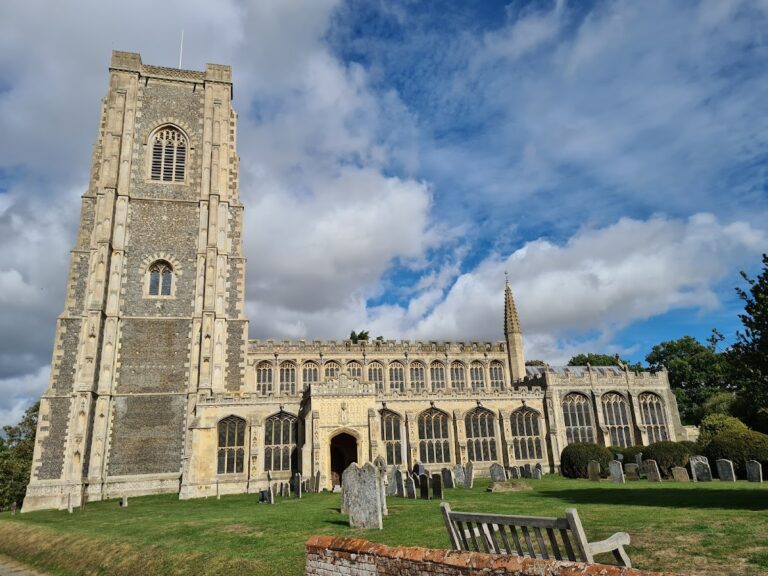
The four-stage tower has diagonal buttresses, a castellated parapet shaped with battlements, and patterned flint chequerwork. An octagonal stair turret rises against it. The two-bay south porch has buttresses that terminate in crocketted pinnacles, pointed architectural finials decorated with projecting ornament. The north porch follows a similar design but is less elaborate. Weddings and funerals enter through the fifteenth-century west doors. The tower contains eight bells.
Roofs and interior fabric
The interior ceiling contains moulded and carved beams with carved panels. In the nave, the roof has hammer beams alternating with tie beams, horizontal members connecting the sides of the roof. Arched braces rise from the hammer beams and meet at the centre, creating the principal visible pattern of the nave roof. The north aisle also contains a defaced stone-carved frieze.
Fonts, screens, and medieval furnishings
Two baptismal fonts survive inside the church, one dating from the twelfth century and the other from the fifteenth. The church also retains a fifteenth-century lectern and chancel screen. A small section of the medieval rood screen survives. A rood screen is an internal division between the nave and chancel that traditionally supported or accompanied a representation of the Crucifixion. The surviving section was recovered from a local farm and restored, and its panels show saints and kings, including Edmund the Martyr, the ninth-century king of East Anglia who was venerated as a Christian martyr.
Organ and community book crossing
The church has a two-manual pipe organ made by Bishop & Son of Ipswich and London. It was moved in 2012 and 2013 to create space for kitchen and toilet facilities at the west end of the north aisle. The tower also houses a community book crossing with more than one hundred books. It was used extensively during the COVID-19 period and is valued by the local community.