Blagoveschensky Monastery (Kirzhach): A Russian Orthodox Monastic Complex


Site at a Glance
- Rating
- 4.8
- Popularity
- Low
- Country
- Russia
- Primary era
- Early Modern
- External website
- Open
- Eras represented
- Early Modern, Modern
- Civilizations
- Russian
- Site type
- Religious
- Remains
- Monastery
On this page11 sections
History
Blagoveschensky Monastery (Kirzhach) is a Russian Orthodox women’s monastery in Russia, founded in 1358 by Sergius of Radonezh. Its surviving historic core includes buildings from the early sixteenth century, the period when Moscow architectural forms were developing under Ivan the Great, the grand prince of Moscow from 1462 to 1505. The monastery originally belonged to the Trinity-Sergius Lavra, a major center of Russian Orthodox monastic life near Moscow.
Foundation and early leadership
According to the foundation tradition preserved in the chronicles of the Trinity-Sergius Lavra, Sergius left the Trinity Monastery in 1358 to establish a new religious community. Travelling with the monk Simon, he settled on the high left bank of the Kirzhach River. His disciples built monastic cells and a wooden church dedicated to the Annunciation of the Virgin.
Sergius remained at Kirzhach for four years before returning to the Trinity Monastery. He left the hieromonk Roman of Kirzhach, his disciple, as abbot. Roman directed the development of the monastery until his death in 1392 and is regarded as its first abbot. He was later canonized.
Church building and the Miloslavsky foundation
The original wooden Annunciation church was replaced by a stone building in the sixteenth century. A refectory church dedicated to Sergius of Radonezh was also established during that period. The Annunciation Cathedral belongs to the early Moscow architectural tradition associated with the reign of Ivan the Great and is regarded as one of its last and most representative examples.
In 1656, the boyar Ivan Andreyevich Miloslavsky financed the construction of the Church of the Savior behind the altar of the Annunciation church. Built above the graves of his parents, it became the Miloslavsky family burial church.
Parish period and nineteenth-century additions
Catherine II’s secularization of church properties dissolved the monastery in 1764. Its property passed to the Trinity-Sergius Lavra, while the monastic brethren were transferred partly to the Lavra and partly to other monasteries. The former monastery then became the Annunciation parish.
During the middle of the nineteenth century, Alexander Petrovich Soloviev, regarded as the founder of Kirzhach’s silk industry, worked on the wall paintings of the parish churches. His sons, Peter and Alexander, financed the Church of All Saints, built between 1864 and 1869.
Soviet disruption and revival
The monastery ceased to function during the Soviet period. The Church of Sergius of Radonezh was blown up between 1932 and 1934. During the Second World War, the Annunciation Cathedral was used for ammunition storage and at different times housed a sausage workshop and a kerosene shop. The Church of All Saints was used as the city bakery.
The Annunciation and Savior churches were returned to the Russian Orthodox Church in 1990. In July 1995, the monastery resumed activity as a women’s religious community by decree of Evlogy, Archbishop of Vladimir and Suzdal. In 1997, a reliquary containing the relics of Roman of Kirzhach was installed in the basement level of the Annunciation Cathedral. Patriarch Alexy II of Moscow and All Rus’ took part in the services marking the discovery of the relics.
Blagoveschensky Monastery is an operating religious community belonging to the Aleksandrov Eparchy. It is also a federally significant cultural-heritage site of the peoples of the Russian Federation. The listed abbess is Theodora (Trubach).
Remains
Historic church ensemble
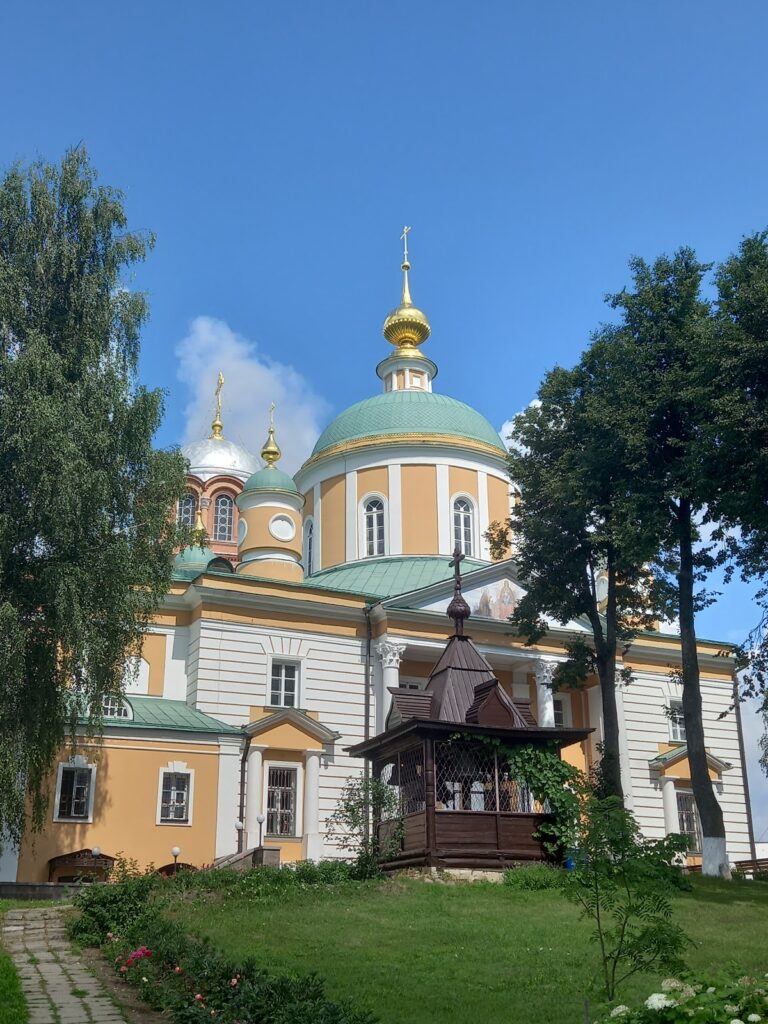
The surviving historic core is formed by the Annunciation Cathedral and the Church of the Savior, with the Church of All Saints standing beside the older buildings. An open gallery, or raised passage, connects the Savior church with the cathedral and unites the two principal ancient structures into a single architectural composition. The medieval monastery was enclosed by a stone boundary, and a chapel over a well stood on its northern side. Tradition holds that Sergius of Radonezh dug the well.
Annunciation Cathedral
The Annunciation Cathedral is a four-pillared, single-domed church whose upper structure rises in a stepped pyramid of kokoshniks, Russian gable-like decorative elements arranged in tiers. Its interior contains a system of arches and stepped vaults. The exact construction date is unknown, but its architectural forms place it at the beginning of the sixteenth century. The building follows the early Moscow cathedral style that developed during Ivan the Great’s reign.
The cathedral also contains the basement-level reliquary holding the relics of Roman of Kirzhach. This placement connects the surviving building with the monastery’s earliest leadership and its continuing religious function.
Church of the Savior
Built in 1656 as the Miloslavsky family burial church, the Church of the Savior has a restrained form appropriate to that purpose. Its main structure is a plainly defined quadrangular volume standing on a podklet, or supporting lower level. Above it rises a bell tower with a steep tent-shaped roof rather than a conventional dome. The open gallery linking the church to the Annunciation Cathedral forms part of the complex’s unified layout.
Church of All Saints
The Church of All Saints was constructed between 1864 and 1869 in the Russian style. Its most prominent architectural feature is a tall bell tower arranged in six tiers. The church stands beside the older cathedral and Savior church, adding a nineteenth-century building to the historic ensemble.
Medieval enclosure and well chapel
A stone enclosure surrounded the monastery in the Middle Ages. On the northern side, a chapel was built over a well traditionally associated with Sergius of Radonezh, who was said to have dug it. The enclosure and chapel formed part of the monastery’s historic setting around its churches.