Sant’Elena: A Gothic Parish Church in Venice


Site at a Glance
- Rating
- 4.5
- Popularity
- Low
- Country
- Italy
- Primary era
- Medieval
- External website
- Open
- Eras represented
- Medieval, Early Modern, Modern
- Civilizations
- Italian, Venetian
- Site type
- Religious
- Remains
- Church
On this page13 sections
History
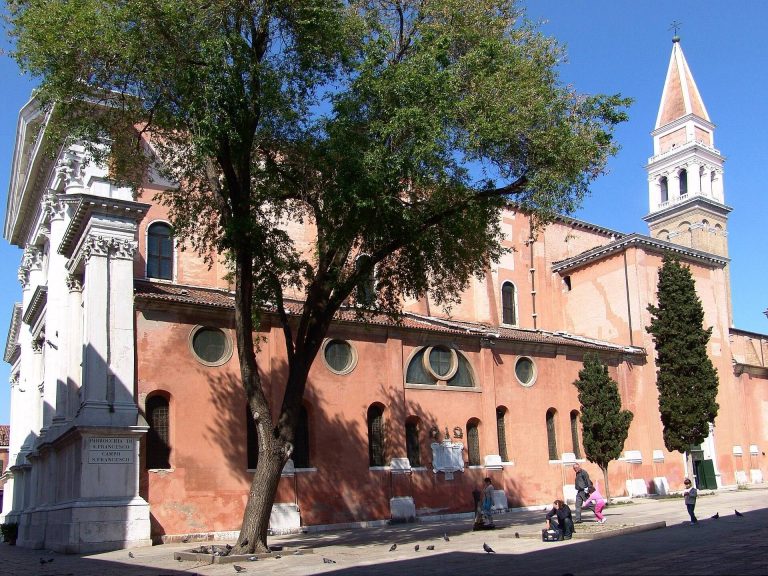
Sant’Elena is a Roman Catholic parish church in Venice, Italy, dedicated to Saint Helena. Its present Gothic brick building was rebuilt after 1407 and completed in 1439, although worship at the site began with a chapel founded in 1028. The church stands on the island of Sant’Elena at the eastern end of the Castello district and remains an active parish church.
Augustinian Foundation
The first chapel dedicated to Saint Helena was built in 1028 and entrusted to Augustinian religious, who established a monastery beside it. By 1175 or 1176, the island contained both a monastery and a hospice for pilgrims travelling to the Holy Land. The Augustinians later incorporated the original chapel into a larger church.
In 1205, Doge Pietro Ziani, the elected head of the Venetian Republic, ordered a new church on the site. Tradition holds that in 1211 the Augustinian canon Aicardo brought the purported body of Saint Helena from Constantinople to Venice. A chapel for the relics was subsequently incorporated into the church. Saint Helena, the mother of the Roman emperor Constantine the Great and a figure traditionally associated with the discovery of the True Cross, gave the church its devotional identity and pilgrimage importance.
Olivetan Rebuilding
By 1407, the monastic complex had declined. A papal bull then transferred it to Benedictine-Olivetan monks, members of a reform congregation founded at Monte Oliveto. The church was rebuilt after the transfer under the design of Giacomo Celega, assisted by Bartolomeo Tesenata, and the work was completed in 1439.
The church was consecrated in 1515 by the bishop of Aleppo. It developed into an important religious centre with extensive property and a substantial collection of artworks. From 1684, part of the monastery and adjoining land was used by the Venetian Republic to bake bread for naval vessels.
Sant’Elena was also linked to the Venetian Ascension ceremony known as the Festa della Sensa. In this ritual, the patriarch travelled by gondola to Sant’Elena, where the Olivetan monks and their abbot received him and blessed water. The water was then carried to the Lido for the symbolic marriage of Venice to the sea.
Suppression and Revival
Napoleonic suppressions brought the closure of the church and monastery in 1807. Under Napoleonic rule, the church was deconsecrated, the monastery was partly demolished and converted into storage, and the church was first used as a granary and later as a warehouse for the Royal Navy. It subsequently fell into ruin. One hundred and two paintings were removed, while the purported remains of Saint Helena were transferred to the Basilica of San Pietro di Castello.
The church was rebuilt in 1915 and reopened for worship in 1928 under the care of the Servite Order, a Catholic order devoted particularly to the Virgin Mary. It was reconsecrated in 1929, when the urn associated with Saint Helena was returned and the original portal was replaced. After 88 years of administering the parish, the Servites transferred responsibility to the Salesians in October 2016.
The church and adjoining monastery are owned by the Municipality of Venice. Restoration and recovery works have included the partial reconstruction of the convent complex and its reconnection with the church. The complex is now associated with an international peace centre devoted to study and research, while other rooms serve catechetical and cultural purposes.
A local legend explains why Saint Helena’s relics remained on the island of Olivolo, now San Pietro di Castello. According to the story, the ship carrying the urn repeatedly ran aground nearby and became free only when the urn was taken ashore. The sailors therefore left the relics on the island and continued to Venice.
Remains
Sant’Elena survives as a single-nave Gothic church built of brick, with a narrow gabled facade and an adjoining former Olivetan convent. The complex combines medieval fabric, Renaissance sculpture, twentieth-century rebuilding, and surviving interior works. Its spaces include the nave, three side chapels, a polygonal apse, a later bell tower, and the partly reconstructed convent around a cloister.
Church Exterior
Facade and Portal
The narrow facade has strong corner pilasters, hanging trilobed arches, Gothic mullioned windows, and a central polychrome rose window. Its Renaissance entrance portal dates from 1467. During the Napoleonic period, the portal was transferred to the facade of Sant’Aponal, restored in 2002, and returned to Sant’Elena in 1929.
The portal incorporates a monument to the Venetian admiral Vettore Cappello, who is shown kneeling before Saint Helena. The sculpture is attributed to Niccolò di Giovanni Fiorentino and was formerly attributed to Antonio Rizzo. Fluted columns on high bases support an entablature and archivolt decorated with Renaissance mouldings. Above them, a coffered ceiling carries rosette motifs.
Bell Tower
The original campanile, or bell tower, was built in 1558 and demolished after the church was deconsecrated. A replacement was constructed during the 1950s and completed in 1958. Rising 52 metres, it has six electromechanically operated bells arranged in a diatonic B-major scale. The Colbachini foundry of Padua cast the bells, which were consecrated by Patriarch Roncalli, later Pope John XXIII. A separate call bell was cast by the Cavadini foundry of Verona.
Interior and Chapels
Nave and Apse
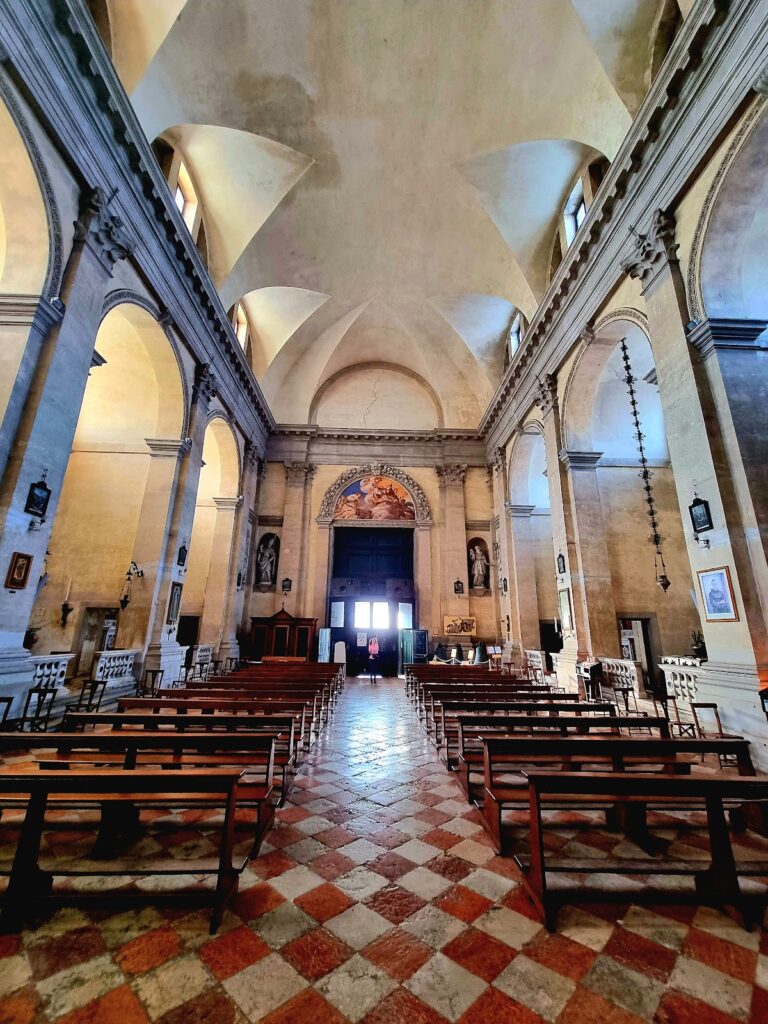
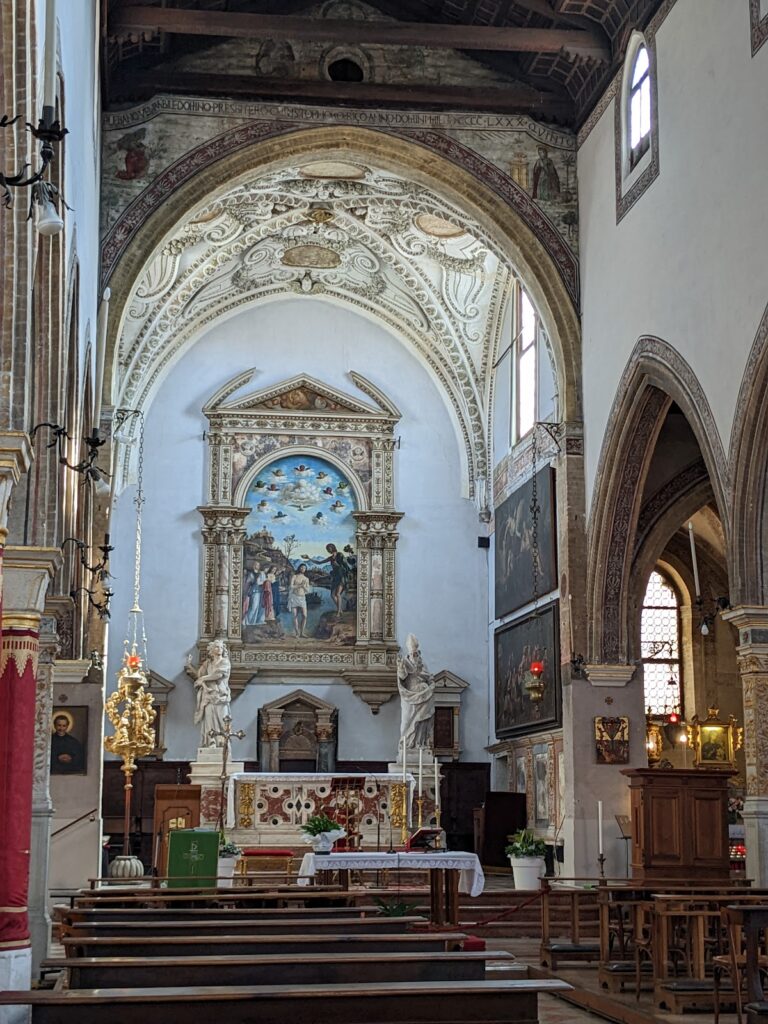
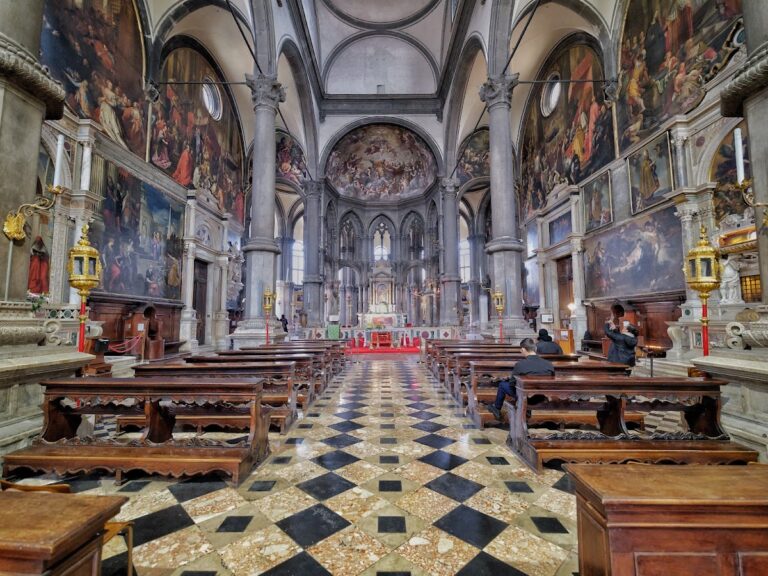
The interior is arranged around a single nave with cross vaults, original carved wooden twisted tie rods supported by corbels, and a small dome. At the eastern end, the polygonal apse has two superimposed rows of Gothic mullioned windows. These windows were remade in the twentieth century.
Side Chapels
Three chapels adjoin the nave, with one on the left and two on the right. The first chapel on the right is dedicated to Saint Helena and contains the urn associated with her remains. The other right-hand chapel was built by the Giustinian family, serves as the sacristy, and is dedicated to the Crucifix. One of the chapels was built between 1418 and 1420.
Altarpiece and Paintings
The high altar is a replica of the Neogothic altar in the Church of the Seven Holy Founders of the Servite Order in Florence. The original high-altarpiece, Jacopo Palma the Elder’s Adoration of the Magi with Saint Helena, was stolen during the Napoleonic period and is now in the Pinacoteca di Brera in Milan. Paintings by Antonio da Firenze, Paolo Piazza, and Marco Vecellio remain associated with the interior.
Other works removed after the 1807 suppression include Jacopo Moranzone’s polyptych of the Assumption of the Virgin with Saints Helena, John the Baptist, Benedict, and Elizabeth; Lazzaro Bastiani’s Nativity; and Michele di Matteo’s Polyptych of Saint Helena. These works are now in the Gallerie dell’Accademia.
Former Olivetan Convent
The surviving parts of the former Olivetan convent include fifteenth-century wings adjoining the cloister on three sides. The wings have round-headed arches, while a loggia beside the church has architraves. An eighteenth-century well head stands at the centre of the cloister. The partly reconstructed complex contains rooms used for peace studies, exhibitions, catechesis, and related cultural activities.