Basilica of Santa Maria a Pugliano: Mother Church of Ercolano

Site at a Glance
- Rating
- 4.6
- Popularity
- Low
- Country
- Italy
- Primary era
- Early Modern
- External website
- Open
- Eras represented
- Medieval, Early Modern, Modern
- Civilizations
- Italian, Kingdom of Naples, Kingdom of the Two Sicilies, Spanish
- Site type
- Religious
- Remains
- Basilica
On this page11 sections
History
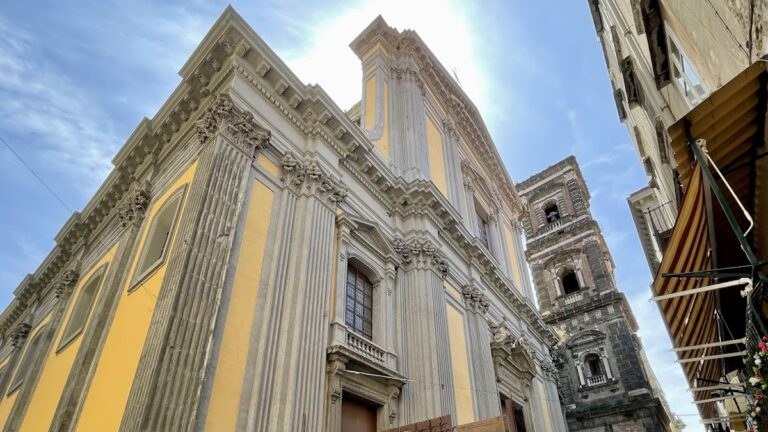
The Basilica of Santa Maria a Pugliano is a Roman Catholic church in Ercolano, Italy, whose history reaches back to an eleventh-century Marian sanctuary. Regarded as the oldest church in the city and the surrounding area of Mount Vesuvius, it is the mother church of Ercolano, belongs to the Archdiocese of Naples, and has been raised to the rank of basilica. Its present interior is largely late Baroque, although the building has been altered repeatedly, including major changes through 1935.
Origins and Medieval Connections
An oratory dedicated to the Virgin Mary stood on Pugliano Hill by the eleventh century. The name Pugliano is probably derived from praedium pollianum, a suburban estate associated with ancient Herculaneum and with a person named Pollio or Pollione.
A bequest made in 1076 by a Neapolitan noblewoman to “S. Maria at Pugnanum” provides early evidence of the church’s existence and reputation. At that time, the church depended on the monastery of San Sebastiano in Naples. An inscription recalls Giovanni, son of Guaimaro V, a medieval prince of Salerno. Giovanni took religious vows at the monastery and became its abbot in 1097, linking the sanctuary to an important ecclesiastical institution in the region.
Municipal Administration and Pilgrimage
After the municipality of Resina was established, responsibility for administering the sanctuary passed from San Sebastiano to the civic community. The municipality exercised this role through the Estaurita, an administrative body governed by formal statutes.
The sanctuary’s cult expanded considerably during the sixteenth century, drawing pilgrims from settlements across the Vesuvian area. It was first recorded as a pontifical basilica in 1574 and became the parish church of Resina and Portici in 1576. Its spiritual jurisdiction extended from Mount Vesuvius to the sea and from Torre del Greco to San Giovanni a Teduccio. Portici received an independent parish in 1627.
Pope Gregory XIII confirmed the sanctuary’s plenary indulgences in a bull dated 13 June 1579. A plenary indulgence was a Catholic remission of temporal punishment associated with sins whose guilt had already been forgiven, traditionally granted under specified religious conditions. At Santa Maria a Pugliano, the indulgences applied to pilgrims who prayed there on the first Friday of March, Easter Day, or 15 August.
Sixteenth- and Seventeenth-Century Transformation
Major enlargement and embellishment works took place during the second half of the sixteenth century. The church survived the eruption of Mount Vesuvius in 1631 because the lava divided upstream of Pugliano Hill. One branch devastated much of Portici, while another filled the valley east of Resina.
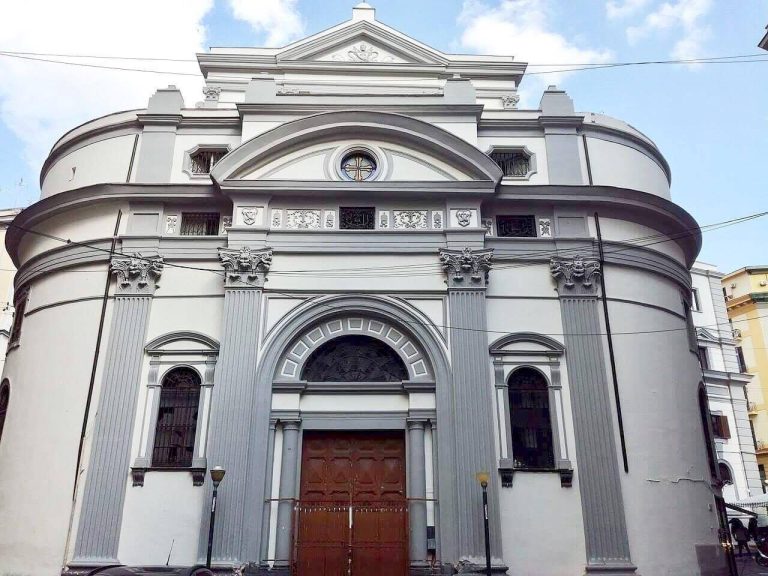
Once the lava had solidified, a broad and direct road to the sanctuary was constructed during the second half of the seventeenth century. The new approach contributed to a major transformation of the basilica. Its orientation was rotated, and a new facade was built beside the bell tower, facing Via Pugliano.
The Terra Santa cemetery was established beside the church after these alterations, on the side facing Via Trentola. It became Resina’s first cemetery and remained in regular use until 1906, when a new cemetery was created uphill. It was among the last Italian cemeteries situated within a city perimeter.
Marian Devotion and Local Religious Institutions
The sanctuary originally venerated Madonna di Ampellone, or Madonna of the Vines, a title connected with the vineyards surrounding Pugliano Hill. By the fourteenth century, devotion to Madonna delle Grazie, also called Madonna di Pugliano, had become established. The wooden statue was produced during the period when French artistic taste spread through the Angevin court of Naples, the royal court of the dynasty that ruled the Kingdom of Naples.
Although the image represents Madonna delle Grazie, the statue is also venerated as the Assumption of the Virgin. The Assumption is the Christian belief and feast commemorating the bodily taking of Mary into heaven. The principal patronal festival takes place on 15 August, the feast of the Assumption and one of the dates associated with the basilica’s plenary indulgence.
The Royal Archconfraternity of the Most Holy Trinity stands beside the basilica. Founded in the fifteenth century, it was a lay religious association concerned with shared worship, charitable activity, and the maintenance of a religious institution. Ferdinand II of Bourbon granted it the title of archconfraternity in 1850 because it was the oldest confraternity of Resina, the former name of Ercolano. Pope Pius IX confirmed the title in 1851.
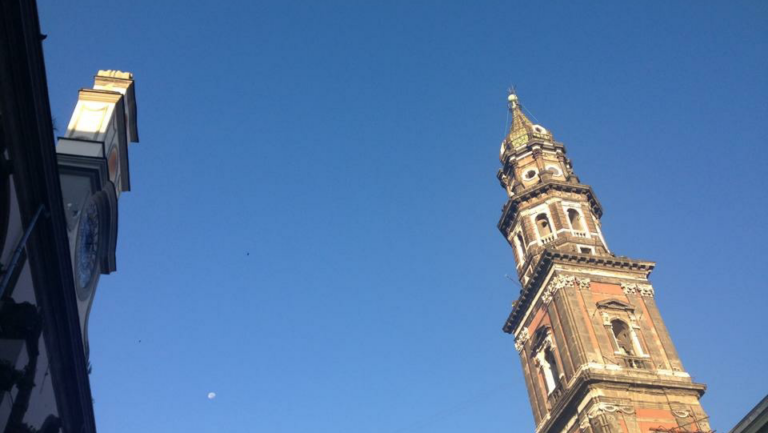
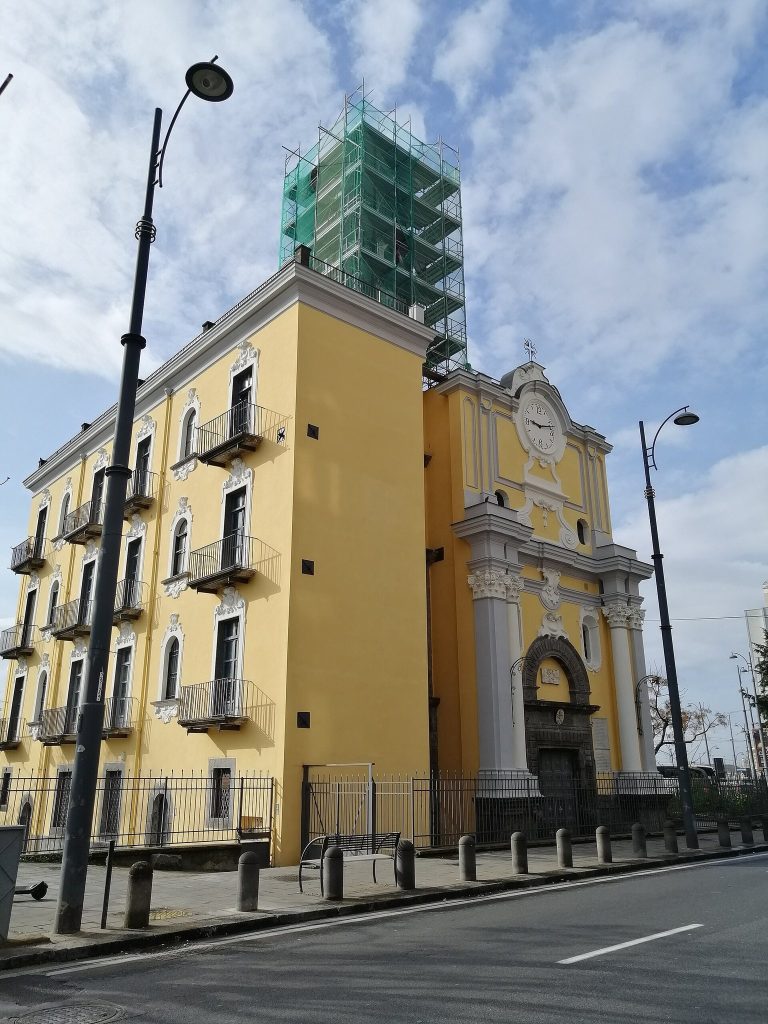
A chapel for the Royal Archconfraternity was built beside the bell tower in 1843. In 1860, the outermost arch was walled up to form a two-story tower. A clock was later installed there, and gates were added to the three arches between the bell tower and the new tower.
Pope Pius IX visited the basilica on 18 October 1849 while in exile at Portici. The statue of Madonna delle Grazie was solemnly crowned in 1875. Another important local devotion concerns the wooden statue of Saint Januarius, the patron saint of Naples and a figure associated with protection from volcanic danger in the region. During eruptions of Mount Vesuvius, it was traditionally carried in procession toward the advancing lava.
Remains
The basilica occupies Piazza Santa Maria a Pugliano alongside its bell tower and the church of the Royal Archconfraternity of the Most Holy Trinity. The earliest sanctuary was probably aligned from east to west, while the present building runs from north to south. This interpretation is based on the former access route and the later changes to the church. A sixteenth-century marble portal, now blocked, survives along the line of the route from Via Trentola and may have served as the principal entrance to the earliest building.
The Basilica
Plan and Exterior
The church has a Latin-cross plan, meaning that a long central axis is crossed by a shorter transept, and it contains three naves with an asymmetrical transept. The later facade beside the bell tower includes a portico with four arches. Two domes covered in maiolica, a brightly colored tin-glazed earthenware, formed part of the major embellishment campaign of the later sixteenth century, together with several portals and the bell tower.
Historic Furnishings and Art
Two pagan marble sarcophagi from the second and fourth centuries AD were adapted as Christian altars, probably during the eleventh century. Their marble slabs remain among the church’s historic furnishings. Two holy-water stoups were made from Roman-period basins and adapted for Christian use in 1584.
The wooden Madonna delle Grazie, or Madonna di Pugliano, shows Mary seated on a throne while nursing the Christ Child. It and the Black Crucifix date from the first half of the fourteenth century. The baptismal font dates from 1425 and is described as one of the oldest outside Naples Cathedral. The high altar was made at the end of the sixteenth century.
A wooden bust of Saint Januarius dates from the seventeenth century. The walnut pulpit, made in 1685, belongs to the late seventeenth century, as do the walnut choir behind the high altar and the fitted cabinet in the sacristy. The oldest paintings date from the sixteenth century. They include the Baptism of Jesus in the Chapel of Saint John the Baptist, the Virgin with Saint Sebastian and Saint Roch in the Chapel of Saint Sebastian, and the Most Holy Virgin of the Rosary in the Chapel of the Most Holy Sacrament. Many other paintings were produced by local artists during the sixteenth and seventeenth centuries.
Bell Tower
The square bell tower was built between the second half of the sixteenth century and the beginning of the seventeenth. It rises 36.26 metres and measures 6.68 metres across. Four levels are arranged with three orders of arches on the principal facade and two orders on each of the other sides. The belfry contains three bells. The largest measures 1.40 metres in diameter and weighs four tonnes; it was cast using a donation of 1,100 pounds of gold from Ferdinand II. Despite twentieth-century construction around it, the tower remains one of the most visible structures around the Gulf of Naples.
Royal Archconfraternity Church
The adjacent church of the Royal Archconfraternity has a barrel-vaulted interior with gilded coffering and stucco cornices. In the apse, a throne stands between two Corinthian marble columns, with a painting of the Virgin and Child, God the Father, and the dove representing the Holy Spirit. Two wooden aedicules, small architectural shrines containing images, hold statues of the Risen Christ and the Madonna of the Rosary.
The confraternity church’s principal artwork is an eighteenth-century inlaid wooden choir made for its members. Its stucco pulpit dates from 1916, while the sacristy contains an old bas-relief of the Redeemer.