Chiesa di San Domenico: A Dominican Church in Rieti, Italy

Site at a Glance
- Rating
- 4.6
- Popularity
- Very Low
- Country
- Italy
- Primary era
- Medieval
- External website
- Open
- Eras represented
- Medieval, Early Modern, Modern
- Civilizations
- Italian, Papal States
- Site type
- Religious
- Remains
- Church
On this page12 sections
History
Chiesa di San Domenico is a Roman Catholic church in Rieti, Italy, built by the Dominican Order during the thirteenth century in a Romanesque-Gothic setting. Dedicated to Saint Dominic of Guzmán, founder of the Order of Preachers, it developed during a period when Rieti enjoyed economic prosperity and frequent papal residence. The church belonged to a wider expansion of mendicant institutions in the city, alongside Sant’Agostino and San Francesco.
Dominican foundation
Pope Gregory IX, the medieval pope who canonized Saint Dominic, carried out the canonization in Rieti Cathedral on 13 July 1234. Dominican friars established themselves in Rieti by 1263 and initially held their services in the church of Santi Apostoli. Construction of San Domenico began in 1266, and the adjoining convent was formally established in 1268.
Throughout the fourteenth century, painters from central Italy decorated the church’s walls and chapels with frescoes. During the Baroque period, aristocratic families installed their own altars, and the chapels were covered with plaster. This work concealed parts of the earlier painted decoration. The present bell tower was built in 1642.
Decline and military conversion
The church fell into neglect during the eighteenth century. In 1779, proposals called for its demolition and replacement by a new church, but the plan was not carried out. Instead, the building was restored and embellished.
Napoleon’s invasion brought the suppression of the Dominican convent in 1810 and the expulsion of the friars until the Restoration. After Italian rule was established in 1862, the Dominicans were expelled permanently. The church was deconsecrated, and the complex was converted to military use. The church served as a stable and, by about 1890, as a garage or armory. In the early twentieth century it was separated from the barracks, used as a sawmill, and later abandoned.
Restoration and renewed religious use
Several valuable works were removed for conservation during the church’s decline. The main altar was transferred to San Pietro Apostolo, while frescoes by Liberato da Rieti were detached in the 1960s and moved to the Civic Museum of Rieti. Bishop Massimo Rinaldi sought the church’s reconsecration by 1939.
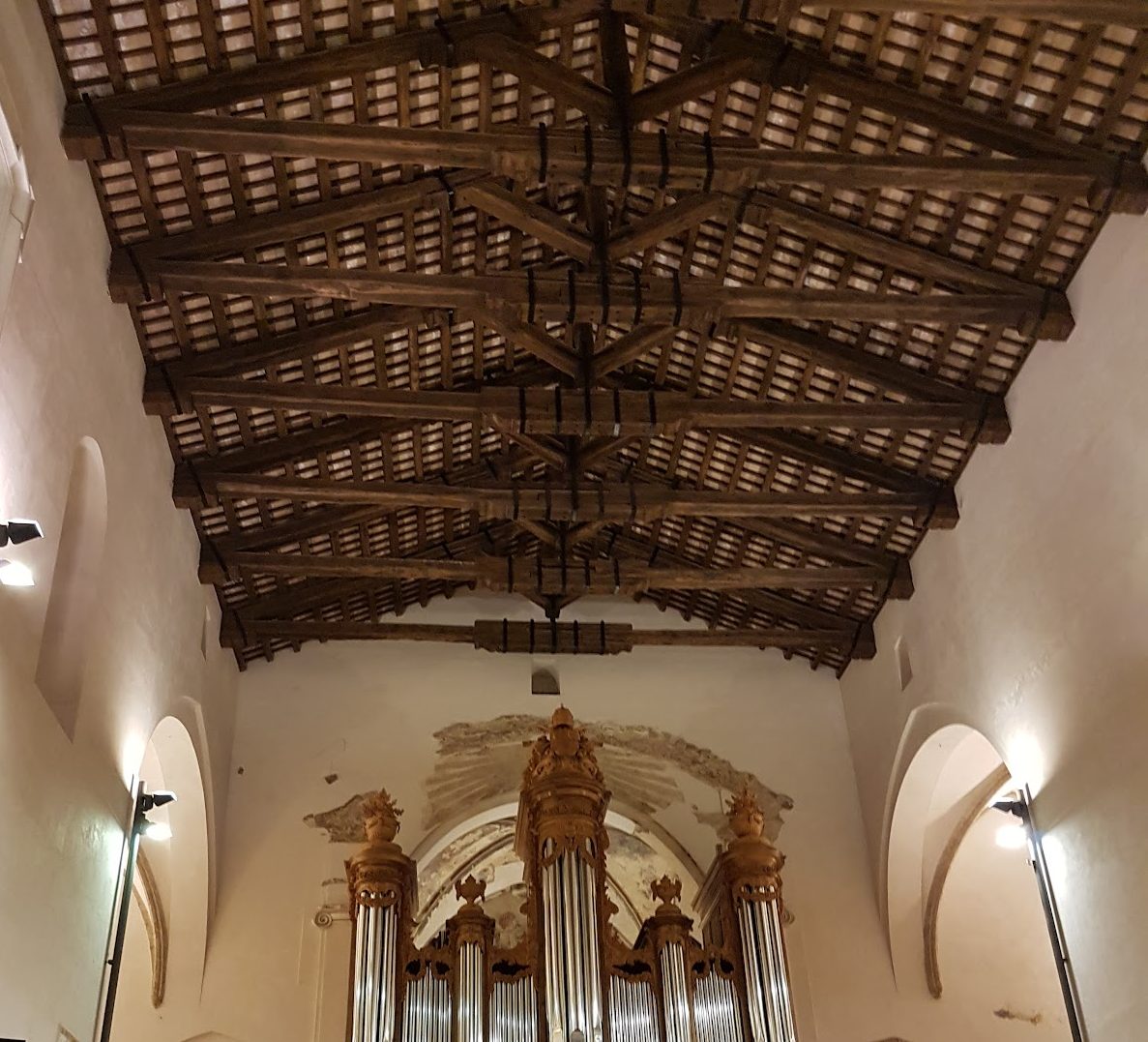
The earthquake of 1979 caused the roof to collapse. Restoration continued over several decades, with Luigi Bardotti, parish priest of Santa Lucia, helping to bring together public and private funds during the 1990s. The principal works included rebuilding the roof with twenty wooden trusses and consolidating the bell tower. The church was reconsecrated in 1999, when the restoration was completed. In 2008, it was enriched by the installation of the Dom Bedos-Roubo organ.
The convent has remained within the military area of the Attilio Verdirosi Barracks since 1862. The convent and the adjacent Oratory of San Pietro Martyr serve the barracks, including as a military chapel, and access is generally restricted.
The Oratory of San Pietro Martyr
The Oratory of San Pietro Martyr formerly housed the Confraternity of San Peter Martyr, a lay religious association also linked with the merchants of Rieti. In 1576, the confraternity moved to the church now called San Pietro Martyr, formerly known as San Matteo all’Yscla. Its 1546 stone portal was taken from the oratory and now forms the entrance to that church.
The oratory’s Last Judgment was painted between 1552 and 1554 by the Veronese brothers Lorenzo and Bartolomeo Torresani. In 1574, the apostolic visitor Pietro Camaiani, a papal representative appointed to inspect ecclesiastical institutions, demanded the removal of the fresco’s nudes. The Dominicans opposed the order, and the painting was preserved.
The fresco’s authorship was debated for centuries. The nineteenth-century restorer Andrea Pozzi assigned it to leading pupils of Raphael’s school, but Angelo Sacchetti Sassetti established the Torresani brothers’ authorship in the early twentieth century through a document found in the Rieti notarial archive. Giuseppe Colarieti Tosti restored the oratory in 1907. It later became a storehouse for equipment and stretchers used by the Public Assistance, then the headquarters of the Dante Alighieri Society, and eventually part of the Attilio Verdirosi Barracks when a military non-commissioned-officer training school was established there. Plans to make access more open were abandoned after security regulations were tightened following 11 September because of the oratory’s proximity to strategically important military offices.
Remains
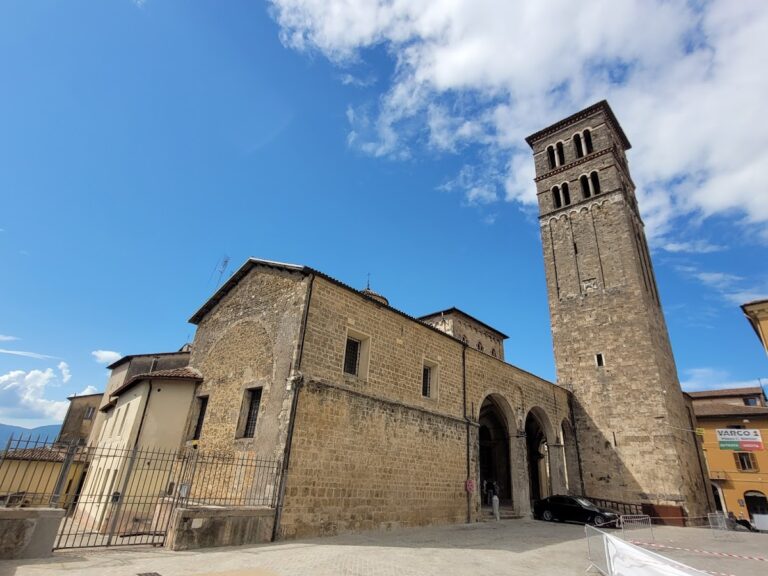
Chiesa di San Domenico stands on Piazza Beata Colomba in Rieti’s medieval centre. Its exterior combines a simple composition with walls built from travertine blocks. The main facade has a wooden doorway beneath a round, semicircular arch, a pediment, and two small flanking windows. A rose window, a large circular church window, stood above the portal until the end of the eighteenth century, when it was replaced by the present large window.
The church interior
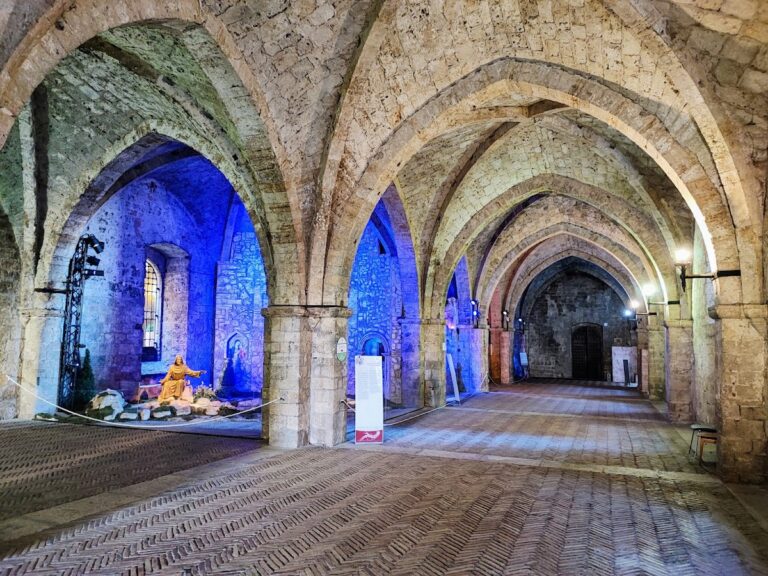
The church has a single broad nave. Much of its interior decoration was lost during the period of abandonment, and the walls are now white-plastered. Restoration nevertheless revealed original paintings in some areas, while several movable and detached works were preserved in the Civic Museum of Rieti.
Alemanni Chapel
The Alemanni Chapel contains Stories of a Saint and a Saint, a fresco attributed to Liberato da Rieti and dated to about 1441.
Grimaldi Chapel
The Grimaldi family chapel formerly contained Liberato da Rieti’s Crucifixion and Massacre of the Innocents. The signed fresco bears the date 1 May 1441. A wall that had probably closed the chapel during the late sixteenth century concealed the painting until its accidental rediscovery in 1924. Because of the church’s deteriorated condition, the fresco was detached in 1966, transferred to canvas, and subsequently preserved in the Civic Museum of Rieti.
Other paintings
Other works associated with the church include a fifteenth-century Crucifixion by a painter of the Sienese school, Madonna and Child with Saints and Putti from 1491, attributed to a follower of Antoniazzo Romano, and a fifteenth-century Madonna of Mercy with God the Father by an unknown painter. The collection also includes The Baptism of Christ and Giovanni Giacomo Pandolci’s Enthroned Madonna with Saints, painted in 1596 for an altar designed by Dionisio Colonnese. Several works were poorly conserved, and some were detached and transferred to the Civic Museum.
Organ and convent complex
The church contains the monumental Dom Bedos-Roubo organ, a French-style Classical instrument built by Bartolomeo Formentelli. Its design draws on two treatises published in 1760. The organ has 4,040 pipes and a 32-foot facade, meaning that its visible front pipework reaches that scale, making it one of the largest organs in Europe.
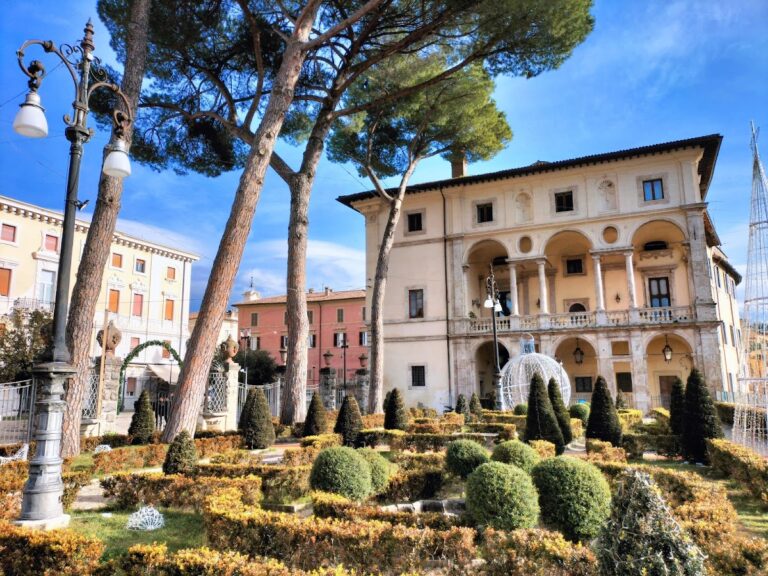
The convent is arranged around the Cloister of Blessed Columba. Its Italian-style garden has ordered planting, geometric organization, and a well at the centre, with a ground-floor portico surrounding it. The portico walls carry lunettes, or painted semicircular panels, depicting episodes from the life of Blessed Columba of Rieti, the Dominican religious figure commemorated in the cloister’s name.
Oratory frescoes
The small Oratory of San Pietro Martyr lies on the southern side of the cloister, adjacent to the church. Its principal decoration is the Torresani brothers’ Last Judgment. Saint Peter Martyr occupies the central wall, surrounded by angels and saints including Saint Barbara, Saint Thomas Aquinas, Saint Anthony the Abbot, and Saint Francis of Assisi. Twelve angels sound trumpets below them, while two others display the sentences translated as “Come, blessed ones” and “Depart from me, accursed ones.”
The left wall presents the destiny of the righteous through the Resurrection. On the right, the damned fall into Charon’s boat. Another fresco on the oratory’s right side, painted in 1552 by Bartolomeo Torresani, depicts Saint Peter Martyr.