St. Jakob in Wasserburg am Inn: A Late Gothic Parish Church in Germany


Site at a Glance
- Rating
- 4.6
- Popularity
- Very Low
- Country
- Germany
- Primary era
- Medieval
- External website
- Open
- Eras represented
- Medieval, Early Modern, Modern
- Civilizations
- Electorate of Bavaria, German, Holy Roman Empire
- Site type
- Religious
- Remains
- Church
On this page19 sections
History
St. Jakob in Wasserburg am Inn, Germany, is a Late Gothic church whose present building campaign began in 1410, when the citizens decided to replace an earlier church with a larger one. Originally a filial church, meaning a dependent branch church, of Attel Benedictine Abbey, St. Jakob was first mentioned in 1255. Its construction brought together several late medieval master builders and craftsmen, and the church later underwent Baroque, nineteenth-century Gothic Revival, and twentieth-century restoration campaigns.
From Abbey Church to New Civic Building
Hans von Burghausen directed the planning and construction of the new church from 1410, probably with extended interruptions, until his death in 1432. His successor was Hans Stethaimer, identified as von Burghausen’s nephew. Stethaimer was a stonemason and painter, and he is first mentioned in the 1431 contract for the church at Schnaitsee.
Once the nave had been completed, the earlier High Gothic choir was demolished. A new Late Gothic choir followed under Stephan Krumenauer, the son of Hans Krumenauer, who had built Passau Cathedral and later worked on Salzburg Cathedral. Jörg and Michael Sallinger served as foremen, supervising aspects of the building work, while Conrad Rottaler was among the stonemasons employed.
The choir, its five chapels, and the sacristy were consecrated in 1448. The Münzmeister Chapel, now called the Herz Jesu Chapel, was completed on the south side of the choir in 1452. The two side chapels north and south of the tower followed in 1452 to 1454.
Tower Construction and Later Changes
Work on the tower began in 1458 under Stephan Krumenauer. After his death in 1461, Wolfgang Wiser continued the construction, which reached completion in 1478. An inscription in the westernmost chapel on the south side of the nave commemorates Wiser as master of the building works.
Between 1635 and 1658, the church was redecorated in the Early and High Baroque styles. A major renovation in 1826 created new side entrances in place of the central nave chapels. In 1879 and 1880, Michael Geisberger directed a further renovation that removed the stucco and Early Baroque altars in an attempt to restore the church’s Gothic appearance. The Neo-Gothic side altars, removed in 1945, were reinstalled during the renovation of 1979 and 1980.
St. Jakob belongs to the St. Jakob parish in Wasserburg am Inn within the Archdiocese of Munich and Freising. Its bells also reflect the church’s long history. They were cast between 1473 and 1663. The Prälatenglocke came from Attel Abbey in 1805 to 1807, while the Neue Zügenglocke was transferred from the Michaelskapelle in 1811.
Remains
Building Layout and Exterior
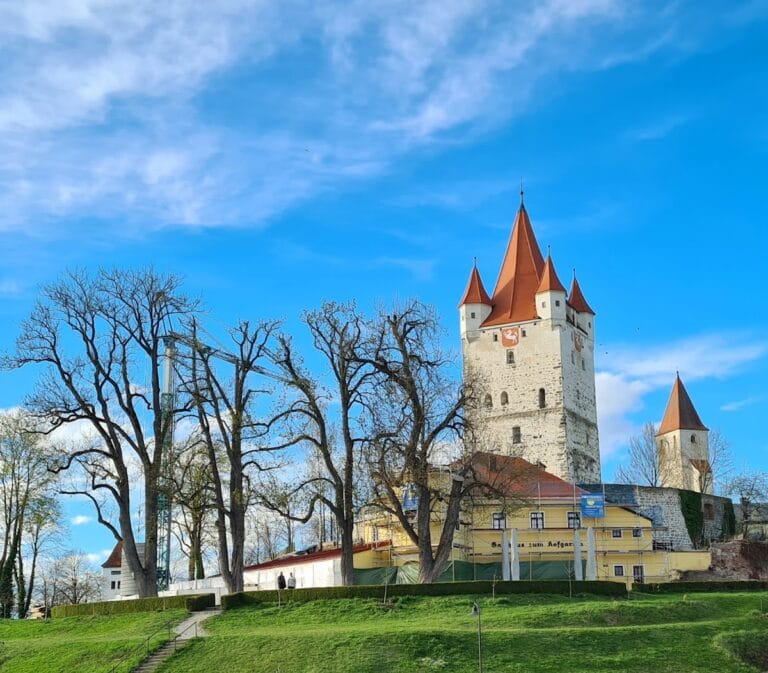
St. Jakob is a Late Gothic brick-built hall church, a form in which the nave and side aisles are approximately equal in height. Side chapels of varying sizes extend the building. The nave is made of brick, while the choir, sacristy, and western tower use tuff ashlar masonry. The three-bay nave leads eastward to a two-bay ambulatory choir, meaning a choir surrounded by a passage, and extends westward to the six-storey tower.
Nave and Choir
The side aisles rise almost to the height of the central nave, giving the interior a broad, unified form. Large windows with tracery, the ornamental stone framework of Gothic windows, shape the exterior. Steps and belt ribs separate the choir from the nave. The nave has stellar vaults, whose ribs form star-like patterns, while the choir has Late Gothic vaults with curved ribs.
Western Tower
The six-storey western tower was built between 1458 and 1478. Its unusual termination has a hipped roof. The tower contains the church’s historically valuable bronze peal, whose stated strike-tone sequence is cis 1, e 1, fis 1, a 1, and g 2.
Choir Art and Furnishings
Tree of Life Painting
A wall painting on the southeast side of the choir was created around 1460 to 1480. It presents the Tree of Life through seven grouped scenes concerning Original Sin and Redemption, with God the Father above. The imagery includes Ecclesia and Synagogue, traditional personifications of the Church and Judaism, as well as the Host Tree, the Tree of Knowledge, and the Risen Christ between the Blessed and the Damned. Eight half-length figures appear in vertical strips along the sides, while three individual scenes are placed on each side of the central arrangement.
Windows, Altars, and Sculptures
The choir’s stained-glass windows were made in 1880 by Franz Xaver Zettler of Munich. Their subject is the condemnation of Saint James the Elder, one of the Twelve Apostles and, in Christian tradition, the first apostle to be martyred.
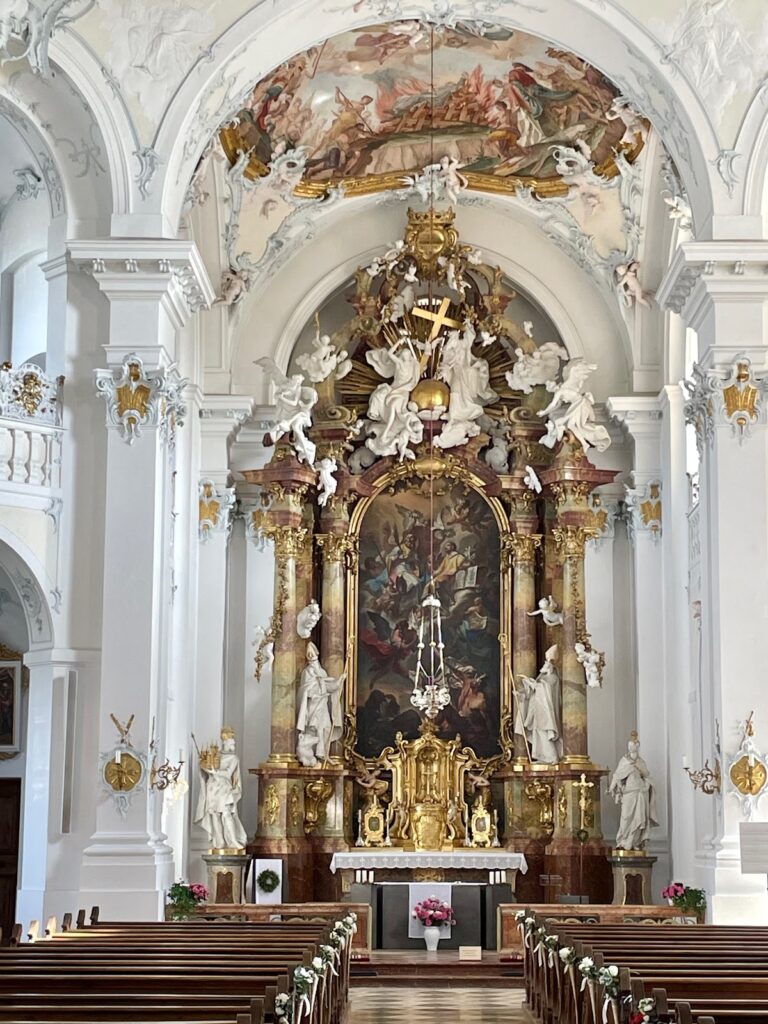
The side altars were produced from designs by Johann Marggraff, with some partly executed by Joseph Elsner the Elder. Heinrich Geigenberger made the Sebastian altar. The high altar’s tabernacle, the enclosure for consecrated Eucharistic hosts, was created in 1831 by the Augsburg silversmith Joseph Muehmann from a design by Johann Brand, a Wasserburg Kistler, or skilled woodworker and cabinetmaker.
Pulpit and Other Works
Martin and Michael Zürn the Elder of Waldsee made the pulpit in 1638. It is regarded as a major work of South German Early Baroque sculpture. Adam Hartmann created the crucifix on the choir arch in 1678. On the north wall of the choir, a painting by Johann Ulrich Loth from 1649 to 1650 depicts the Assumption of Mary.
A mid-eighteenth-century depiction of Christ at Rest is located beneath the gallery. Apostolic sculptures made from shell limestone by Max Heilmaier in 1902 to 1906 stand on the columns. The Neo-Gothic Stations of the Cross consist of terracotta reliefs made by the Mayer Court Art Institute.
Organ and Musical History
The organ case originally belonged to an instrument made by Anton Bayr in 1764. Wolfgang Amadeus Mozart, the Austrian composer and musician of the Classical period, played its predecessor instrument in 1763 when he was seven years old.
The present organ was built in 1958 by Georg Glatzl of the St. Gregoriuswerk in Altmühldorf. It has 48 stops, three manuals, and a pedal. Its listed couplers are II/I, including a super-octave coupler, III/I, III/II, I/P, II/P, and III/P. The playing aids include two free combinations, two free pedal combinations, tutti, a crescendo roller, and reed silencers.
Memorials and Tomb Monuments
Numerous tomb monuments and epitaphs, commemorative funerary monuments that may include inscriptions, portraits, reliefs, or coats of arms, commemorate Wasserburg patricians, council families, officials of the ducal and electoral administrations, and the nobility of the surrounding area.
Estermann Chapel and North Choir Wall
The Estermann Chapel contains tomb slabs for Stefan Widder, who died in 1509, and his wife Elisabeth Scheuchenstuhl, who died in 1497. It also holds the slab of Peter Fröschl, who died in 1475, with a finely worked coat of arms by Franz Sickinger; the monument for Jörg Estermann the Elder, who died after 1500, and his wife Katharina; and the monument for Christoph Martein, who died in 1513, and his two wives.
The north choir wall carries epitaphs for Hans Steinhauf and Wolf Steinhauf, both of whom died in 1575. Their monuments bear the signum W.H. The wall also contains the epitaph of Wolfgang Sträßl, who died in 1527, and his two wives, together with that of Sigmund Perckhofer of Holzhausen, who died after 1500, and his wife Afra Fröschl.
Western Chapels and Tower Memorials
The westernmost chapel on the north side contains the epitaph of Michael Egkstetter, who died in 1485. Franz Sickinger executed it in 1473. Beneath the gallery is a large epitaph for the ducal rentmaster Hans Baumgartner, who died in 1500. Its finely worked relief of the deceased was made by the Wasserburg sculptor Wolfgang Leb.
A memorial stone for Ludwig the Bearded stands in the westernmost chapel on the south side. It commemorates his order to strengthen Wasserburg’s town walls in 1415, while the associated inscription panel remains on the southeast exterior wall of the choir. A tomb slab for Peter Paumgartner, who died in 1477, was made by Hans Haldner and is set into the southern nave pier of the tower.
Exterior Epitaphs
The exterior south wall of the choir bears a heraldic epitaph for the two wives of Kaspar Kienberger, installed in 1483. On the exterior south wall of the nave is a transverse rectangular Early Renaissance epitaph for Wolfgang Gumpolzhaimer, who died in 1514, and Jörg Gumpolzhaimer, who died in 1521. Their coats of arms are enclosed within a Renaissance aedicule, a small architectural frame resembling a miniature temple.
The same wall contains a large Renaissance epitaph for the patrician Abraham Kern of and at Zellereit, who died in 1628, and his wife Maria Altershamer. It includes a relief of the Entombment of Christ signed by the Wasserburg sculptor Gregor Pichler. Other monuments on the exterior south wall commemorate Jakob Kulbinger, who died in 1532, and his wife Elspeth, who died in 1534, with their coats of arms in a Renaissance aedicule, as well as Sibylla von Donnersberg, who died in 1634, with reliefs of the Risen Christ and the Virgin Mary.
Further fifteenth- to seventeenth-century tomb slabs and epitaphs survive on the western and northern exterior walls of the nave. They include monuments for Ruprecht Surauer and his wife, Urban Eder, Georg Kern, and Abraham Pfundtmer.
Historic Bells
Great Bell and Landshuterin
The Great Bell, also called the Storm Bell, was cast in 1473 by Georg Glockpitscher of Salzburg. It weighs approximately 4,000 kilograms and has the tone cis 1. The Landshuterin was cast in 1490 by Mathäus Herl of Landshut, weighs approximately 1,600 kilograms, and has the tone e 1.
Later Bells
The Prälatenglocke was cast in 1663 by Bernhard Ernst of Munich and serves as the eleven-o’clock bell. The Alte Zügenglocke, a death bell, dates from 1523 and serves as the twelve-o’clock bell. The Neue Zügenglocke was cast in 1631 by Jakob Lidl, has the tone g 2, and also serves as a death bell.