Our Lady of the Gate of Dawn Church in Drogosze: A Medieval Parish Church


Site at a Glance
- Rating
- 4.7
- Popularity
- Very Low
- Country
- Poland
- Primary era
- Medieval
- External website
- Open
- Eras represented
- Medieval, Early Modern
- Civilizations
- Kingdom of Prussia, Teutonic Order
- Site type
- Religious
- Remains
- Church
On this page10 sections
History
Our Lady of the Gate of Dawn Church in Drogosze, Poland, is a fourteenth-century brick Gothic parish church founded in 1361 in Groß Wolfsdorf. Some historians propose 1363 as the precise construction date. A charter issued under Kulm law, a medieval framework governing settlement, landholding, taxation, and local rights in Prussia, granted the parish priest four free hides for his glebe. One fifteenth of the peasants’ dues, known as a skot, was assigned to furnishing the church.
Medieval foundation and Lutheran administration
A sacristy was added during the fifteenth century. After the Reformation in East Prussia, the church became Lutheran. Between 1543 and 1618 it was subordinate to the church at Paaris within the Rastenburg inspection. A deacon was serving there provisionally by 1607, and evangelical pastors ministered at the church from 1618 until 1945.
Patronage belonged to the estate owners of neighboring Dönhofstädt. The von Dönhoff family held this right from 1681 to 1863, when it passed to the counts of Stolberg-Wernigerode. Ludwig von Rautter, an estate owner and church patron, was associated with a major renovation in 1593 and was later commemorated by an inscribed plaque in the church.
Union, shared pastorate, and the end of the former congregation
In 1817 the Groß Wolfsdorf congregation joined the Old Prussian Union, a church body that brought Lutheran and Reformed congregations in Prussia into a common organization while retaining elements of both traditions. The neighboring Dönhofstädt congregation, founded in 1725 and remaining Reformed, joined only in 1839. In 1875 the two congregations were united under one Lutheran pastorate based at Dönhofstädt. Services continued regularly at Groß Wolfsdorf, while the Dönhofstädt castle chapel received an additional monthly service.
Until 1945, the united congregations belonged to the Rastenburg church district and the East Prussia church province of the Church of the Old Prussian Union. In 1926 the Groß Wolfsdorf parish district had 1,375 members, while the Dönhofstädt district had 155. Before 1945, the area’s relatively small Catholic population belonged to the parish church at Korschen in the Reszel deanery of the Diocese of Warmia.
The flight and expulsion of the prewar population brought the former evangelical congregation to an end. After 1945, Groß Wolfsdorf was absorbed into neighboring Drogosze, and the church became Catholic. The resettlement of Polish citizens greatly increased the Catholic population, leading to the establishment of a Catholic parish in Drogosze on 1 April 1962. Dedicated to Our Lady of the Gate of Dawn, a Marian title associated particularly with the shrine at the Gate of Dawn in Vilnius, the parish belongs to the Reszel deanery of the Archdiocese of Warmia.
Extensive building work in 1965 adapted the church for Catholic use and probably removed many furnishings from the eighteenth and nineteenth centuries. The church entered Poland’s heritage register in 1950. Evangelical residents now living in the area belong to the Kętrzyn parish, whose branch church is at Barciany, within the Masurian Diocese of the Evangelical-Augsburg Church in Poland.
Remains
Church building
Medieval exterior
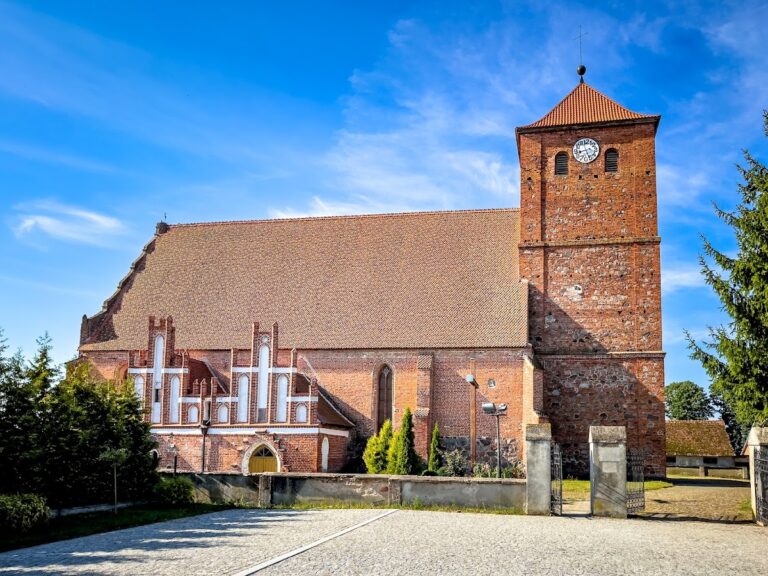
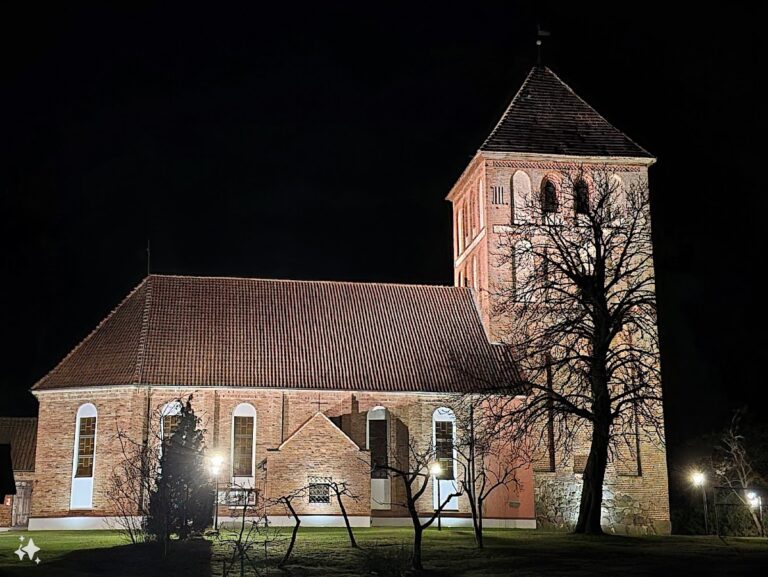
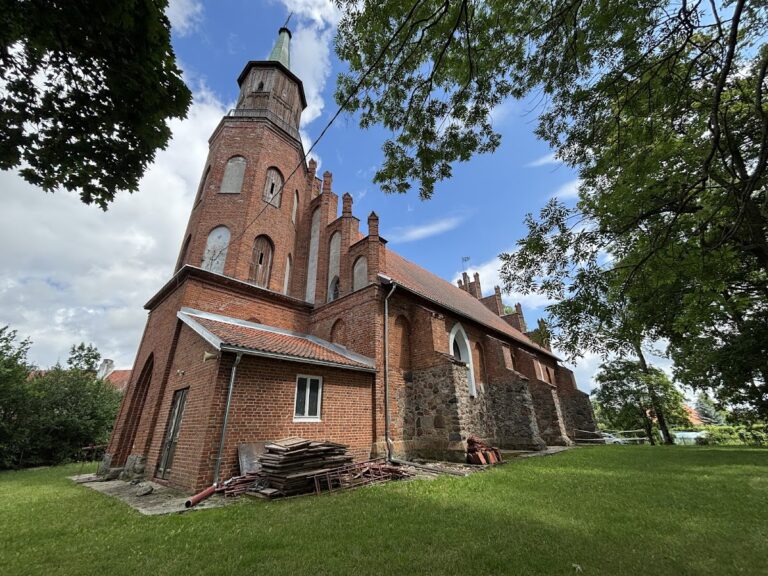
The church is a fourteenth-century brick Gothic hall church measuring approximately 23.7 by 7.2 metres. It has no masonry vault and is organized around a nave, a west tower, a later sacristy on the northeast side, and a south-side entrance hall added in 1788. Fieldstone forms the base of the church and is also incorporated into the sacristy’s north wall.
The sacristy has a three-axis stepped gable with an unusual pattern of cross-shaped blind tracery. Each side step is crowned by two finials, while the central step has three. The free-standing west tower is structurally bonded with the nave. Its plain ground floor is medieval, while its overall design combines a Gothic-derived conception with Renaissance-influenced details. A stepped pointed-arch portal and recessed plaster bands marking the horizontal termination of the facades are among its notable features.
Interior and furnishings
Inside, a wooden barrel vault, a continuous curved ceiling, spans the church, and deep galleries extend through the interior. The altar and pulpit form a mid-nineteenth-century ensemble. Angelika zu Dohna-Lauck, née von Dönhoff, renewed the interior in 1835, including both furnishings.
The superstructure of an earlier altar was made by Joseph Anton Kraus in 1715–1716. It included sculptures of Moses and Aaron, figures of angel boys, and a representation of the crucified Christ. Only scant remains of these sculptural works survive. Eighteenth- and nineteenth-century altar vessels probably remained preserved for a long period, as did a baptismal angel.
A large rectangular metal plaque in the central aisle bears a Latin inscription dedicated to Ludwig von Rautter. The organ stands on the west gallery. Its date and maker are unknown. On major feast days, the cantor could activate a miniature carillon concealed inside an eagle figure during the final stanza of each chorale, causing the figure to move as the bells sounded. The peal consists of two bells cast in 1786 and 1844.
Associated buildings
Dönhoff funerary chapel
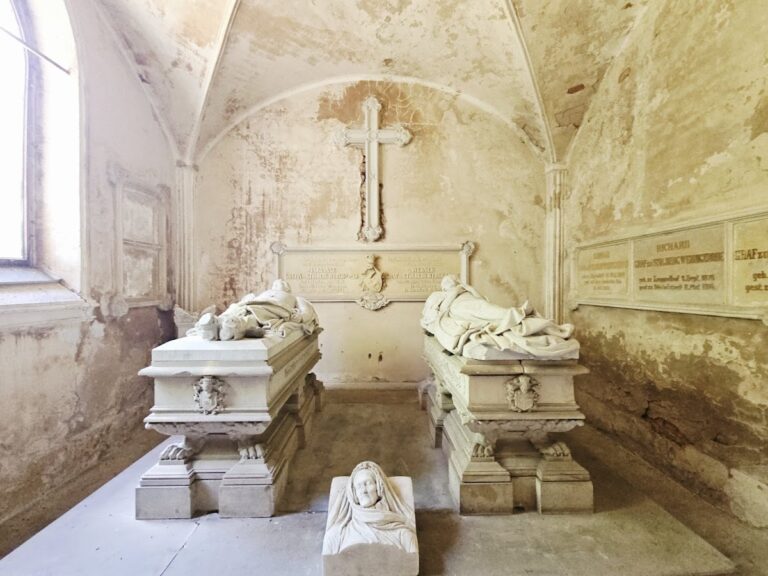
A funerary chapel of the Dönhoff family stands on the north side of the church. Its pediment carries a bust of Bogusław Fryderyk Dönhoff, identified as the builder of the Dönhofstädt palace. Johann Heinrich Meissner, a sculptor from Gdańsk, made the bust.
Parsonage
A Baroque parsonage from the eighteenth century stands beside the church.