San Pancrazio: A Historic Roman Catholic Church in Bergamo


Site at a Glance
- Rating
- 4.4
- Popularity
- Very Low
- Country
- Italy
- Primary era
- Medieval
- Eras represented
- Medieval, Early Modern, Modern
- Civilizations
- Venetian
- Site type
- Religious
- Remains
- Church
On this page14 sections
History
San Pancrazio is a Roman Catholic church in Bergamo, Italy, dedicated to Saint Pancras and the Blessed Virgin Mary. Documented by 888, it gave its name to the San Pancrazio vicinia, a historic urban district whose residents shared civic and religious responsibilities. The church remained a parish church until 22 June 1805, when it became a subsidiary church of Bergamo Cathedral, Sant’Alessandro.
Early church and fifteenth-century enlargement
A church and vicinia dedicated to San Pancrazio were already recorded in Bergamo in 888. The dedication reflects the spread of devotion to Saint Pancras, an early Christian martyr whose cult was associated with a basilica in Rome that had been enlarged in 1280.
The church was enlarged during the fifteenth century, including the construction of its entrance portal in 1452. Bishop Lodovico Donà consecrated the building on 3 October 1474. By the sixteenth century, a cemetery extended around the church, as noted during Cardinal Carlo Borromeo’s pastoral visit in 1575. Borromeo was Archbishop of Milan and a major promoter of Catholic reform after the Council of Trent.
Post-Tridentine restoration and later changes
From the seventeenth to the nineteenth century, the church was restored and enlarged in response to reforms associated with the Council of Trent, the sixteenth-century Roman Catholic council that reshaped worship, church administration, and the arrangement of sacred spaces. The works included a sacristy, the Bagnati Tower bell tower, modernized altars, and stucco decoration designed by Giovan Battista Caniana.
In 1624, the vicinia requested a major restoration that would raise the church and introduce a new barrel vault, a continuous semicircular or segmental ceiling. The request was unanimously approved and sent to Bishop Federico Corner. An earlier pastoral visit by Corner had noted the church’s altars and their family patronages, together with a baptistery at the rear of the nave and a dark, undersized presbytery, the part of a church reserved for the altar and clergy, that required liturgical adaptation.
The restoration had begun by 1625, but it was still underway in 1634. Francesco Moroni and later his sons Alessandro, Giovanni Antonio, and Ambrogio made an important contribution. During Bishop Luigi Ruzzini’s pastoral visit in 1699, the Moroni coat of arms was recorded on the keystone of the triumphal arch, and the renovated interior received a favorable description.
Twentieth-century conservation
In the early twentieth century, the exterior facade was repainted and the flooring was renewed. Giovanni Cavalleri also painted the vault with scenes from the life of Saint Pancras. A major restoration followed in the 1990s under the Milan Superintendency for Architectural Heritage, with work carried out by the Formica company. Damage caused by the 2004 earthquake led to further vault restoration in 2010.
Remains
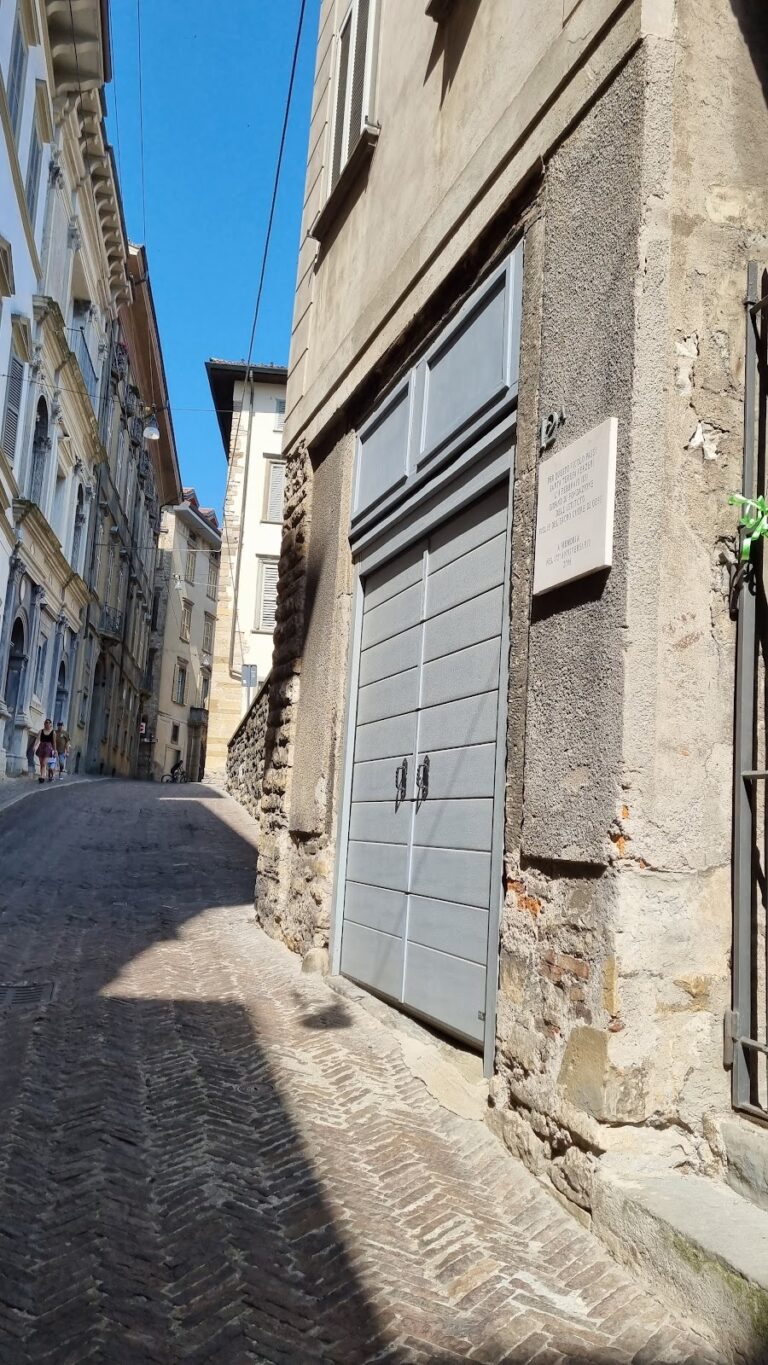
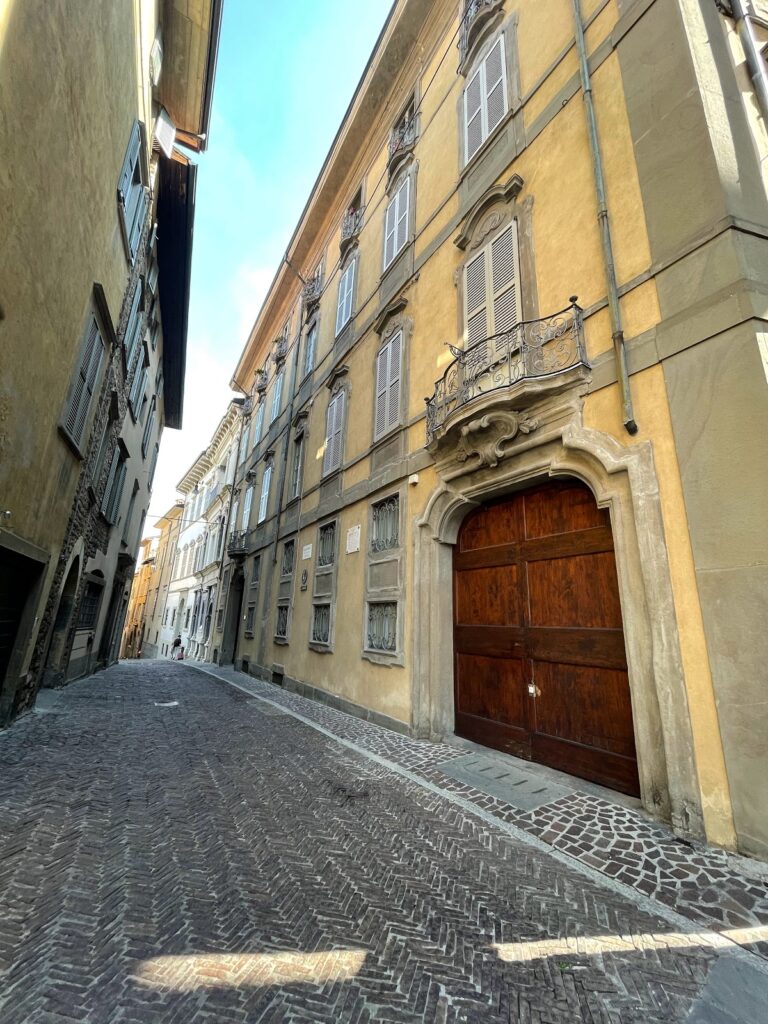
San Pancrazio stands slightly back from the principal street, with its gabled main facade facing Piazza San Pancrazio and its side extending along Via Gombito. The church has a single nave organized around five chapels on each side. The square also contains the small San Pancrazio Fountain, known as the Hyacinth Bud, which dates from 1549.
Facade and entrance portal
The gray-stone entrance portal has a molded pointed arch ending in two carved angel heads. Its lunette, the semicircular area formed where an arch meets a wall, contains high-relief figures of Saint Pancras, the Madonna and Child, and a blessing bishop. Above this group is a Trinity fresco showing God the Father holding the crucified Christ, with a dove representing the Trinity. Saints Sebastian and Bernardino occupy the sides, and these lateral figures are dated 1452, during the episcopate of Giovanni Barozzi.
Two single-lancet windows with lunettes and iron grilles occupy the side sections of the facade. A circular window opens above them in the upper part of the front.
Nave and principal chapels
The chapels occupy separate bays divided by pilasters with sandstone bases and Corinthian capitals, classical capitals decorated with stylized acanthus leaves. The pilasters support an entablature, the horizontal architectural assembly above them, from which the barrel vault rises.
Chapel of the Madonna
The Chapel of the Madonna is Neoclassical and follows a design by Angelo Cattò from 1830. It contains two statues made by Gaetano Manfredini in 1842, while Giovanni Brina produced the stucco decoration.
Chapel of the Immaculate Conception
The Chapel of the Immaculate Conception belonged to the Moroni family. Its paintings, once attributed to Cristofano Allori and now attributed to Francesco Curradi, include an altarpiece of the Immaculate Conception with saints, flanked by images of the Archangel Gabriel and the Annunciation. Their arrangement follows the model of a fresco in the Basilica of the Santissima Annunziata in Florence. Giovan Giacomo Manni made the altar frontal.
Chapel of the Blessed Virgin
The Chapel of the Blessed Virgin belonged to the Rosary confraternity by 1638. Its altarpiece of the Virgin and Child is by Ermanno Stroiffi, and Vincenzo Angelo Orelli painted depictions of the fifteen Mysteries of the Rosary.
Chapels of Saints Peter and Paul and the Madonna of the Rosary
The Chapel of Saints Peter and Paul contains Gian Paolo Cavagna’s altarpiece of the Virgin and Child with Saints Peter and Paul. The Chapel of the Madonna of the Rosary contains an altarpiece attributed to Jacopo Palma the Younger.
Chapel of Saint Charles
The Chapel of Saint Charles appears in the 1659 pastoral visitation with an altarpiece of the saint attributed to Chiara Salmeggia.
Chapel of the Ten Thousand Martyrs
The Chapel of the Ten Thousand Martyrs contains a Crucifix altarpiece attributed to the Moroni.
Presbytery and apse choir
The presbytery is raised by three steps and enclosed by a marble balustrade. It contains an elliptical dome and a large Baroque high altar.
The apse choir contains Antonio Balestra’s Ecstasy of Saint Teresa of Avila, dated 1715, together with Francesco Terzi’s Madonna and Child in Glory and Jacopino Scipioni’s Madonna Enthroned with Saints. A wooden choir completes the apse arrangement.