St.-Matthäus-Kirche: Evangelical Lutheran Church in Stadland

Site at a Glance
- Rating
- 4.5
- Popularity
- Very Low
- Country
- Germany
- Primary era
- Medieval
- External website
- Open
- Eras represented
- Medieval, Early Modern, Modern
- Civilizations
- German, Holy Roman Empire
- Site type
- Religious
- Remains
- Church
On this page11 sections
History
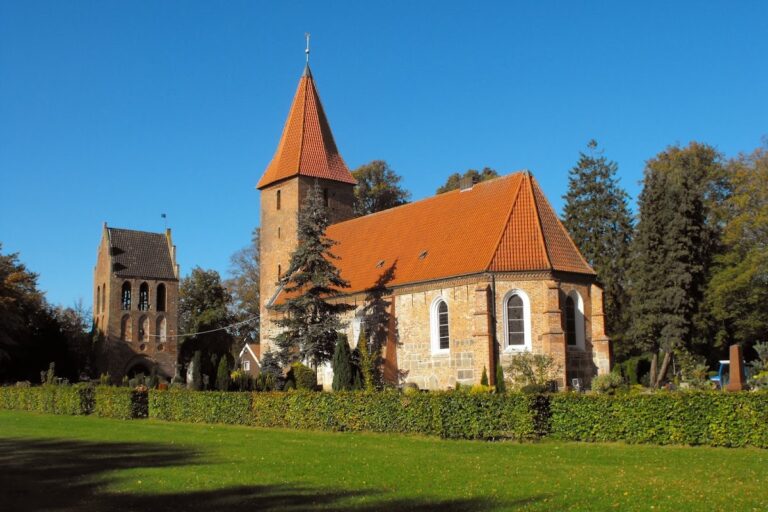
St.-Matthäus-Kirche is an Evangelical Lutheran church in Rodenkirchen, Germany, whose oldest surviving parts are generally dated to the thirteenth century and whose original design was predominantly Romanesque. During the Middle Ages, it served as the principal church of the Rüstringian Stadland. The church is now recognized as a cultural heritage monument in Lower Saxony.
Medieval beginnings and alterations
The beginnings of the church are undocumented. Since Rodenkerken was first mentioned in 1244, a church probably stood here by that time, although the early building history cannot be reconstructed with certainty. The thirteenth-century structure had an eastern apse in the longhouse and smaller apses at the arms of its transept. Two round windows stood above each of the side apses.
The building changed substantially during the later Middle Ages. Additional portals were opened in the sides of the longhouse during the fourteenth century, and a straight-ended choir was added in the fifteenth century. Twelve carved apostles from a lost medieval altar also survive from the second half of the fifteenth century.
Conflict and post-Reformation transformation
Wars involving the city of Bremen and the counts of Oldenburg against Frisian chieftains, who resisted from the surrounding area, brought destruction and alterations to the church. The eastern parts had originally been vaulted, but were eventually provided with flat ceilings. The altered openings and the simplified south gable triangle further reflect the building’s later physical changes.
The church’s historical character was reshaped after the Reformation, particularly through its richly carved furnishings. The altar retable and pulpit were created by Ludwig Münstermann, a leading North German woodcarver associated with Mannerism, an artistic style known for elaborate ornament, dynamic figures, unusual proportions, and complex spatial effects. The western wall and attached bell house date from 1901.
Conservation and continuing use
The altar has undergone three restoration campaigns. The latest, carried out between 1996 and 1998 by the Ochsenfarth family, could not completely restore Münstermann’s original color scheme because layers of repainting from the eighteenth through the twentieth centuries remained over it. The surviving furnishings and altered medieval fabric together preserve the church’s development from a medieval regional centre into a Lutheran church shaped by the art of the seventeenth century.
Remains
St.-Matthäus-Kirche is a towerless single-nave building, meaning that it has one principal nave rather than parallel aisles. It is built of Porta sandstone, a regional sandstone used in northern German medieval construction, and stands on an approximately five-metre-high clay terp, an artificial mound raised in low-lying coastal regions to protect settlements and buildings from flooding. The medieval layout, later choir, surviving furnishings, organ, and separate bell house form the principal elements of the preserved complex.
Medieval church fabric
The original thirteenth-century church was predominantly Romanesque. Its longhouse had a main apse in the east wall, while subsidiary apses occupied the arms of the transept. Two round windows were placed above each side apse. Later changes altered the openings, and the south gable triangle was rebuilt in simplified form. The eastern parts now have flat ceilings rather than the vaults for which they were originally designed.
The fifteenth-century choir ends in a straight wall and contains the principal eastern window. This opening was initially entirely late Gothic, but it was adapted during the Renaissance to accommodate the new altar. Its glazing now consists of four rectangular panels. The additional portals inserted into the longhouse sides during the fourteenth century remain part of the building’s medieval development.
Altar retable
The altar retable, a decorated structure rising behind the altar, is a signed work largely made personally by Ludwig Münstermann and dated 1629. His workshop probably began it in 1618, while the painting was completed gradually between 1630 and 1639 as funds became available. The framework is oak, and the ornaments and figures are carved from limewood. The retable measures 591 centimetres high and 455 centimetres wide.
Its highly open and spatially complex design is arranged in two principal levels around scenes of the Last Supper and the Crucifixion. Prophets and Reformers appear within an extensive presentation of salvation history, and the structure is crowned by the resurrected Christ. The Last Supper uses an unusual stage-like perspective that extends more than two metres in depth toward the sill of the choir window.
The retable’s visual effect depends on dense ornament and strong colors. Some surfaces use lüster, a technique in which colored glazes are applied over silver foil. The present painted finish only partly reflects Münstermann’s original scheme, since repainting from the eighteenth to the twentieth centuries could not be fully removed during the latest restoration.
Pulpit
Münstermann and his workshop also produced the pulpit, its sounding board, and its original staircase. A sounding board is the canopy above a pulpit that helps project the speaker’s voice. An inscription on the pulpit floor gives 1631 as the completion year and names workshop members, including Münstermann’s sons Johan and Claus.
The pulpit support takes the form of a tree, leafy on the right and withered on the left. Beneath it are Adam, Moses, and John the Baptist. Its upper imagery contrasts the Old and New Testaments and the related ideas of law and grace, damnation and redemption. Prophets, Evangelists, the Brazen Serpent, the Crucifixion, the Fall, and the Resurrection all contribute to this program.
The sounding board depicts Pentecost with Mary and the twelve apostles. Its gable panels contain the Church Fathers, while putti with instruments of Christ’s Passion appear above them. The lantern presents the Trinity, and an angel holding a model of the church forms the crowning element. The staircase includes personifications of the Five Senses, a comparatively secular part of the ensemble. Its painted finish was reconstructed in 1964 from exposed traces of the first color scheme, dated to 1638.
Baptismal font and seating
The stone baptismal font has a chalice-shaped form. Strapwork ornament covers its foot, while six oval panels on the bowl are set between herms, carved figures used as supporting motifs. The panels contain a pelican emblem, a coat of arms, and four donors’ house marks. The donors’ names run around the rim. The unsigned font was probably made around 1630 in Münstermann’s workshop, together with a cover that is now lost.
Confessionals and rows of choir stalls stand to the south and north of the altar. The twelve carved apostles from the lost late medieval altar are now mounted on the balustrade of the organ gallery, where they remain as surviving elements of the church’s earlier furnishing.
Organ
The first organ had two manuals and was built in 1758 by Johann Hinrich Klapmeyer. After water damage, a new instrument with fifteen stops was installed inside the historic case in 1906, retaining eight historic stops. The present organ was built in 1986 by Alfred Führer of Wilhelmshaven. It has twenty-one stops divided between two manuals and a pedal, follows the disposition of the 1758 organ, and retains five stops from that instrument. Its actions are mechanical.
Bell house
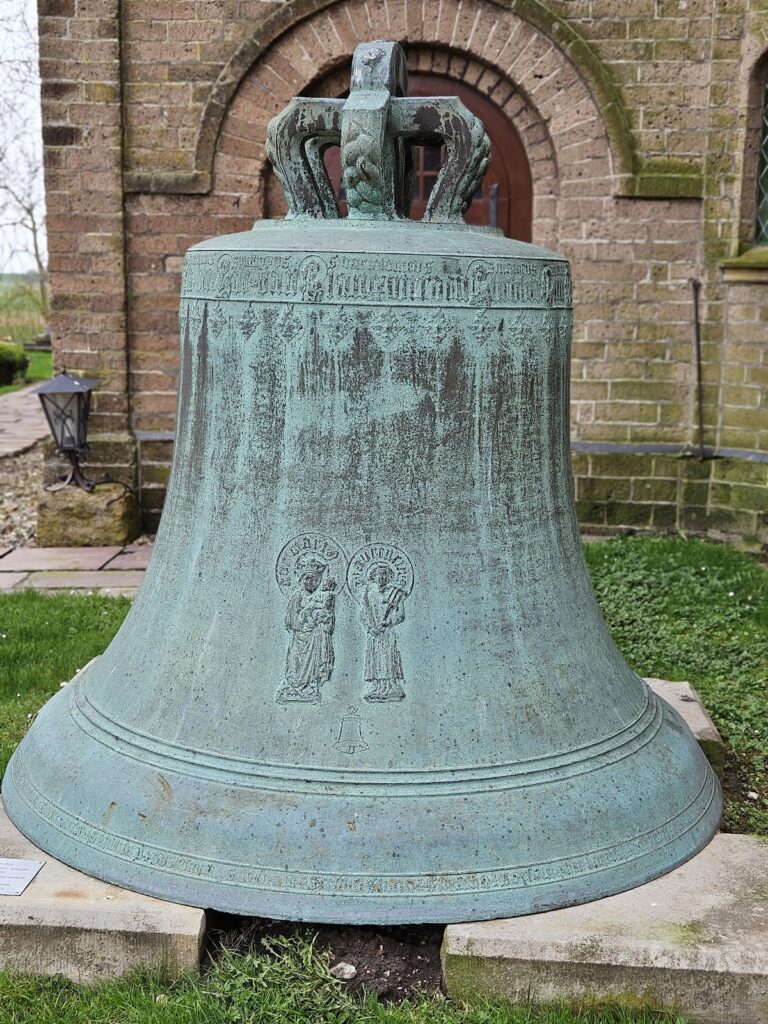
A heavy bell hangs in the bell house attached to the western part of the church. Andreas van Bergen of Stickelkamp, near Hesel, cast it in 1863 by recasting an older bell from 1849. That earlier bell had already been recast twice. The surviving bell measures 1.70 metres in diameter and carries an inscription based on Friedrich Schiller’s Das Lied von der Glocke. Its translated text describes fate striking the metal crown forged deep beneath the earth, after which the bell rings to edify those who hear it.