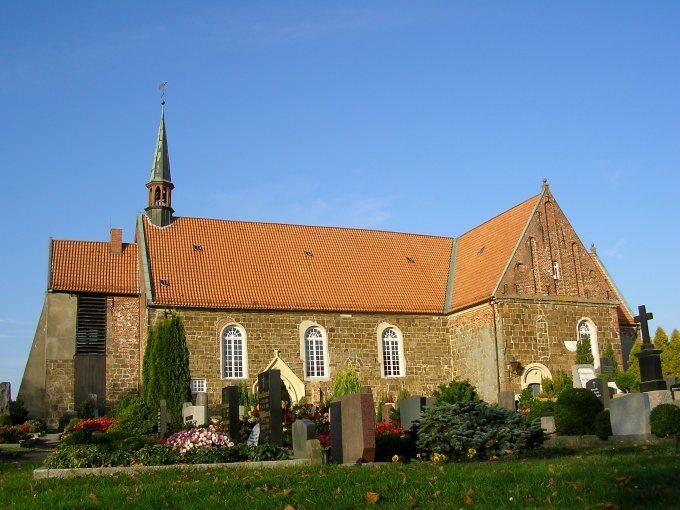
Saint Ulrich’s Church: A Medieval Parish Church in Rastede, Germany


Site at a Glance
- Rating
- 4.7
- Popularity
- Low
- Country
- Germany
- Primary era
- Medieval
- External website
- Open
- Eras represented
- Medieval, Early Modern, Modern
- Civilizations
- Holy Roman Empire
- Site type
- Religious
- Remains
- Church
On this page17 sections
History
Saint Ulrich’s Church is a medieval evangelical church in Rastede, Germany, founded in 1059 and rebuilt largely as a Gothic brick hall church during the fifteenth century. Its foundation, established by Count Huno of Oldenburg and his wife Willa, is regarded as the founding year of Rastede and is the second-oldest church foundation in the Ammerland after Saint John’s Church in Wiefelstede. The church was dedicated to Saint Ulrich of Augsburg, a tenth-century bishop and canonized Christian saint.
Foundation and medieval development
The church, or a predecessor of the present building, was consecrated on 11 November 1059, exactly 66 years after Saint Ulrich’s canonization. A Romanesque church was built around or after 1100. The present structure reflects later rebuilding and development, especially during the fifteenth century, while parts of the earlier building survive in the crypt, the base of the west tower, and the western nave wall.
The crypt remained under the control of the counts and later the kings until 1762, when King Frederick V of Denmark transferred it through a gift decree. It was originally dedicated to Mary and was rededicated as a Saint Anne chapel during the late Middle Ages. The space may first have been intended as a comital burial place, a function it resumed after the Reformation.
Reformation and structural change
Oltmann Kröger, a former Benedictine monk, preached the first Lutheran sermon in the church in 1524. After the Reformation, new furnishings were introduced, and some survived the later destruction of the vaults. The church’s association with the ruling family continued through the crypt, whose use as a burial place linked the medieval foundation with the later history of the counts and kings.
In 1645, parts of the Gothic vaults collapsed. The falling structure damaged the pulpit and destroyed the organ. The remaining vaults were removed, and a timber ceiling was installed in 1696. Gerd von Bloh decorated this ceiling with blue-and-white vine paintings, which were later uncovered again. The west tower also collapsed several times and had to be renewed repeatedly.
Burials and later preservation
After the former monastery church of Saint Mary at Rastede was demolished, some remains were transferred to Saint Ulrich’s Church. These included those of Count Moritz of Oldenburg and probably also those of Count Huno and Willa. The crypt was then converted into a burial vault. Five additional coffins remained there until 1948, when they were chopped up and, together with the bones and burial clothing, sealed into a side passage.
The passage was reopened in the 1990s. During a complete renovation of the crypt in 2001 and 2002, the human remains were reburied in a purpose-built ossuary, a place for bones collected after burial. Earlier interventions also shaped the church’s present appearance. The blue-painted rocaille decoration on the galleries, an eighteenth-century style based on shell-like, rock-like, and asymmetrical forms, was dated by an inscription to 1774 and uncovered and restored in 1983.
The church also preserves later memorial and artistic elements. Two stained-glass windows depicting the Apostles Peter and Paul date from 1909, while the Ulrich window, designed by György Lehoczky, dates from 1959. A survey benchmark on the tower belongs to the first leveling survey carried out by the Royal Prussian Land Survey between 1868 and 1918. Its recorded elevation was 18.346 meters above Normal Null.
Remains
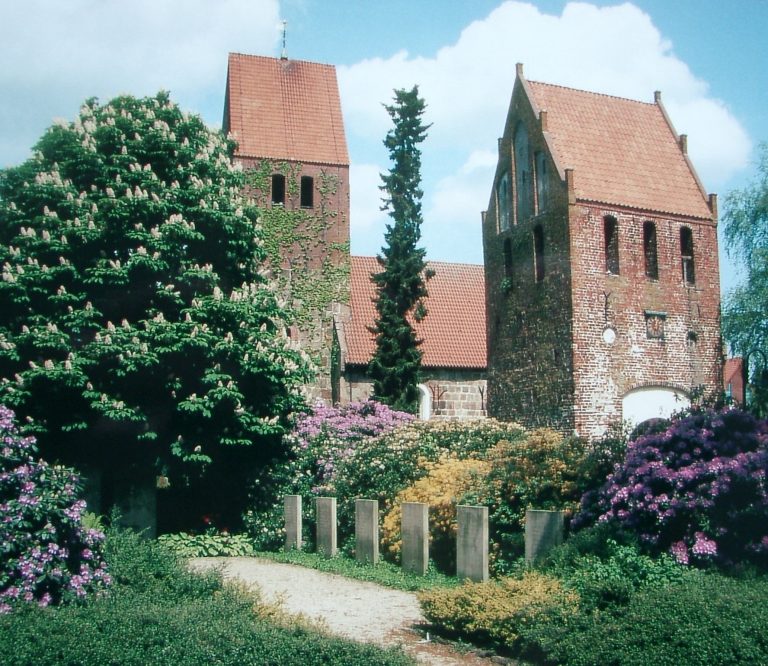
Saint Ulrich’s Church is a four-bay Gothic brick hall church. Its surviving medieval fabric incorporates remains of an earlier Romanesque building, while the interior contains a group of furnishings ranging from the thirteenth century to the twentieth century. The church stands with a separate lower bell tower beside it, and the crypt extends beneath the choir.
Medieval fabric and burial spaces
The crypt
The crypt beneath the choir is an unusual feature for a parish church and is the only crypt of its kind in the former administrative district of Weser-Ems. It was probably built around 1100, although proposed dates range from between 1059 and 1091 to approximately 1100. Cross-rib vaults, which are supported by intersecting stone ribs, rest on four columns with cushion capitals. The column bases have corner spurs. The crypt is regarded as the oldest surviving church interior in the Oldenburg region.
Builders who also worked on the eastern crypt of Bremen Cathedral probably participated in its construction. Two painted consecration crosses survive from the medieval period. A Baroque sandstone sarcophagus remains visible in the crypt and contains the burial of Sophie Eleonore of Schleswig-Holstein-Sonderburg-Beck, who lived from 1659 to 1744. The ossuary created during the 2001 to 2002 renovation contains the reburied human remains from the former burial arrangements.
The church walls and hagioscope
The fieldstone masonry at the base of the west tower and parts of the western nave wall belong to the earlier Romanesque building. A small window remains visible in the south wall, although it is now bricked up. It was probably a hagioscope, also called a leper window, through which people excluded from the main congregation could see the altar and follow the Mass. The opening is associated with the altar made in 1637.
The bell tower
The lower bell tower stands separately beside the church, a form common in the Ammerland. It is a fifteenth-century structure with a stepped gable and contains three bells. The two older bells were cast in 1498 and 1522 by Johannes Frese of Osnabrück. The third was cast in 1992 by the Rincker firm in Sinn.
Memorial sculpture and baptismal font
The grave slab of Count Moritz
The grave slab of Count Moritz of Oldenburg, who died in 1420, is located in the tower hall. It represents the knight almost life-size in nearly fully three-dimensional sculpture. He wears a fashionable suit of armor decorated with small bells, and two dogs at his feet represent loyalty. The figure’s resemblance to the Roland of Bremen has been attributed to its hairstyle and period style rather than to work by the same sculptor. A more recent interpretation connects it with the anonymous Master of the Bentlage Crucifixion Relief from Münster.
The baptismal font
The thirteenth-century baptismal font carries eight expressive figures in high relief, including Christ, Saint Peter, and other Apostles. The stone figures stand beneath a band of foliage inhabited by fantastic creatures, making the font one of the church’s surviving medieval works.
Baroque furnishings and later decoration
The pulpit
Duke Anton Günther donated the pulpit in 1612, and Ludwig Münstermann made it in 1632. Münstermann was a major early seventeenth-century sculptor and woodcarver active in the Oldenburg region. The pulpit originally stood at the front edge of the raised choir. After the vault collapse of 1645, its remains were reassembled, but its present condition and reconstruction cannot reliably represent the original work.
Two of the five niches in the pulpit basket now contain Mary and John from a former Crucifixion group that once crowned the soundboard. The original alabaster figures of the Savior and the four Evangelists were still present in 1859 but have since disappeared. The Crucified figure from the soundboard has been missing since 1959, and renewed paintwork can no longer be reliably compared with the original surfaces.
The altar retable
The altar retable, the decorated architectural structure behind the altar, has a frame in the cartilage style, a highly ornamental seventeenth-century manner with curling and ear-like forms. Lucretia de St. Simon both designed and painted its three signed pictures in 1636. The predella, or lower section of an altarpiece, shows the Last Supper. The central panel represents the Resurrection, and the upper roundel depicts the miracle of Pentecost.
Ten of the twelve small wooden Apostles on the side consoles of the altar structure came from a late Gothic carved altar. Later overpainting partly obscures the quality of their carving.
The Schröder epitaph
On the south wall of the choir is a wooden epitaph for Reinhard Schröder, who died in 1662 after serving as a riding master in the comital stables. It contains a painting of the Crucifixion set within a richly carved frame with auricular ornament.
The galleries and stained glass
The galleries carry varied blue-painted rocaille ornament. Their decoration is associated with the inscription dated 1774 and was uncovered and restored in 1983. The church’s later glazing includes the 1909 representations of Peter and Paul and the 1959 window devoted to Saint Ulrich, designed by György Lehoczky.