St. Mary Magdalene’s Church: A Historic Church in Riga, Latvia


Site at a Glance
- Rating
- 4.8
- Popularity
- Low
- Country
- Latvia
- Primary era
- Early Modern
- External website
- Open
- Eras represented
- Medieval, Early Modern, Modern
- Civilizations
- Holy Roman Empire, Russian, Swedish
- Site type
- Religious
- Remains
- Church
On this page8 sections
History
Cistercian foundation
St. Mary Magdalene’s Church is a historic Baroque church in Riga, Latvia, founded for a Cistercian women’s abbey in the late fourteenth or early fifteenth century. The Cistercians were a Catholic monastic order that emphasized communal religious life, prayer, and disciplined observance. The abbey was popularly called the “Abbey of the Singing Virgins.” Its choir nuns came from wealthy bourgeois families, while unmarried women and widows could also seek a withdrawn religious life there.
The Cistercian abbey was closed in 1582 after the Reformation reached Riga. The church then ceased to serve as a place of worship and deteriorated. It was deliberately destroyed in 1621 during the Swedish capture of Riga. After 1632, Gustav II Adolf, the Swedish king who led Sweden during its major seventeenth-century military expansion, permitted its reconstruction in conditions associated with the Truce of Altmark.
Swedish Lutheran rebuilding
Reconstruction continued from 1632 to 1639. Swedish garrison architects worked with Latvian guild stonemasons to restore the building. In 1639 it was consecrated as a Lutheran garrison church, a Protestant church intended for the military community stationed in a town or fortress. Wealthier and more prominent Lutheran worshippers attended nearby St. James’s Church instead.
Orthodox transformation
The adjoining monastery was destroyed by bombardment in 1710. After Russian forces under Field Marshal Boris Sheremetev entered Riga on 14 July that year, Peter I ordered the church rebuilt as an Orthodox church dedicated to St. Alexis the Man of God, a Christian ascetic and saint venerated in Eastern Christianity. The dedication honored the patron saint of Peter’s father, Alexei Mikhailovich. The church consequently became the principal Orthodox church of the region.
During its Orthodox period, the church contained the tombs of prominent Russian military and administrative figures, including Riga governor-general Anikita Repnin, his son General Vasily Repnin, Prince Dolgorukov, and General-in-Chief Lopukhin. Anikita Repnin was a Russian commander and governor-general of Riga, while Vasily Repnin was his son and a general. Prince Dolgorukov served as governor of Livonia and Riga, and Lopukhin held the rank of general-in-chief. These tombs had disappeared by 1914.
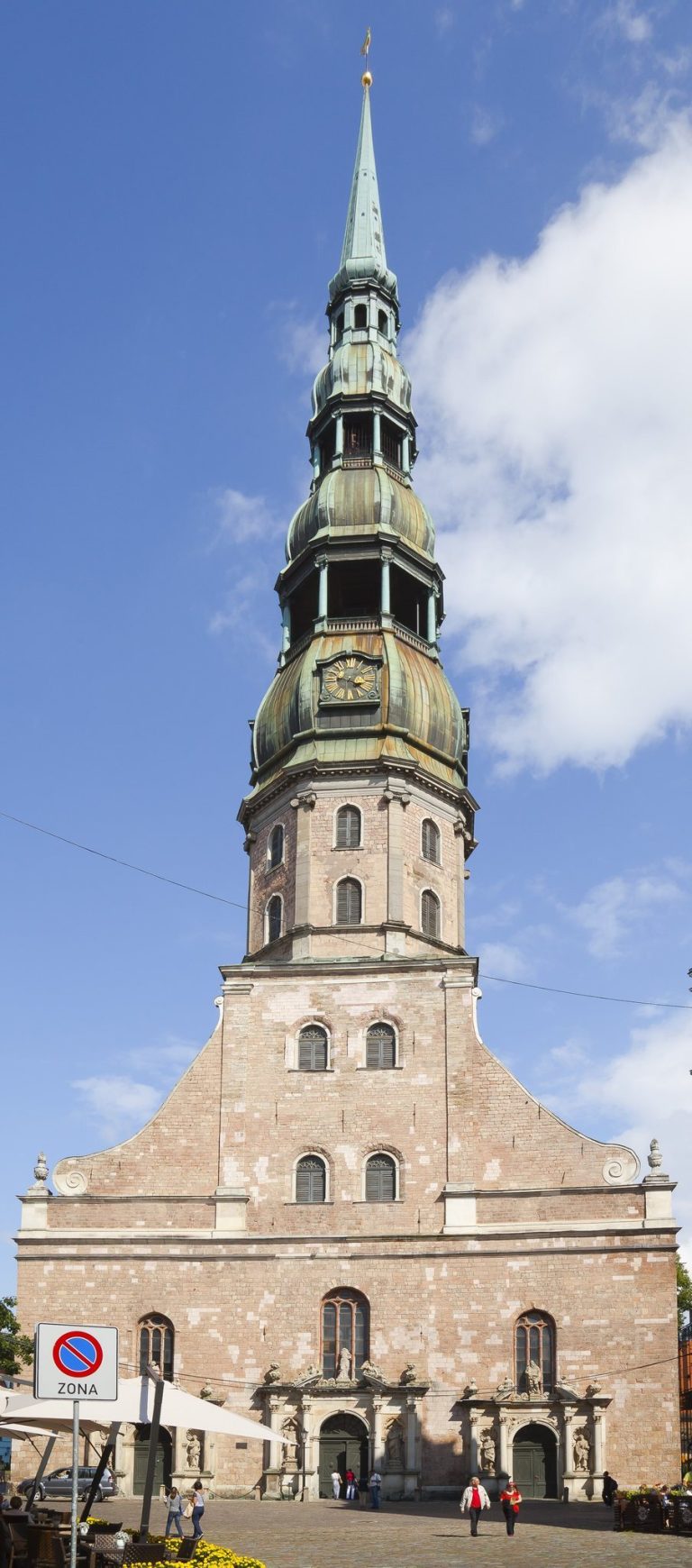
Extensive reconstruction took place in 1746, when the church was Riga’s only Orthodox church. Some datings place this rebuilding between 1751 and 1761. The Livonian architect Nikolai Vasilyev designed the tower and altar section, while the facade and interiors were remodeled in Baroque forms, an early-modern style characterized by dramatic forms, elaborate decoration, and richly treated interiors.
From Orthodox monastery to Catholic church
A Holy Synod decree dated 19–26 April 1896 established a monastery at the Riga Bishop’s House. The Orthodox parish was closed, and the former parish church of St. Alexis became a monastic church. During the political upheavals and civil war in Latvia from 1917 to 1919, authorities operating under German power closed it as an Orthodox institution.
After Latvian independence, the government transferred the church to Riga’s Catholic community in 1923. In 1929 Arthur Mödlinger, a Baltic German architect and pupil of Konstantīns Pēkšēns, substantially redesigned the spire of Vasilyev’s tower. The church was later restored, and a women’s Franciscan community established itself in the former Orthodox monastery during the 1930s. It is now a Roman Catholic institution serving that community and bears the name of Mary Magdalene, a New Testament figure traditionally regarded as a close follower of Jesus and an early witness to his resurrection. Latvia designated it a national architectural monument on 18 December 1998.
Remains
Church building
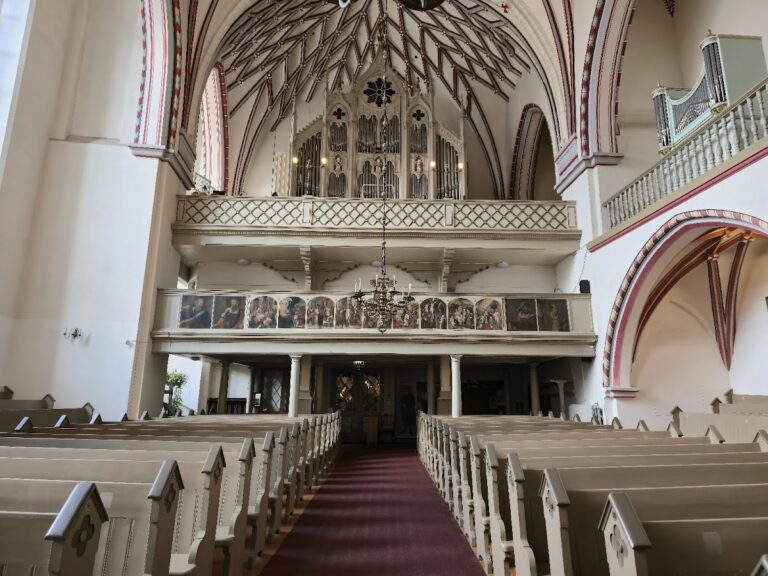
The church stands in Riga’s Old Town at 2 Klostera Street, between Riga’s Catholic cathedral and Riga Castle, the official residence of Latvia’s president. Its surviving form is a Baroque, three-nave hall church with unusually narrow side aisles. Decoratively treated galleries are incorporated into the naves, giving the interior a structured vertical arrangement. Vasilyev’s tower and altar section belong to the church’s Orthodox rebuilding, while the facade and interiors reflect their later Baroque remodeling. Mödlinger’s 1929 intervention substantially altered the tower spire.
Monastic setting
The buildings of the former Cistercian monastery have not survived. The church is adjoined by a women’s Franciscan monastery, which occupies the buildings formerly used by the Orthodox St. Alexis monastery. This surviving adjoining complex reflects the building’s later religious history, after the original Cistercian institution had been closed and the site had passed through Lutheran, Orthodox, and Roman Catholic use.