San Giovanni Grisostomo, Venice: A Renaissance Roman Catholic Church


Site at a Glance
- Rating
- 4.6
- Popularity
- Low
- Country
- Italy
- Primary era
- Early Modern
- Eras represented
- Early Modern
- Civilizations
- Venetian
- Site type
- Religious
- Remains
- Church
On this page14 sections
History
San Giovanni Grisostomo is a Roman Catholic church in Venice, Italy, rebuilt in the Renaissance period from 1495 under the direction of the Venetian architect Mauro Codussi. Located in the Cannaregio district, it belongs to the Patriarchate of Venice and serves as a filial church attached to the parish of San Canciano Martire.
Foundation and medieval parish
Tradition attributes the foundation of the original church to the Cattaneo family in 1080, when Byzantine influence remained strong in Venetian religious and artistic culture. Documents from the first decades of the twelfth century show that the church already held parish rights.
The dedication honored Saint John Chrysostom, a Christian theologian and church leader who served as Patriarch of Constantinople from 398 to 404. His name, meaning “Golden-Mouthed,” refers to his reputation for eloquent preaching. In 1204, after the conquest of Constantinople, he became patron of the Latin Patriarchate established there, reinforcing his importance within Venetian religious culture.
Fire and Renaissance rebuilding
A fire in 1475 partly or wholly destroyed the original church and affected the surrounding district, including the nearby house associated with Marco Polo. The Venetian Senate ordered reconstruction, and preparatory work began in 1485. Pope Innocent VIII granted an indulgence in 1488 to people who financially supported the rebuilding.
Construction of the present church began in 1495. Mauro Codussi directed the design, while the parish priest Ludovico Talenti initiated the rebuilding and encouraged the renewed use of Byzantine-inspired forms. Codussi died in 1504, and his son Domenico completed the building around 1525. The church was consecrated that year.
Alterations and modern religious life
Street-widening ordered by the Venetian Senate began in 1531. During this work, the original campanile, or bell tower, dating from 1080 was demolished in 1532. The present tower was built later, between 1552 and 1590.
The church was damaged by wartime bombing on 26 February 1918, when the facade was affected. Between 1943 and 1949, the Tamburini company of Crema installed an organ with electro-pneumatic action, probably incorporating parts from an earlier instrument.
San Giovanni Grisostomo also developed a strong cult of the Madonna delle Grazie, a devotional title meaning “Our Lady of Grace.” Giovanni Zanin, appointed vicar on 1 September 1947, promoted the Marian devotion. In March 1977, Patriarch Albino Luciani granted the church the honorary title of sanctuary, a sacred place given special status because of an established devotional cult. On 1 May 1977, he formally proclaimed it the Sanctuary of Madonna delle Grazie. After years of neglect, major repairs to the organ and the church interior began in 2025.
Remains
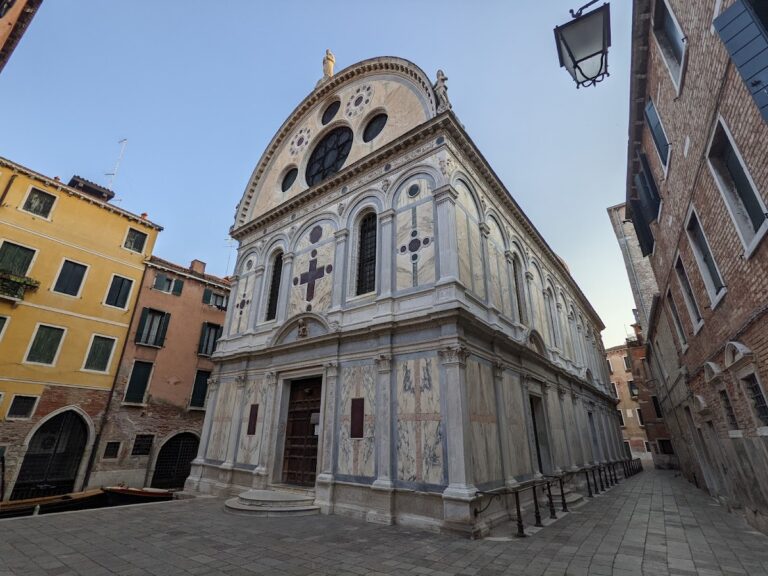
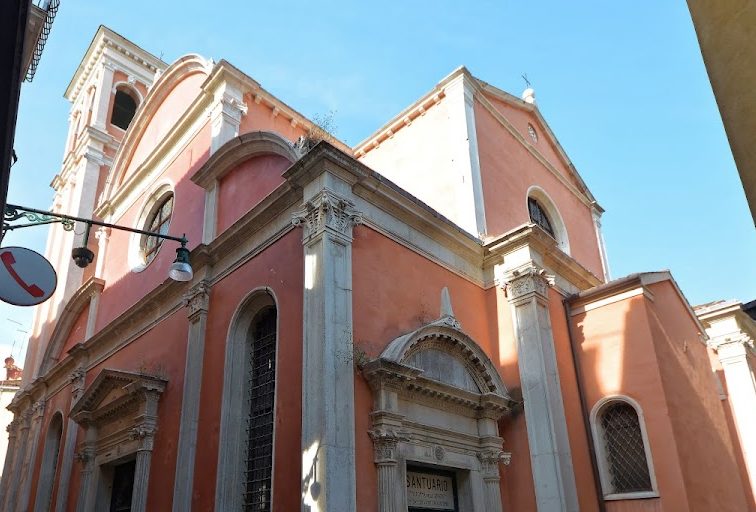
San Giovanni Grisostomo is a small Renaissance church with a regular Greek-cross plan, in which four arms of approximately equal length meet at a central crossing. Its restricted site produces relatively vertical proportions. The facade faces the principal street, while the side walls face two small squares.
Church structure
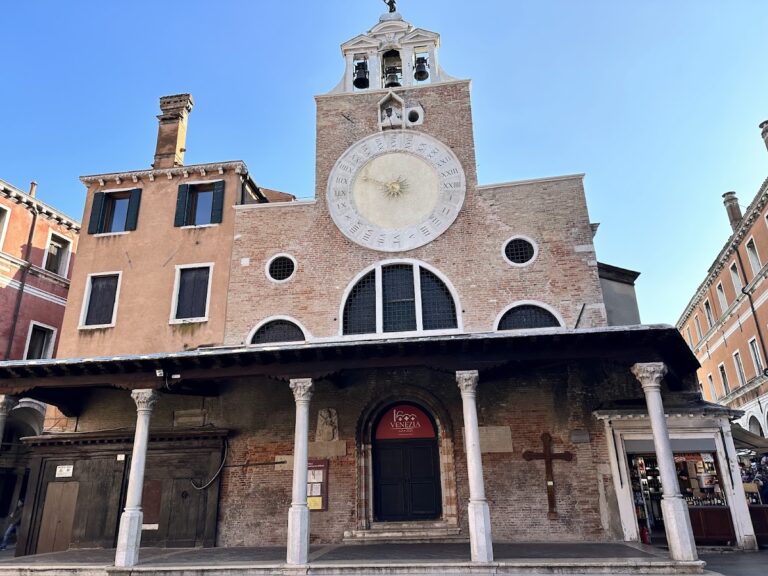
The facade follows Codussi’s characteristic arrangement, with Tuscan influences and three sections crowned by semicircular gables. Brick forms the principal construction material, while plastered and painted surfaces cover much of the exterior. Stone details are concentrated around the doors.
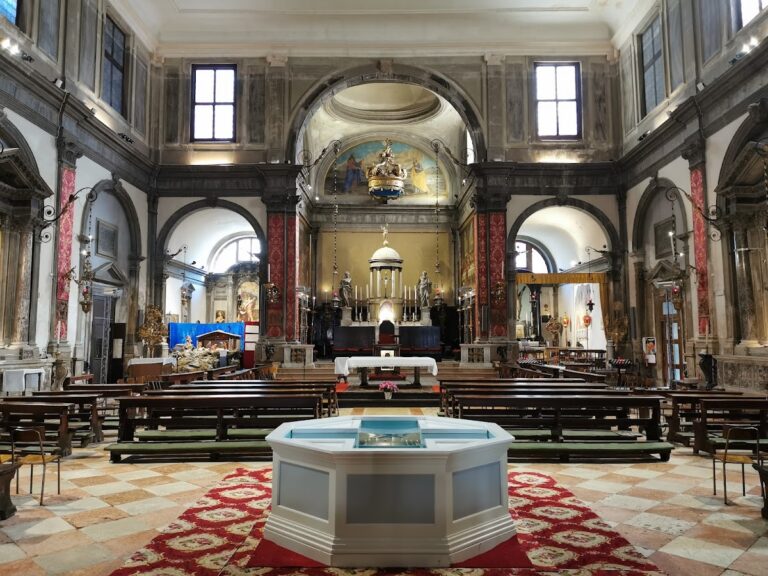
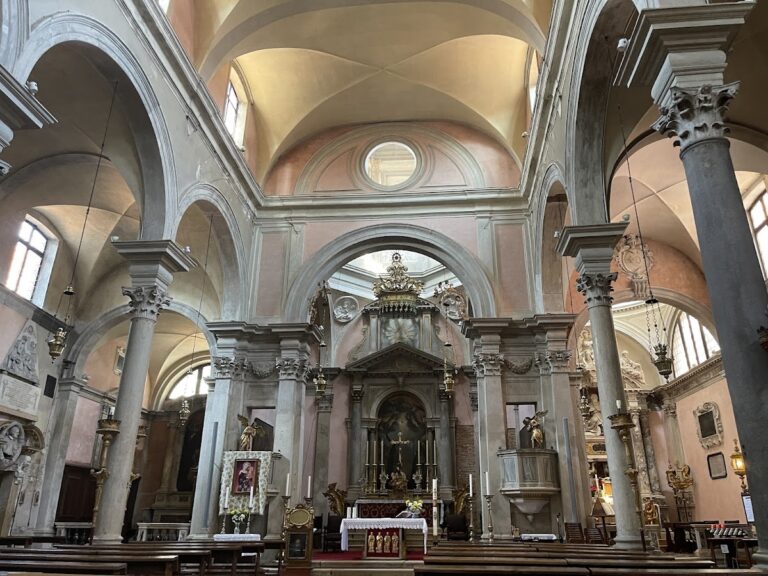
Inside, four classical pillars support the arches of the crossing and carry a hemispherical central dome. The plain walls are enlivened by decorated chapels. The design reflects Codussi’s earlier experience at Santa Maria Formosa. A choir vault attributed to Codussi was replaced by a flat roof to admit more light, and the ceiling before the presbytery is divided into nine compartments of different sizes.
Campanile
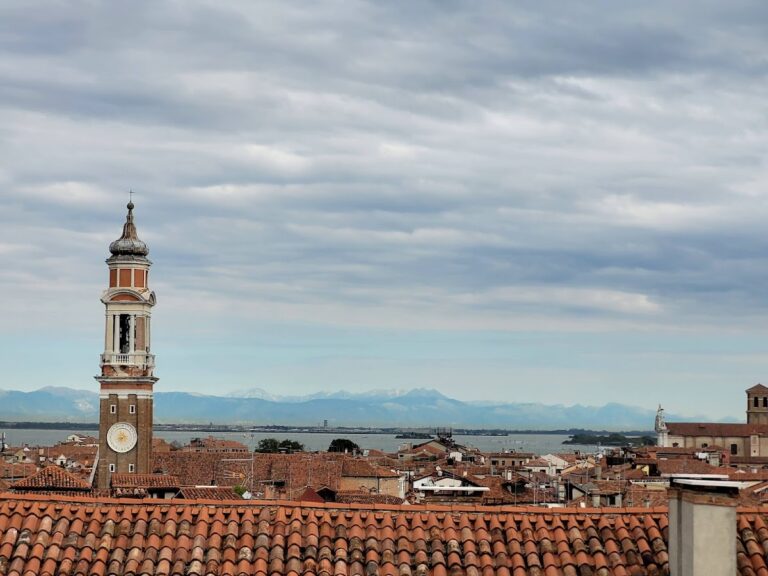
The present campanile was erected between 1552 and 1590 and rises 21 metres. Its bells are operated manually.
Paintings and sculpture
Giovanni Mansueti’s canvases
Behind the facade are two canvases by Giovanni Mansueti that were formerly used as organ doors. They depict Saints Onuphrius, Agatha, Andrew, and John Chrysostom. A finger relic of Saint Onuphrius was brought to the church in 1516.
Bellini’s altarpiece
The chapel to the right of the entrance wall contains Giovanni Bellini’s 1513 altarpiece of Saints Christopher, Jerome, and Louis of Toulouse, also described as an allegory of the Church. The merchant Giorgio Diletti commissioned it with the support of the Scuola Grande di San Marco, one of Venice’s major charitable and religious confraternities. The work is regarded as one of Bellini’s last. Christopher represents action, Jerome intellectual or liturgical life, and Louis contemplation.
Sebastiano del Piombo’s altarpiece
The left rear chapel, also known as the Rosary or Madonna delle Grazie chapel, contains Sebastiano del Piombo’s early-sixteenth-century altarpiece of Saint John Chrysostom. He is shown with Saints John the Evangelist, John the Baptist, Theodore, Catherine of Alexandria, Mary Magdalene, and Lucy of Syracuse. Caterina Contarini commissioned the work, which is dated approximately to 1508–1511.
Tullio Lombardo’s marble altarpiece
Tullio Lombardo made the marble altarpiece of the Coronation of the Virgin among the Apostles between 1500 and 1502 for the Bernabò de Catenariis family of Montepulciano. Its relief shows the Virgin crowned among the twelve Apostles beneath a large coffered vault. God the Father blesses from above, while the Holy Spirit appears among angels.
High altar and chapels
The high altar includes a relief of the Deposition from the Cross. A chapel built for Giacomo Bernabò contains a sculptural design attributed to Mauro Codussi.
Apse paintings and ceiling fresco
The apse contains canvases concerning the life of Saint John Chrysostom and the life of Christ. They include Zaccaria Facchinetti’s Translation of the Body of Saint John Chrysostom of 1610 and Alvise dal Friso’s Saint John Chrysostom Ordained Bishop. The ceiling fresco God the Father among Putti and Cherubim was painted by Giuseppe Diamantini.