San Defendente: A Plague-Votive Church in Clusone, Italy


Site at a Glance
- Rating
- 4.6
- Popularity
- Low
- Country
- Italy
- Primary era
- Medieval
- External website
- Open
- Eras represented
- Medieval, Early Modern, Modern
- Civilizations
- Italian, Venetian
- Site type
- Religious
- Remains
- Church
On this page15 sections
History
San Defendente, formally the Church of Saints Defendente and Rocco, is a Roman Catholic church in Clusone, Italy, built during the plague outbreaks of the 1470s. Construction began in 1470 and ended in 1471, producing a simple late-fifteenth-century church associated with the protection sought from epidemic disease. Saint Rocco, traditionally linked with care for plague victims, and Saint Defendente, a locally venerated Christian martyr regarded as a protector against epidemics, were honored as the church’s patrons.
A votive foundation
The church was built as a votive offering, expressing thanksgiving for protection believed to have been received. Its dedication is connected either with 1471, the year of construction, or with the plague epidemic that affected the Seriana Valley in 1477. From its foundation, a confraternity dedicated to Saints Defendente and Rocco was associated with the church. Votive inscriptions named prominent families of Clusone, including members of the confraternity, linking the building’s devotional purpose with the town’s leading households.
At the edge of Clusone
In 1575, during the apostolic visitation of Cardinal Carlo Borromeo, the church was described as an almost rural oratory. It stood outside the town center, where Clusone’s principal religious, civic, and manufacturing institutions were concentrated. The building lay beyond the defensive walls and the Cima Clusone gate, later known as the San Defendente gate, beside an important road used by merchants, soldiers, pilgrims, and local inhabitants. Its position placed a devotional foundation for protection from disease along a route used by both the local community and travelers.
Suppression, reuse, and restoration
A decree of the Napoleonic Kingdom of Italy dated 25 April 1806 abolished the confraternity that administered San Defendente. The parish retained ownership, but worship ceased. On 3 June 1809 the church was sold to the state and converted into a powder magazine and depot. It briefly reopened for worship in 1863, then closed again and fell into neglect, damaging both its structure and its interior and exterior frescoes.
Archpriest Rizzoli acquired the church in 1878, after which structural restoration included the provision of a new bell tower. San Defendente reopened for worship in 1894, but it was abandoned again after 1904. Further restoration allowed it to reopen in August 1971. Work carried out between 1995 and 2004 on the interior and exterior brought additional fifteenth- and sixteenth-century frescoes to light. The church remains part of the Roman Catholic tradition and belongs to the Diocese of Bergamo.
Remains
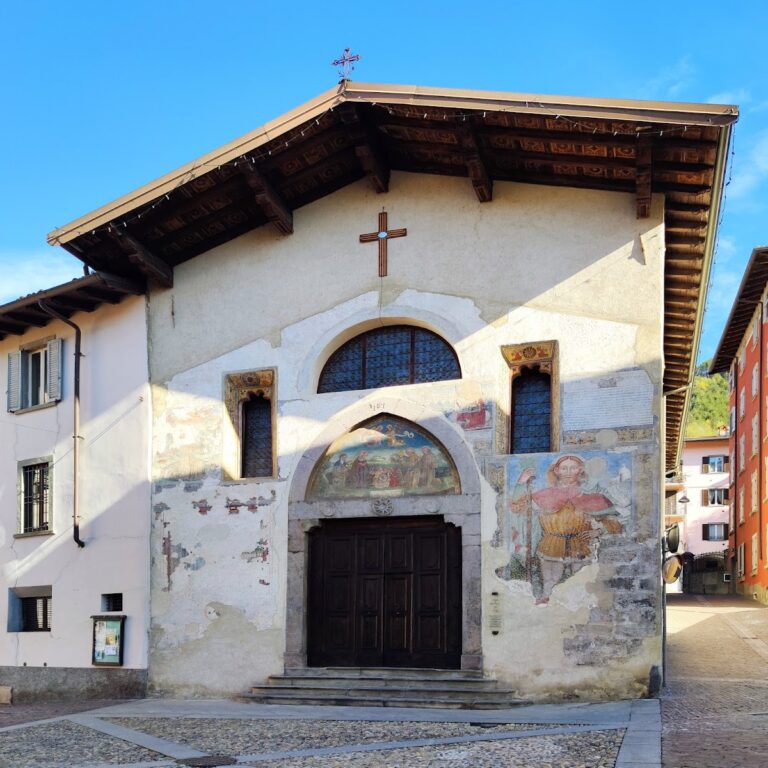
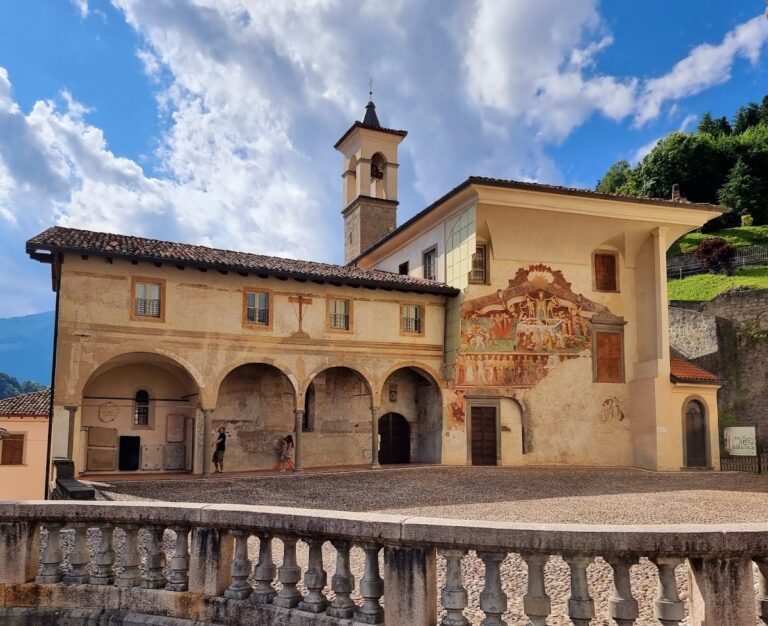
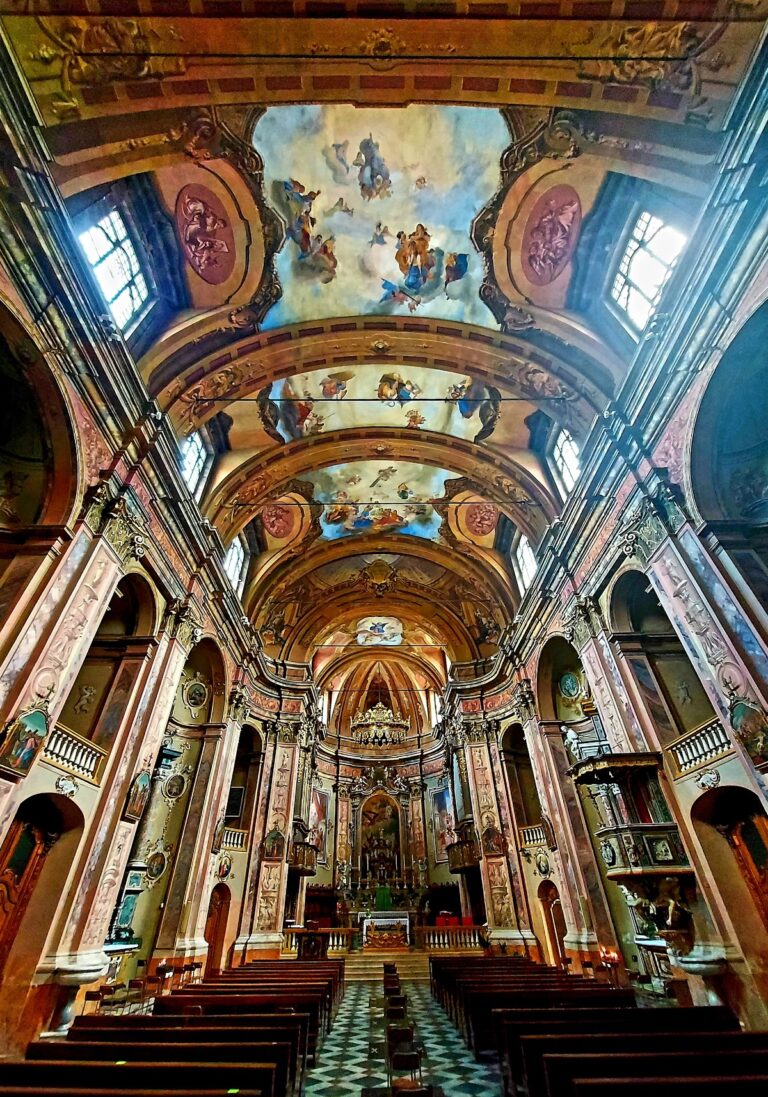
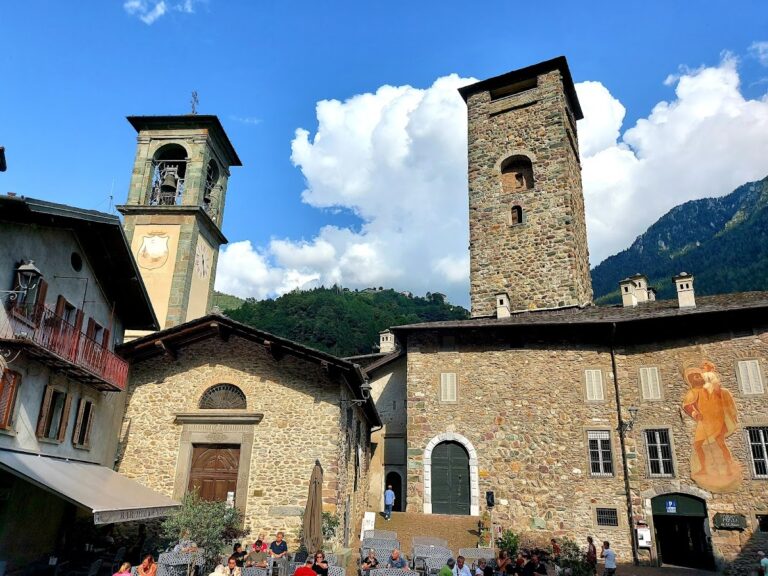
San Defendente retains a compact late-fifteenth-century plan centered on a single nave, a pointed triumphal arch, and a presbytery covered by a cross vault. A small bell tower and a three-bay portico shape the exterior. The portico was added at the end of the sixteenth century against the original gabled facade, concealing early-sixteenth-century paintings while creating a sheltered space for worshippers who could not enter the church. Two sixteenth-century windows were opened so that people outside could contemplate the altar and pray without entering, while also bringing more light into the interior.
Exterior frescoes
The facade triptych
A large triptych, an artwork formed from three panels, occupies the facade. Painted in 1514, it bears an inscription identifying Gelmo de Galopis, an artist from Clusone who died during the plague of 1516, as its painter. The Virgin and Child appear in majesty at the center. Saint Defendente wears ornate armor and a parade giornea, a richly decorated sleeveless outer garment, and holds a martyr’s palm and sword. Saint Martin stands beside them. His presence reflects the spread of Saint Martin of Tours’s cult through the valley and the area’s subjection to the monastery of Tours after Charlemagne’s donation of 774.
The Holy Family fresco
Another exterior painting shows the Holy Family with Saints Defendente and Rocco in the foreground. The landscape includes shepherds, sheep, terraced slopes, and a musician playing a baghèt. An inscription held by an angel gives the fresco the date 1517. Its combination of sacred figures and recognizable rural activities connects the saints’ protective role with the everyday world of the Clusone community.
The Crucifixion and the Passion symbols
An exterior Crucifixion presents Saints Defendente and Rocco witnessing Christ’s death. The horizontal composition includes Christ on a large wooden cross, disks representing the sun and moon, and angels collecting the Precious Blood. Read vertically, the scene becomes a Trinity: God the Father appears as a judge among the Instruments of the Passion, the objects associated with Christ’s suffering and crucifixion, while the dove of the Holy Spirit is placed between the Father and the Son. The arrangement expresses salvation through the cross.
The Instruments of the Passion recur twice elsewhere among the exterior paintings. They appear in a small medallion above the lunette, a semicircular wall surface, containing Christ in the tomb, and in the Pietà in the small lunette above the entrance on the south side. Together, these scenes extend the Passion imagery across the church’s outer walls.
Later votive paintings
A fresco dated 1597 depicts a saint’s vision, in which the saint points toward the Virgin. Its style and brushwork have led to a possible attribution to Domenico Carpinoni, a painter from Clusone. The exterior frescoes as a whole were commissioned by people who associated the intercession of Saints Defendente and Rocco with graces and healings. They therefore combine devotional testimony with images of local landscapes, clothing, occupations, and community life.
Interior paintings
Surviving layers
Part of the former interior decoration remains visible, while at least three fresco layers from the 1530s and 1540s survive beneath the wall plaster. These overlapping campaigns preserve evidence of changing decoration within the church and help explain the dense concentration of images devoted to its two patrons.
Images of Saint Defendente
Saint Defendente appears twenty-five times inside the church in differing forms. He is shown as an ancient-style armored soldier, as a sixteenth-century armored soldier, and as a young man wearing contemporary civilian clothing. On the left side of the north wall, one fresco presents him in aristocratic and courtly dress. Decorated clothing, gold chains, cuffs, and a staff give the figure a regal appearance associated with refined patronage.
In that image, Saint Defendente holds a spiked mace. The weapon refers to the tradition that the Roman emperor Maximian threw a mace at the saint, but it miraculously missed him and fell at his feet. Defendente then took up the emperor’s scepter and proclaimed the triumph of Christianity over pagan worship. The painting thus combines the saint’s military appearance with the story of his victory over imperial authority.
Images of Saint Rocco
Saint Rocco is represented twenty-six times inside the church. Three images occupy the right side of the south wall. In the first, he appears as a young pilgrim displaying the plague bubo on his thigh and holding a pilgrim’s staff, with a traveler’s hat hanging from it. In the central image, he joins his hands in prayer while the bubo remains visible beneath his clothing. In the third, he looks toward a small dog carrying a piece of bread.
The paintings include the details traditionally associated with Saint Rocco’s pilgrimage, including his clothing, staff, pouch, sandals, and hat, together with the plague mark on his left thigh. The dog and bread refer to the tradition that, after contracting the plague and withdrawing to a cave when no one would help him, he was fed each day by a dog until he recovered.
The Madonna and Child
A late-fifteenth-century votive fresco by an unknown painter, possibly connected with Giacomo Borlone de Buschis, shows the Madonna and Child with gentle, smiling faces. A small bird rests in the Child’s hands. Within the image’s devotional meaning, the bird symbolizes liberation from both disease and sin.