Santa Maria degli Angeli: A Renaissance Church and Former Convent on Murano


Site at a Glance
- Rating
- 4.4
- Popularity
- Low
- Country
- Italy
- Primary era
- Early Modern
- Eras represented
- Medieval, Early Modern
- Civilizations
- Venetian
- Site type
- Religious
- Remains
- Church
On this page20 sections
History
Santa Maria degli Angeli is a Roman Catholic church on Murano in Venice, Italy, whose origins date to 1188 and whose present building emerged from a major Renaissance rebuilding between approximately 1494 and 1529. The church belonged to a monastery governed by the rule of Saint Augustine and later became associated with the Augustinian Celestines, a community of nuns that did not observe strict enclosure.
Foundation and Augustinian community
The institution began when Ginevra Gradenigo, compelled by her father Marino Gradenigo to enter religious life, gave land and adjoining waters to Abbess Giacomina Boncio in 1188. The grant provided the setting for a church and monastery on Murano. In later centuries, women from Venice’s leading patrician families joined the community. By about 1590, more than sixty nuns lived there.
The monastery was enlarged in 1429, but its accommodation soon proved inadequate. In 1490, Pope Innocent VIII permitted the transfer of benefices, endowed ecclesiastical offices whose revenues supported their holders or institutions, from the suppressed Cistercian monastery of Santa Maria dell’Ospitale di Piave at Lovadina. The union with the Lovadina foundation greatly increased Santa Maria degli Angeli’s wealth and influence.
Renaissance rebuilding and artistic patronage
The church was rebuilt from its foundations in the late fifteenth century during the priorship of Gabriella Venier. A foundation tablet gives the year 1495 and names Pope Alexander VI, Maximilian of Habsburg, King of the Romans and later Holy Roman Emperor, and Doge Agostino Barbarigo. The completed church was reconsecrated on 16 May 1529.
Agostino Barbarigo strongly supported the rebuilding and the monastery, where two of his daughters were nuns. The Venetian doge, who ruled from 1486 to 1501, gave substantial property and presented Giovanni Bellini’s Virgin Enthroned between Saint Mark Presenting Doge Agostino Barbarigo and Saint Augustine, signed and dated 1488. The painting was later moved to San Pietro Martire on Murano.
The monastery’s wealth and status attracted artists connected with the Venetian tradition, including the Vivarini, Giovanni Bellini, Titian, Il Pordenone, Paolo Veronese, Jacopo Palma the Younger, Francesco Salviati, and Pier Maria Pennacchi. Its apostolic privileges also gave the abbess an unusual institutional role. With the Patriarch of Venice’s approval, she invested eleven mainland parish priests and the priest of San Salvador in Murano. Each chosen priest received a ring, cap, oath, and formal investiture from the abbess before being given the keys to the new church.
Prestige, suppression, and restoration
The monastery’s reputation extended beyond Venice. In 1574, Henry III, king of Poland and newly crowned king of France, visited the church. His reception on Murano included a specially built dragon-shaped boat on which leading glassmakers worked glass paste.
Napoleonic decrees of 1805 and 1806 made the monastery state property, and the community was suppressed in 1810. The monastery building was demolished in 1832, while many artworks from the church were dispersed. The church itself closed in 1848 because it was considered structurally unsafe. Restoration in 1861 prepared it for reopening in 1863, and in 1871 and 1872 the former nuns’ gallery was enclosed and three-storey rooms were constructed for a charitable organization.
Further deterioration led to another closure in 1902, after artworks were removed from the unsafe high altar. A substantial restoration undertaken from 1932 to 1935 at the request of priests from San Pietro Martire strengthened the walls, revealed sections of fresco, repaired the wooden coffered ceiling and marble floor, and restored the sacristy. Artworks and eighteenth-century collections were also brought back from other locations. The church reopened for worship in 1935.
External conservation in 1996 replaced the roof covering, reinforced the walls with stainless-steel rods, renewed the exterior plaster on the presbytery and western sides, and temporarily supported parts of the eastern wall. Santa Maria degli Angeli is now a filial church, meaning a church attached administratively to a parish rather than serving as its principal church, associated with the parish of San Pietro Martire.
Remains
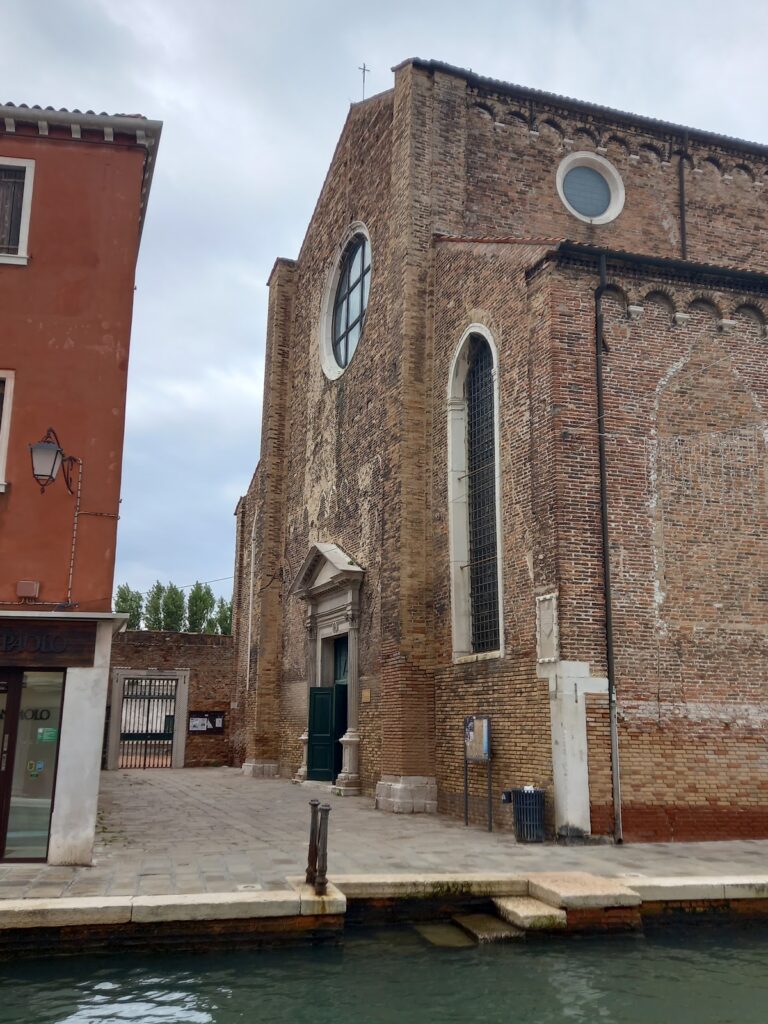
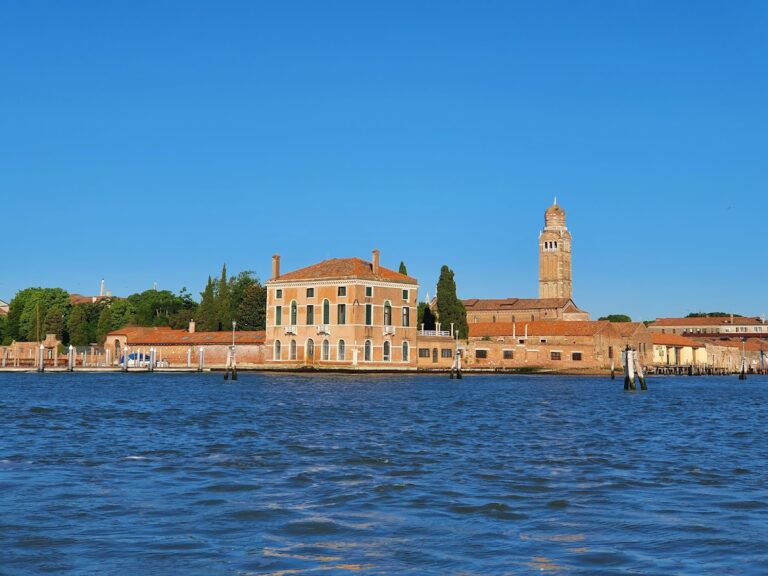
Santa Maria degli Angeli survives as a Renaissance brick church with a single nave, a separate bell tower, and a spacious square presbytery beneath a dome. It is approached across the campo named for the church from Fondamenta Venier through a side gate. The surviving interior combines the restrained spatial organization of the rebuilt Renaissance church with later Baroque altar furnishings and paintings returned or retained after the monastery’s suppression.
Exterior and entrance
Facade and campanile
The campanile, an Italian bell tower, stands to the left of the facade. The facade is arranged in three parts by pilasters that carry a stone cornice and a pediment with a central window. Two rows of arched windows and a rose window illuminate the front, while the main portal is crowned by a broken pediment. The eastern wall remains exposed brick and has arched windows with four pilasters; the northern wall is plastered.
Annunciation gate
The side entrance gate is topped by an Istrian-marble relief of the Annunciation by an unknown artist. Mary stands with her arms crossed over her breast and her head bowed, while the kneeling Archangel Gabriel holds a lily and raises his right hand. Above them, the Holy Spirit appears as a dove sending rays toward Mary, with a lectern between the two figures. The composition recalls fifteenth-century Lombard art.
Principal doorway relief
A high relief above the main doorway shows God the Father emerging from foliage and holding a book. His right hand is mutilated and probably once held a globe. The relief may have belonged to the earlier church that preceded the Renaissance rebuilding.
Nave and upper galleries
Nave and presbytery
A long corridor leads into the interior. The single nave contains five altars, large arched windows, and a flat coffered ceiling, meaning a ceiling divided into recessed painted panels. At the eastern end, the nave opens into a broad square presbytery, the area around the main altar reserved for clergy. A dome rests above it on pendentives, curved triangular surfaces that support a dome over a square space.
Painted ceiling
The ceiling holds thirty-nine painted panels. Their subjects include the Apostles, seven Prophets, the symbols of the four Evangelists, the four Fathers of the Church, and angels surrounding a central Coronation of the Virgin. The panels have been placed either around 1495 or about 1520 and are attributed either to Nicolò Rondinelli, a painter from Ravenna associated with Giovanni Bellini, or to Pier Maria Pennacchi.
Former nuns’ gallery and music gallery
The raised choir gallery used by the nuns, known as a barco, once stood above the entrance but was later demolished. Above the sacristy door is a music gallery made of yellow marble with mother-of-pearl inlay. The gallery was recovered during the 1935 restoration from San Pietro Martire, where it had been reused as a large pulpit. Its original organ no longer survives.
Altars and paintings
High altar
The high altar and its surrounding sculpture were made around the turn of the eighteenth century by the Marinali brothers. The ensemble is built in Carrara marble as a richly ornamented Baroque composition. Faith, Hope, and Charity support the mensa, the altar’s top slab or table. Above it, a tabernacle stands on a marble base decorated with mother-of-pearl and jasper. Cherubim and angels frame an inlaid representation of the Annunciation.
Above the high altar hangs Il Pordenone’s Annunciation, painted around 1537. It was commissioned after the nuns failed to reach an agreement with Titian over the price of his proposed work. The painting remains associated with the church’s Renaissance and later artistic patronage.
Side altars
Two small Baroque altars beside the presbytery arch are made from Carrara marble. They contain Giuseppe Porta’s, also known as Salviati, Touch Me Not and Christ Taken Down from the Cross. The right-hand altar bears Jacopo Palma the Younger’s Virgin in Glory and Saints. On the left, Pietro Damini’s Virgin with Saints Prosdocimus and Benedict is accompanied by statues of Saint Augustine and Saint Lawrence.
Counterfacade paintings
Opposite one another on the counterfacade, the inner wall facing the entrance, are Francesco Zugno’s The Pool of Bethesda and The Calling of Levi. The same area contains Antonio Molinari’s imposing seventeenth-century painting of the Death of Uzzah. In the biblical episode, Uzzah is struck by God after touching the Ark of the Covenant.
Monuments and dispersed works
Funerary monuments
The church contains funerary monuments to Lorenzo Contarini, who died in 1566, and Jacopo Soranzo, who died at Murano in 1590. Soranzo’s monument includes a bust by Alessandro Vittoria. The monument and tomb of Doge Sebastiano Venier, the Venetian commander associated with the Christian fleet’s victory at the Battle of Lepanto in 1571, were later transferred to the Basilica of Saints John and Paul in Venice.
Works moved to other collections
Several works once associated with Santa Maria degli Angeli were transferred to San Pietro Martire. They include Giovanni Bellini’s 1488 Madonna with Child, Saint Mark, Doge Agostino Barbarigo, Saint Augustine, and musical angels; Bartolomeo Vivarini’s Saint Christopher of 1491; Paolo Veronese’s Saint Jerome the Hermit; and a painting from Titian’s school showing Saint John the Baptist and Vincenzo Serena.
Other transferred works include M. A. Dal Moro’s Deposition from the Cross, G. A. da Lodi’s Virgin with Saint John the Baptist, Saint George, and Two Bishops, Giuseppe Porta’s Deposition from the Cross, and B. Licinio’s Blessed Virgin between Saint Lawrence, Saint Ursula, and Procurator L. Pasqualigo. Some paintings went to the Accademia, while tapestries were transferred to the Glass Museum.