Basilique Saint-Maurice d’Épinal: A Medieval Collegiate Church and Minor Basilica


Site at a Glance
- Rating
- 4.6
- Popularity
- Low
- Country
- France
- Primary era
- Medieval
- External website
- Open
- Eras represented
- Medieval, Modern
- Civilizations
- French, Holy Roman Empire
- Site type
- Religious
- Remains
- Church
On this page10 sections
History
Basilique Saint-Maurice d’Épinal is a Catholic minor basilica in Épinal, France, whose present form was built between the eleventh and thirteenth centuries in Romanesque and Gothic traditions. Dedicated to Saint Maurice, the church developed from an earlier religious foundation and served both the town and its ecclesiastical communities.
The tenth-century foundation
The basilica probably occupies the site of Épinal’s first church, built in the tenth century by Gerard, Bishop of Toul, at the request of Thierry de Hamelant, Bishop of Metz, also known as Thierry I of Metz. Thierry established a monastery there, and the church was dedicated to Saint Maurice for the use of the town’s population and Benedictine monks.
The foundation was completed through a joint visit by Thierry and Gerard. Thierry brought relics of Saint Goëry, a bishop of Metz and an important local saint whose relics later shaped the monastery’s identity. A miracle was reputed to have occurred during the visit and was recorded by Widric.
Medieval religious communities and rebuilding
Adalbero II later found the monastery deserted and established Benedictine nuns there under the patronage of Saint Goëry. During the thirteenth century, the nuns were probably replaced by a chapter of canonesses, a community of women attached to a collegiate church and governed by ecclesiastical statutes. The canonesses continued at Épinal until the end of the eighteenth century.
The surrounding lands depended in the Middle Ages on the lordship of Metz, while ecclesiastical jurisdiction belonged to the Diocese of Toul and the parish of Dogneville. Épinal’s parish was formed from five medieval landed holdings, or manses, that had previously belonged to Dogneville: Spinal, Grennevo, Avrinsart, Villers, and Rualménil.
A Romanesque church was reconstructed in the mid-eleventh century and consecrated by Pope Leo IX. Major works followed during the thirteenth and fourteenth centuries, including the rebuilding of the choir, construction of a new north entrance, addition of the side aisles, and vaulting of the nave. After its renewed dedication to Saint Maurice, the collegiate church also served as Épinal’s parish church, with a parish altar installed at the eastern end of the nave.
A cloister and convent buildings stood south of the nave, with a separate entrance for the religious community. The town’s first cemetery lay south of the choir in the area now called Place de l’Âtre. A crucifix fixed to the south transept wall preserves the connection between the church and this burial ground.
Revolutionary damage and modern status
The church’s sculpted portal suffered severe damage in 1793. Restoration began in 1843 under Abbé Boullangier, assisted by the departmental architect Léon Charles Grillot. Émile Boeswillwald later supervised work on the portal, which was carried out by Schuler. The church was classified as a French historic monument in 1846, and a new Neo-Romanesque entrance was opened through the bell tower during the nineteenth century.
On 20 February 1933, during the pontificate of Pope Pius XI, the parish church of Saint Maurice received the title of minor basilica. This papal designation is an honor granted to certain Catholic churches and is distinct from a cathedral, which is the seat of a bishop. Major restoration campaigns also took place during the twentieth century. The basilica continues its Catholic religious function, and its status is commemorated by a red-and-gold striped ombrellino, a coat of arms, and a bell in the choir.
Remains
The surviving building combines massive Romanesque construction with later Gothic work. Its principal elements include an eleventh-century nave, thirteenth-century side aisles, a substantial tower, a developed choir, and richly sculpted entrances. These parts preserve the changes made as the church served both the parish and its religious community.
Nave and side aisles
The walls of the nave largely belong to the eleventh century. The side aisles were added in the thirteenth century, and traces of the earlier openings remain visible on the exterior of the south wall. Together, the nave and aisles express the building’s transition from Romanesque forms, characterized by heavy construction and rounded arches, toward Gothic forms associated with pointed arches, rib vaults, and stronger vertical emphasis.
The bell tower
The massive tower rises approximately 30 metres and is divided into two parts. Its broader lower section is 17 metres high and contains two square rooms. Above these rooms is a protected wall-walk opened by bays and loopholes. A narrower belfry, set back 1.5 metres, rises above it and houses the bells. A spiral staircase within the thickness of the south wall climbs from the exterior entrance to the wall-walk and ends in a hooked capital. A second staircase begins in the nave beside the tower door and was rediscovered in 1984.
The tower has a sandstone gabled roof installed in 1933. Two crosses stand on the roof, one made of stone with a nimbus and the other of wrought iron topped by a cockerel.
The choir and apses
The choir is formed by a central vessel with two bays, a five-sided apse, and two four-sided subsidiary apses set back by one bay. The main apse is emphasized as the principal area of worship, while the smaller apses provide secondary spaces. Their axes are arranged 45 degrees from the church’s main axis, an arrangement described as unusual in Romanesque architecture. Comparable arrangements appear at Montbron, Monsempron-Libos, Puypéroux Abbey, and the Saint-Quenin Chapel at Vaison-la-Romaine. The pattern was later used in Gothic buildings including Saint-Yved Abbey Church at Braine, Saint-Gengoult Collegiate Church at Toul, the Sainte-Chapelle of Dijon, Bonlieu, and Saint-Maximin.
The Portal of the Bourgeois
The thirteenth-century north entrance, known as the Portal of the Bourgeois, served parishioners, while the religious community used its separate southern entrance. The portal has a trapezoidal entrance measuring 7.6 metres in length, a rib-vaulted passage, decorated archivolts, and sculpted figures on both side walls. Its lateral and frontal tympana carry decoration, while foliage ornament ends in hooks. The keystone contains an Agnus Dei, the Lamb of God symbol representing Christ, within a foliage circle, alongside a badly damaged figure that may represent an angel.
A projecting ridge above the street front rests on corbels shaped as gargoyles. Between the two doors, a 2.25-metre-high statue of the Virgin and Child stands on the central pillar. The statue retains traces of polychromy and appears to date from the thirteenth century. Five heads from the portal are preserved at the Departmental Museum of Ancient and Contemporary Art in Épinal.
Relics, art, and burials
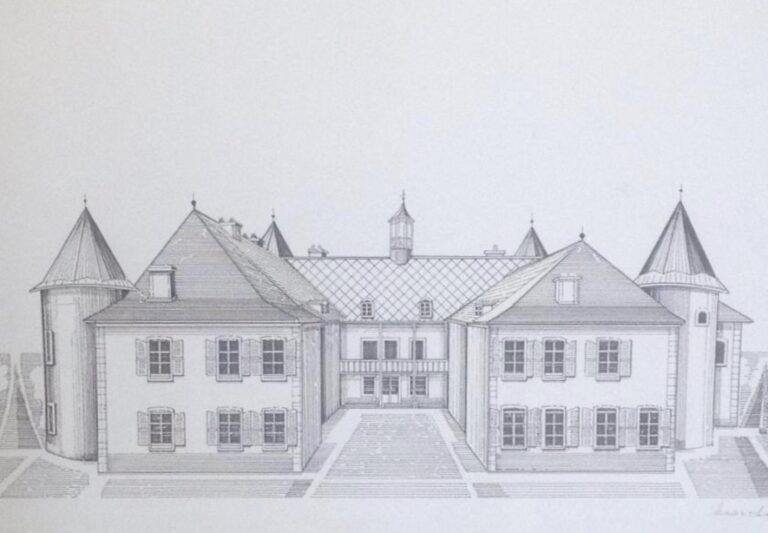
The basilica contains a seventeenth-century painting by Nicolas Bellot showing the Passion of Christ and the château of Épinal, which represents Jerusalem. Above the altar, an eighteenth-century painting depicts Saint Goëry with his daughters, Saint Précie and Saint Victorine. An additional altar is dedicated to the relics.
Relics associated with Saint Auger, Saint Goëry, and Saint Maurice and his companions are preserved in reliquaries. The central reliquary contains Goëry’s body, the one on the left is associated with Auger, and the one on the right contains relics of Maurice of Agaunum and his companions. Saint Maurice of Agaunum is the martyr traditionally linked with the Theban Legion and venerated at Agaunum, now Saint-Maurice in Switzerland.
A necropolis associated with the chapter of Saint Goëry’s canonesses contains burials ranging from Yolande de Bassompierre to Gabrielle de Spada. The basilica also preserves a richly decorated but damaged organ. It is electrically operated and can also function through bellows. Three rosary series represent the Glorious, Sorrowful, and Joyful Mysteries, with one including a representation of the château of Épinal.