Santa Maria delle Grazie: A Renaissance Franciscan Church in Varallo


Site at a Glance
- Rating
- 4.8
- Popularity
- Low
- Country
- Italy
- Primary era
- Medieval
- External website
- Open
- Eras represented
- Medieval, Early Modern
- Civilizations
- Duchy of Milan
- Site type
- Religious
- Remains
- Church
On this page14 sections
History
Santa Maria delle Grazie is a Roman Catholic church in Varallo, Italy, commissioned for the Friars Minor Observant between 1486 and 1493 as the Franciscan Sacro Monte of Varallo was beginning to take shape. Dedicated to Our Lady of the Graces and belonging to the Diocese of Novara, the church and adjoining convent followed the institutional and architectural model of the Observants, a reform branch of the Franciscan Order that emphasized stricter adherence to its rule.
Foundation and Franciscan purpose
Father Bernardino Caimi initiated the church and convent during a period of renewed Franciscan activity in Varallo. Their organization reflected a practice traditionally associated with Saint Bernardino of Siena, the fifteenth-century Franciscan preacher and reformer linked with the Observant movement. A full-height internal partition separated the area used by lay worshippers from the liturgical space reserved for the friars. This arrangement became known as the “Bernardine module.”
The complex formed part of the devotional setting that developed around the Sacro Monte, a Catholic complex of chapels and tableaux presenting scenes from the life of Christ through painted settings and sculpted figures. The church’s partition wall later became especially important to this development, because its sequence of Gospel scenes provided an artistic and programmatic model for the chapels constructed on the rocky slope above Varallo.
Gaudenzio Ferrari and the Sacro Monte
In 1513, Gaudenzio Ferrari painted the principal partition wall. Ferrari, a Renaissance painter from Valsesia, created a cycle that became a major work of Renaissance art in Piedmont and Lombardy. Its arrangement influenced the later development of the Sacro Monte, including the work of Giovanni d’Enrico and Tabacchetti, artists associated with the complex’s subsequent artistic history.
Ferrari’s style brought together Renaissance developments associated with Leonardo in Milan, Bramantino, Perugino, and central Italian painting with the influence of Martino Spanzotti and the older Gothic tradition of Piedmont, particularly the work of Jaquerio. The nocturnal scene of the Arrest of Christ closely follows Spanzotti’s comparable composition at San Bernardino in Ivrea. Ferrari’s treatment of figures with relief-like effects also relates to the three-dimensional tableaux used at the Sacro Monte.
Decline, adaptation, and continuing religious use
By the end of the fifteenth century, the Franciscan convent was considerably larger than the surviving complex. It contained two cloisters, friars’ cells, a refectory, a library, and workrooms, including spaces used in constructing the Sacro Monte. The friars abandoned the convent at the beginning of the twentieth century after the buildings had deteriorated. Later redevelopment included the creation of the present square and the adaptation of parts of the complex for public buildings, changes that provoked controversy.
In 1931, Pope Pius XI granted the church the title of minor basilica, a special papal designation distinct from cathedral status. Since 1953, the complex has been occupied by the Suore Missionarie di Gesù Eterno Sacerdote. The church and its paintings continue to express the religious and artistic culture of the Observant Franciscans in Piedmont and Lombardy during the fifteenth and sixteenth centuries.
Remains
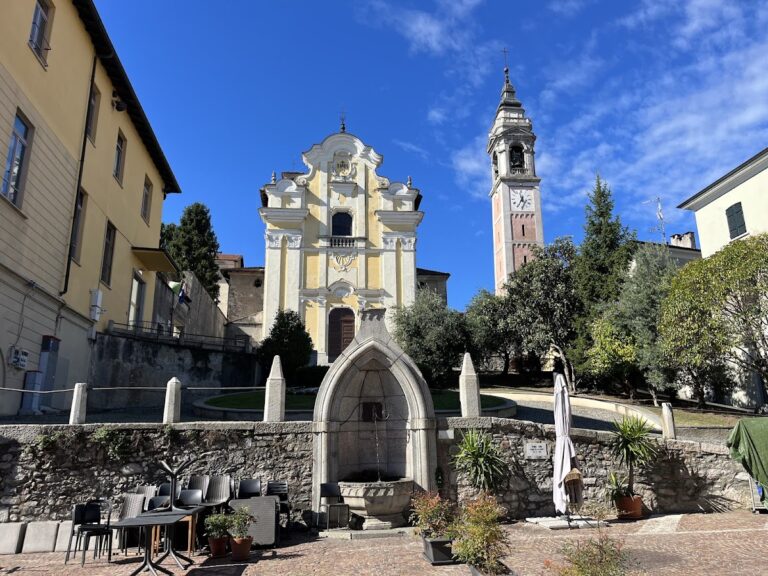
The surviving church is a relatively austere Gothic building whose plain exterior contrasts with the richly decorated interior. Gothic arches support exposed roof trusses, while the principal internal feature is the full-height partition wall that divides the congregation’s area from the hall reserved for the friars. Three round arches carry the wall: the central opening leads into the friars’ hall, and the two side openings lead to chapels.
Partition wall and fresco cycle
Life and Passion of Christ
The partition wall measures approximately 10.4 by 8 metres, covering about 82 square metres. Ferrari arranged the frescoes in twenty equal panels that narrate the Life and Passion of Christ, following the instructional pattern of a Biblia pauperum, or “Bible of the poor,” an image-based presentation of biblical stories and Christian teaching. The sequence begins with the Annunciation and continues through the Nativity, Adoration of the Magi, Flight into Egypt, Baptism of Jesus, Raising of Lazarus, Entry into Jerusalem, Last Supper, Washing of the Feet, Agony in the Garden, and Arrest of Christ.
The narrative proceeds with Jesus before Herod, Jesus before Pilate, Flagellation, Pilate Washing His Hands, Ascent to Calvary, Preparation of the Cross, Lamentation, Descent into Limbo, and Christ Resurrected. The Crucifixion occupies four central panels, giving it the visual and dramatic focus of the composition. Medallions show Saint Francis and Saint Bernardino of Siena, while two others carry Ferrari’s autograph inscription, “Gaudenzius Ferrarius Vallis Siccidae pinxit.”
Ferrari used raised or relief-like treatment in several scenes for armour and halos, intensifying the appearance of reflected light and radiance. Rocky landscapes and carefully constructed architectural perspectives add depth to the compositions. The Arrest of Christ is particularly notable for its dramatic torchlit night setting, which gives the scene a strong sense of movement and illumination.
Chapels beneath the partition
Chapel of Saint Margaret
The Chapel of Saint Margaret lies beneath the partition wall and contains frescoes painted by Ferrari in 1507. They depict the Presentation of Jesus at the Temple and the Debate with the Doctors. Grotesque ornament completes the decoration of the chapel.
Chapel of the Graces
On the right beneath the partition wall, the Chapel of the Graces preserves frescoes from the Milanese school, probably dating to about 1491. The scenes show the Birth of the Virgin, the Marriage of the Virgin, and the Adoration of the Magi, while prophets appear in the arches. The paintings are attributed to the workshop of the Milanese painter Giovanni Scotto.
Above the altar stands a wooden statue of the Virgin with the standing Christ Child on her knees. It has been heavily repainted and is regarded as an ancient icon of strong importance in popular devotion.
Additional interior and convent remains
Fresco by Fermo Stella
Near the pulpit on the left wall of the nave is a fresco by Fermo Stella, Ferrari’s pupil and collaborator. It represents Jesus taking leave of his mother, an uncommon subject in religious art derived from a homily by John Chrysostom.
Former Franciscan convent
The former convent preserves the reduced material remains of a complex that once included two cloisters, friars’ cells, a refectory, a library, and workrooms connected especially with the construction of the Sacro Monte. Frescoes once covered the outer walls. Most have disappeared or deteriorated severely, although a still-legible Pietà survives and has been attributed, with considerable reservation, to Ferrari’s youth.
Monument in the square
The present square contains a monument to Gaudenzio Ferrari made by Pietro della Vedova in 1874. It forms part of the later setting created around the church and the altered convent complex.
Nearby sites