Oratorio di San Lorenzo all’alpe Seccio: A Romanesque Mountain Oratory in Italy


Site at a Glance
- Rating
- 4.9
- Popularity
- Very Low
- Country
- Italy
- Primary era
- Medieval
- Eras represented
- Medieval, Early Modern
- Civilizations
- Duchy of Milan, Duchy of Savoy
- Site type
- Religious
- Remains
- Chapel
On this page10 sections
History
Oratorio di San Lorenzo all’alpe Seccio is a Roman Catholic mountain oratory in Italy, at Alpe Seccio in the municipality of Boccioleto. It is a Romanesque building consecrated in 1446 and associated with the Diocese of Novara. Recognized as a national monument, it served the permanent alpine community that once lived at the settlement and remains closely connected with local religious traditions.
Early traditions and the alpine settlement
Local traditions connect Alpe Seccio with several bishops of Novara. They claim that Agabio, who died in 440, established the first altar in the Sermenza Valley, and that Bishop Pascenzio later found refuge at the site. These stories have no historical foundation. The settlement itself first appears in a document from 1420, when “Comune Secij” marked the boundary of alpine pastures belonging to the Diocese of Novara in Val d’Egua.
Alpe Seccio was inhabited throughout the year until the end of the seventeenth century. The oratory served this community as a place of worship and burial ground, while masses and marriages were celebrated within it. A graffito states that Francesco married Tredesina on 20 January 1544, linking a personal event to the painted decoration of the building.
Consecration and later changes
The exact foundation date of the present oratory is unknown. An inscription above the side door records its consecration on 24 April 1446, and the fresco cycle was probably created around the same period. A seventeenth-century transcription of an earlier inscription on the north wall names the painter as “Johannes Andreas,” but the name does not allow the artist to be identified more precisely.
After the settlement ceased to be permanently occupied, Alpe Seccio became a seasonal alpine pasture, with huts used during the summer. The oratory continued as a focus of popular devotion, religious celebrations, and processions. In the first decades of the eighteenth century, the south wall was opened to form a large chapel dedicated to Saint Grat. This alteration destroyed more than half of the large Last Supper fresco.
Restoration carried out in 2000 brought greater brightness to the frescoes and clarified the painter’s engagement with the International Gothic style, a late medieval style distinguished by elegant figures, refined outlines, elaborate clothing, and rich decorative detail.
Remains
Setting and building
The oratory stands at about 1,380 metres above sea level above Cavaione Valley, a side valley of the Sermenza Valley. A mule track through beech forests leads to the alpine pastures. The structure has the plain exterior of a mountain building and measures 9.8 metres in length, including the apse, and 4.7 metres in width. Inside, the apse, the arch separating it from the main space, and both side walls are covered by an extensive fresco cycle. A fresco is a wall painting made on fresh plaster, so that its pigments become integrated with the plaster as it dries.
Painted decoration
Exterior north wall
Traces of painted decoration remain on the exterior north wall. They include a large image of Saint Christopher and a Wheel of Fortune, a secular representation of the unpredictability of human affairs. These exterior images extend the painted program beyond the interior worship space.
Interior frescoes
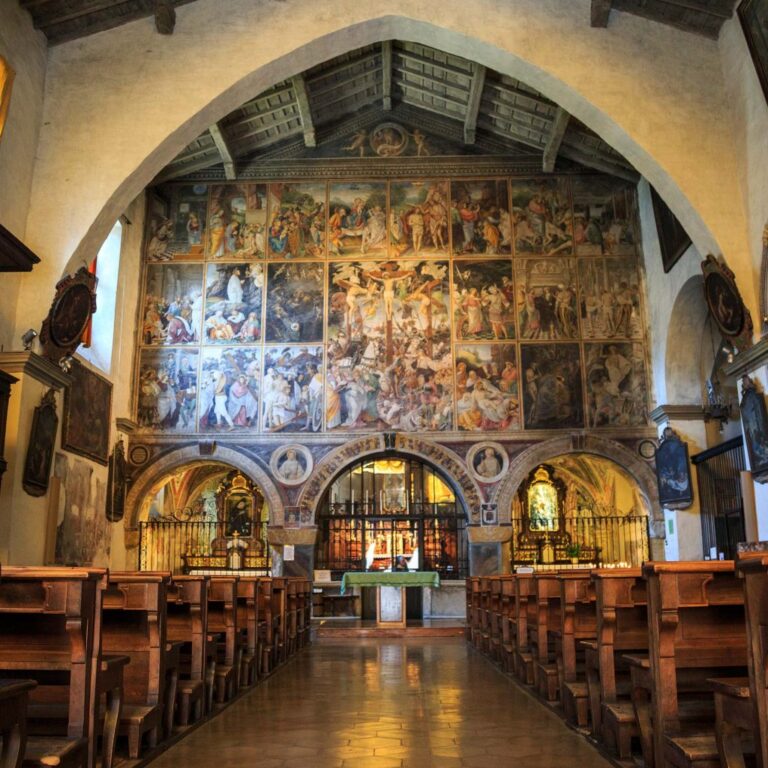
The interior cycle includes scenes from the life and martyrdom of Saint Lawrence. In one scene, the Roman emperor Valerian orders Lawrence to surrender the church treasure. Lawrence was a Christian deacon and martyr traditionally associated with the care of the church’s material goods, while Valerian ruled the Roman Empire from AD 253 to 260 and was associated with persecutions of Christians. The scene gives particular attention to the movement of the conversing figures, their richly detailed clothing, and the modelling of their flesh tones.
Other panels use a more formal devotional arrangement, with saints shown frontally in separate sections and identified by their traditional attributes. Saint Catherine of Alexandria holds a small wheel, Saint Anthony Abbot appears with a tiny pig, and Saint Mark is identified by a very small lion painted on the book in his hands. The north wall also contains Saint Anne Metterza, an image of Saint Anne with her daughter Mary and the infant Jesus. The motif emphasizes Saint Anne’s position as the third figure in the group and her place within the divine family.
Chapel of Saint Grat
The Chapel of Saint Grat occupies part of the south side and contains an altarpiece showing the Virgin and saints associated with the Orgiazzi school. Its creation in the eighteenth century changed the interior arrangement of the oratory and formed a distinct devotional space within the earlier building.
Last Supper
Only the apostles Matthew, Matthias, Peter, Bartholomew, and part of Judas survive from the Last Supper fresco. They stand rigidly before the table in a strongly frontal, archaic composition. Conventional perspective is set aside in order to emphasize the variety of food spread across the table, making the surviving section notable for both its unusual arrangement and its detailed treatment of the meal.