Stiftskirche: Kleve’s Gothic Provost and Parish Church


Site at a Glance
- Rating
- 4.6
- Popularity
- Very Low
- Country
- Germany
- Primary era
- Medieval
- External website
- Open
- Eras represented
- Medieval, Modern
- Civilizations
- Duchy of Cleves, Holy Roman Empire
- Site type
- Religious
- Remains
- Church
On this page12 sections
History
Stiftskirche is the Roman Catholic parish and provost church of Kleve, Germany, dedicated to the Assumption of the Virgin Mary. Its present Gothic building was constructed in the fourteenth and early fifteenth centuries after a collegiate foundation, or stift, was transferred to the town in 1341. A provost church is headed by a provost, while a collegiate foundation is a religious institution in which canons maintained worship and held prebends, rather than living as members of a conventional monastery.
Early churches and the collegiate foundation
A church near Kleve Castle was first recorded in 1170. This earlier parish church was a three-aisled Romanesque basilica built of tuff. Romanesque architecture is characterized by massive masonry, rounded arches, and heavy forms. When Kleve was founded as a town in 1242, the church remained outside the town fortifications. A filial church was established in the lower town from 1425, where a Minorite convent later settled. The Minorites were members of the Franciscan order, whose communities were commonly known as Friars Minor.
Count Dietrich IX of Cleves founded a collegiate foundation dedicated to Mary at Monterberg Castle near Kalkar in 1334. In 1341, with the participation of his brother Johann, the institution was transferred to Kleve. Its principal purpose was to provide prebends for territorial officials. All 13 planned prebends had been endowed by 1366, and the provostship was established in 1441. The parish of Kleve was incorporated into the sovereign’s Marienstift from 1341 until 1802.
Construction of the Gothic church
After the foundation moved to Kleve, Dietrich IX laid the foundation stone for the present church on 12 August 1341. He was buried in its unfinished choir in 1347. The choir was consecrated in 1356, the nave was completed in 1394, and the twin-tower west front was completed in 1426. Gothic architecture developed after the Romanesque period and is associated with pointed arches, greater verticality, and larger window openings.
The church served the collegiate foundation and the parish through the late medieval period. The lower-town church of St. Mary of the Immaculate Conception became an independent parish in 1924, followed by the establishment of the Christ the King parish in 1950. These changes altered the organization of Catholic worship in Kleve while Stiftskirche remained connected to the town’s older ecclesiastical history.
Destruction, reconstruction, and parish changes
French Revolutionary troops entered the region in 1794, and the church suffered heavy damage. The collegiate foundation was dissolved during the Napoleonic secularization of 1802. This process involved the confiscation and dissolution of many ecclesiastical institutions and their property under French rule and the political reorganization of the German territories. After the foundation ended, Stiftskirche became an ordinary parish church.
Bombing by the Royal Air Force during the Second World War almost completely destroyed the church. Reconstruction was completed in 1956, initially without the tower front, and the towers were rebuilt to the historical design by 1969. In 1967, the parish of St. Mary of the Assumption and the church were elevated to a provostship and provost church, giving the parish priest the title of provost. In 2005, five parishes, including St. Mary of the Assumption, were united as a new parish, for which Stiftskirche became the parish church. The church is recognized as a protected monument in North Rhine-Westphalia.
Remains
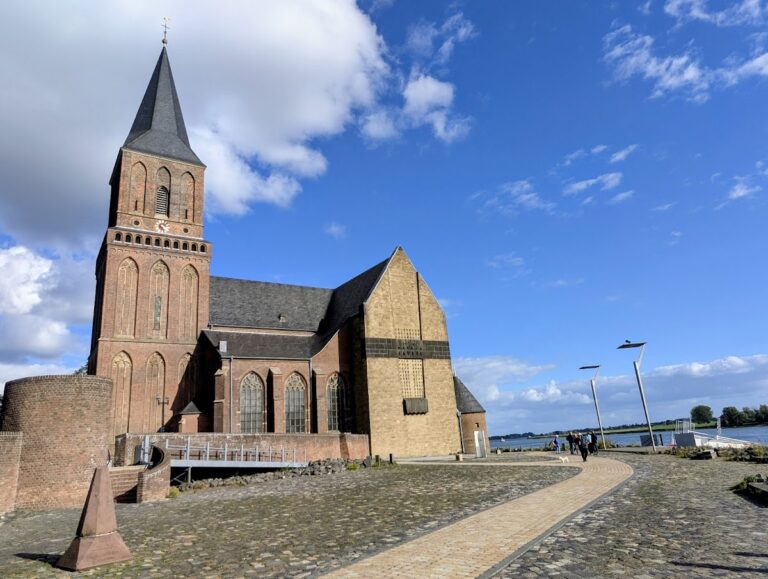
Stiftskirche stands between Kirchplatz and Kleiner Markt in Kleve. Its surviving form combines the Gothic main building completed in 1394 with the twin-tower west front completed in 1426 and reconstructed in 1969 after wartime destruction. The interior and exterior also contain furnishings, memorials, bells, and musical installations from different periods.
Windows and interior furnishings
The present stained-glass windows were made over a period of fifty years, from 1956 to 2006. Artists involved in their design include Dieter Hartmann, Hans Lünenborg, Ursula Lünenborg, Johannes Richstätter, and Paul Weigmann. The windows therefore belong to the long rebuilding and furnishing history that followed the destruction of the Second World War.
Altars and devotional sculpture
The restored Marian altar by Henrik Douvermann stands in the high choir. Douvermann was a sixteenth-century sculptor active in the Lower Rhine region and known especially for religious woodcarving. In the right side aisle, the Cross Altar was produced in Antwerp around the middle of the sixteenth century. Other furnishings include a Gothic Pietà, an Entombment monument dating from 1500, and the celebration altar.
Burial and commemorative features
The church contains an epitaph in the choir of the right side aisle, the ducal burial crypt, and the northern vestibule. Two Stations of the Cross are also present, one painted on copper and the other made of oak. A memorial to Leni Valk is mounted on the exterior wall. Valk was a Jewish girl from Goch who was taken to Boxmeer at the age of five shortly before the war. She later reached an uncle in Leeuwarden, but was deported from Westerbork to Sobibór at the age of nine and killed there on 21 May 1943, the day she arrived.
Organ and bells
The Rieger organ
The organ was built by Rieger Orgelbau of Schwarzach in Austria and dedicated on 20 September 1992. It is a slider-chest instrument, using sliders to admit air to individual stops, with 45 sounding stops across three manuals and the pedal. Its key action and normal couplers are mechanical, while its stop action and octave couplers are electric. The instrument has 12 general combination setters with 16 levels, one standard crescendo, three individually programmable crescendos, a tutti, and one call pedal for each division.
Two 32-foot extensions are located at the rear. A cuckoo effect is associated with Heuss Orgelteile in December 2022. In 2022, Rieger added a 39-note Schiedmayer built-in celesta, a 25-note tubular-bell set, and a six-bell cymbelstern with two rotating stars in the organ façade.
Towers and historic bells
The two towers contain a six-bell peal. In spring 2021, a bell tuned to B-flat 1 from the former Resurrection Church in Kleve-Kellen was incorporated into the peal in the north tower. The roof turret contains two historical bells dating from 1404. Both carry the inscription “Santa Catharina in the year of Our Lord 1404.” One rings at the times of the Liturgy of the Hours, and the other serves as the elevation bell.
The carillon
A 14-bell chime was installed in the north tower on 17 March 2017. Made by the Eijsbouts foundry in Asten, Netherlands, it originally ranged from E-flat 2 to B-flat 3 and could be played from an electronic keyboard or bell computer. In spring 2021, nine additional bells from the same foundry expanded it into a 23-bell carillon. A carillon is a set of tuned bells arranged for melodic performance, controlled by a keyboard or an automated mechanism. The expanded instrument has a chromatic range from E-flat 2 to E-flat 4.