Bolton Abbey: An Augustinian Priory and Historic Estate in England


Site at a Glance
- Rating
- 4.7
- Popularity
- Low
- Country
- United Kingdom
- Primary era
- Medieval
- External website
- Open
- Eras represented
- Medieval, Early Modern, Modern
- Civilizations
- British, English
- Site type
- Religious
- Remains
- Monastery
On this page9 sections
History
Bolton Abbey is a historic Augustinian priory and estate in the United Kingdom, in Wharfedale, North Yorkshire. Founded in the twelfth century, the complex was built for canons regular, members of a Christian religious order who lived communally under the Rule of Saint Augustine and undertook pastoral work. Although traditionally called an abbey, the institution was technically a priory because it was governed by a prior.
From the medieval estate to the priory
The community began at Embsay in 1120. In 1154 it moved to the banks of the River Wharfe, after Lady Alice de Romille of Skipton Castle granted land at Bolton and provided other resources. The priory church developed as part of this new Augustinian foundation, and its nave had been serving as a parish church from about 1170.
Bolton was already the principal administrative centre of a large estate before the priory was established. The Domesday Book, the land survey commissioned by William the Conqueror in 1086, identified it as the caput manor, or main administrative centre, of territory belonging to Edwin, Earl of Mercia. The estate comprised 77 carucates of ploughland, a medieval measure traditionally associated with the amount a team of eight oxen could cultivate in a year. This was approximately 9,240 acres, or 3,850 hectares, and included Bolton, Halton East, Embsay, Draughton, Skibeden, Skipton, Low Snaygill, Thorlby, Addingham, Beamsley, Holme, Gargrave, Stainton, Otterburn, Scosthrop, Malham, Anley, Coniston Cold, Hellifield, and Hanlith.
War, ownership, and dissolution
After Edwin’s rebellion was defeated, the estate was devastated during the Harrying of the North, William the Conqueror’s punitive campaign against rebellions in northern England. It remained classified as disputed Yorkshire land until about 1090, when it passed to Robert de Romille. He moved the estate’s administrative centre to Skipton Castle. When the Romille line ended around 1310, Edward II granted the estates to Robert Clifford.
Scottish raiders temporarily forced the priory’s abandonment in the early fourteenth century and caused serious damage to its structures. Later building continued into the sixteenth century. Work on a church tower began in 1520, but the tower was still incomplete when the priory was dissolved.
The Dissolution of the Monasteries was Henry VIII’s suppression of England’s monasteries and seizure of their property, begun at Bolton in 1539. The Augustinian community ended in January 1540. Because the nave had long been used as a parish church, it survived the dissolution, while much of the wider priory became ruinous.
The Cavendish estate
In 1748, the marriage of Baroness Clifford to William Cavendish brought Bolton Abbey Estate to the Dukes of Devonshire. The eleventh Duke of Devonshire later placed the estate under a trust administered by the Chatsworth Settlement Trustees, although it has otherwise remained associated with the Cavendish family. The estate covers about 33,000 acres, or 134 square kilometres, and is linked with the family’s Chatsworth and Lismore Castle estates.
The Priory Church of St Mary and St Cuthbert remains an active Church of England parish church serving the village and parish of Bolton Abbey. The adjacent Rectory is occupied by a full-time rector. The estate includes six Sites of Special Scientific Interest, protected areas valued for wildlife, geological, or physical landscape features, as well as four Grade I-listed buildings and Bolton Abbey Hall, which has Grade II* listing. These are high levels of legal protection for buildings of architectural or historic importance in England.
Artistic and literary associations
The ruins and surrounding landscape became subjects for nineteenth-century artists and writers. William Wordsworth’s poem The White Doe of Rylstone followed a visit in 1807. J. M. W. Turner made several watercolours of the site, including Bolton Abbey, Yorkshire in 1809, while Edwin Landseer produced works depicting the abbey.
The young Brontë sisters are believed to have visited while Landseer was staying at Bolton Abbey. Charlotte Brontë later exhibited a drawing titled Bolton Abbey at the Royal Northern Festival of Arts in Leeds. The drawing was discovered in 1994. It was first associated with Turner’s 1809 view, but the motif of a drifting heron later connected it more closely with Landseer’s oil sketch. Since that sketch was never exhibited or reproduced, the drawing has been interpreted as supporting the view that the Brontës met Landseer in 1833.
Bolton Abbey also appears in Anthony Trollope’s Lady Anna of 1874, whose Wharfedale excursion includes a dramatic episode beside the river. The site is represented in the third movement of Arthur Wood’s suite My Native Heath. In 1807, the estate also bred the exceptionally large cow known as the Craven Heifer.
Remains
The surviving complex combines the ruined medieval priory, the active parish church, Bolton Abbey Hall, and a broad estate landscape extending along approximately eight miles, or 13 kilometres, of the River Wharfe. The remains reflect both the original Augustinian foundation and later conversion of parts of the medieval buildings into a country residence.
Priory church
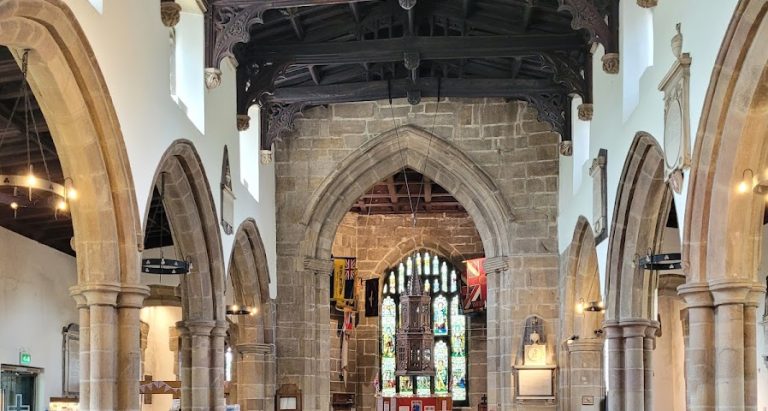
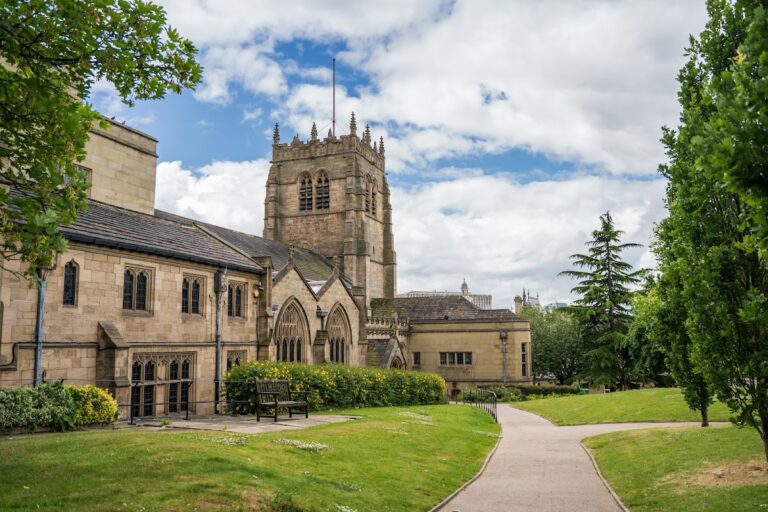
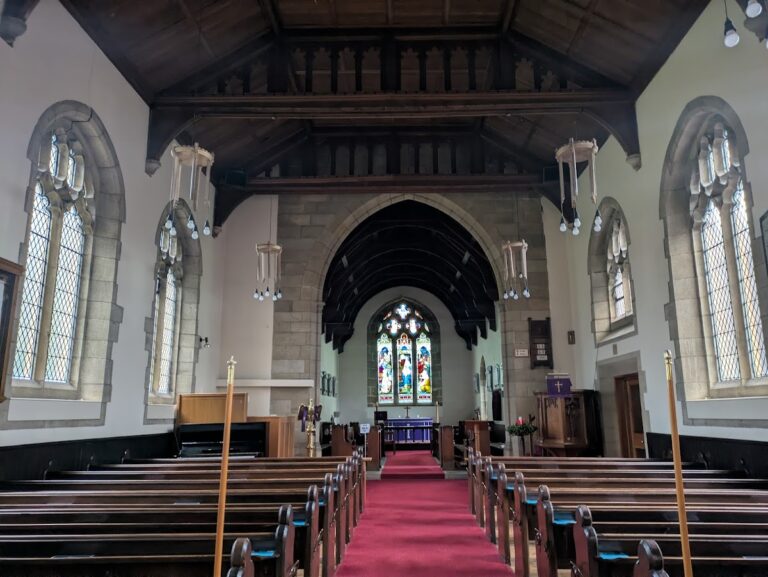
The Priory Church of St Mary and St Cuthbert is the surviving part of the otherwise ruined twelfth-century Augustinian complex. It is predominantly Gothic, a medieval architectural tradition associated with pointed arches, ribbed vaults, and large windows. The nave, the main lengthwise space used by the congregation, remains in ecclesiastical use as the parish church, while the eastern end survives as a ruin. Victorian alterations added further work and stained-glass windows by Augustus Pugin.
The tower begun in 1520 remains only half standing. Its base was later adapted with a bell turret, a small structure containing or supporting bells, and converted into an entrance porch. The priory seal showed the Blessed Virgin Mary and Child and carried the inscription “sigillum sancte Marie de Bolton.” The churchyard contains a First World War grave belonging to an officer of the Royal Flying Corps, Britain’s military aviation service before the Royal Air Force was formed in 1918, and the grave of the cricketer Fred Trueman.
Bolton Abbey Hall
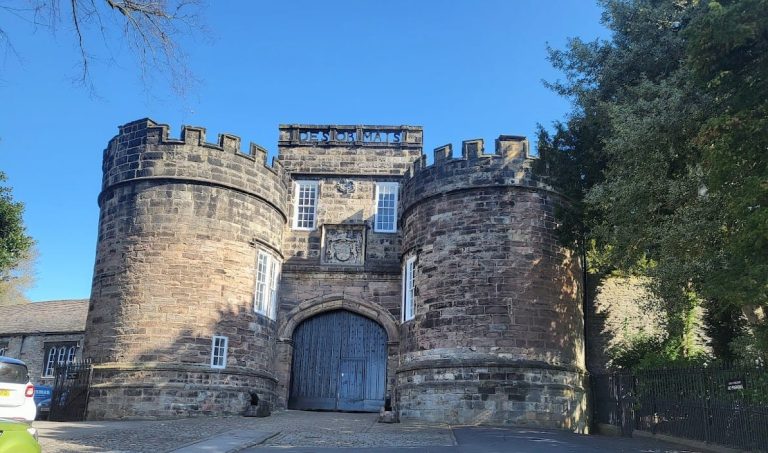
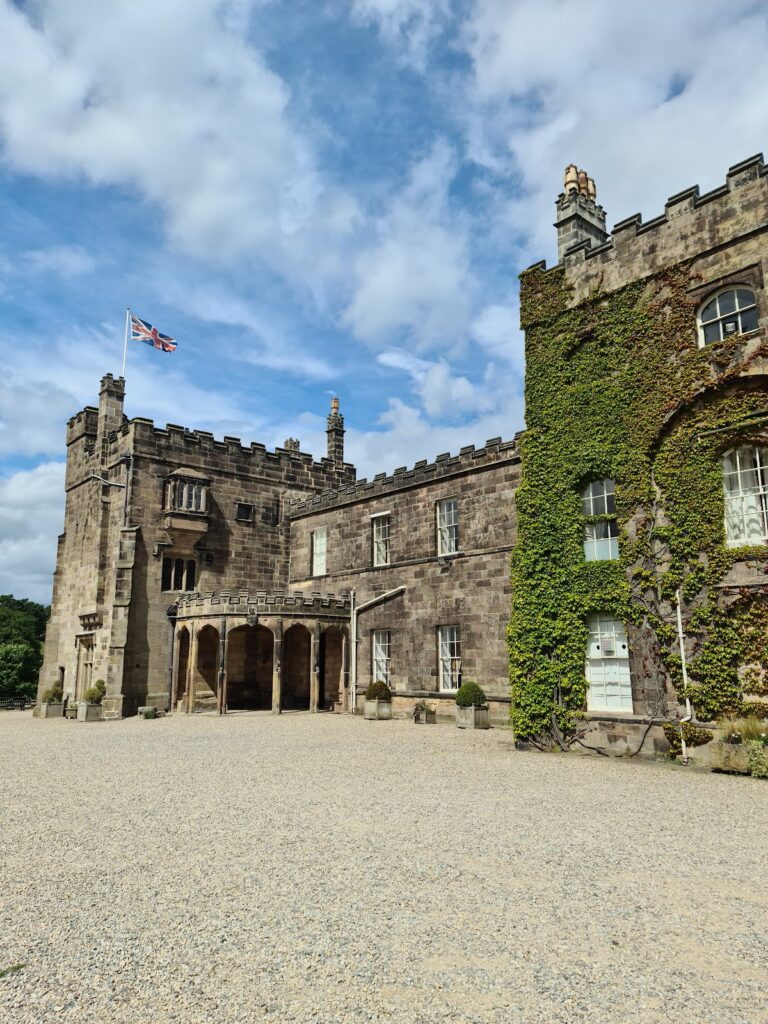
The large gatehouse and adjoining parts of the medieval priory were converted and extended into the substantial country house known as Bolton Abbey Hall. The former gatehouse became a residence for the Cavendish family and remains a private house. Its survival alongside the ruined church illustrates the different later uses that shaped the medieval complex.
River valley and estate landscape
The estate follows the River Wharfe and includes Strid Wood, an ancient woodland consisting mainly of oak. Within the woodland is the stretch of river known as the Strid. The well-known stepping stones cross the Wharfe near the abbey ruins.
Other parts of the estate include a marine-fossil quarry, extensive grouse moors, Barden Moor on the western side of Wharfedale, Barden Fell on the eastern side, and the prominent crag of Simon’s Seat. A pheasant-shooting area, 84 farms, and 84 buildings of architectural interest also form part of the wider estate.