Holy Trinity Church: A Medieval Anglican Parish Church in Skipton

Site at a Glance
- Rating
- 4.6
- Popularity
- Very Low
- Country
- United Kingdom
- Primary era
- Medieval
- External website
- Open
- Eras represented
- Medieval, Early Modern, Modern
- Civilizations
- British, English
- Site type
- Religious
- Remains
- Church
On this page11 sections
History
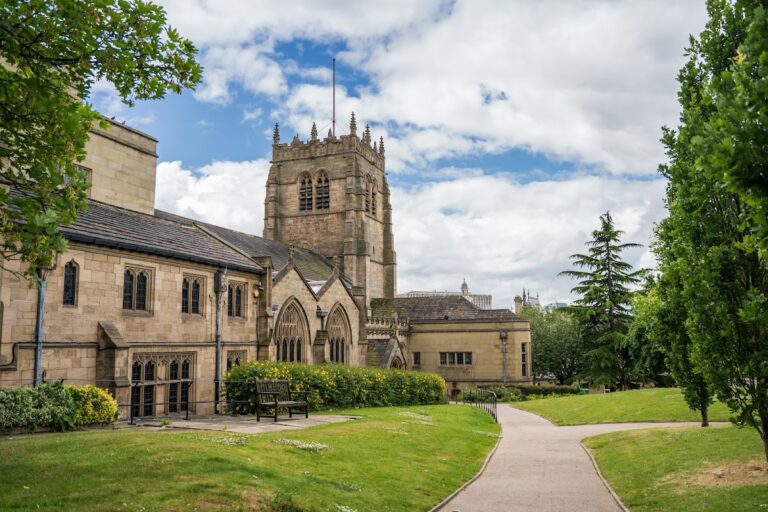
Holy Trinity Church is a medieval Anglican parish church in Skipton, England, dating mainly from about 1300 and built in the Gothic period. It is the older active Anglican parish church in the town and stands on High Street as part of the historic life of Skipton.
Medieval origins and extension
The first church on this site was probably a wooden building erected in the early 12th century. The present church belongs principally to about 1300, while its eastern end was extended in the late 15th century. These phases established the medieval building that still forms the basis of the church.
The church later became associated with the Clifford family, an English noble family whose hereditary titles included Earl of Cumberland and Countess of Cumberland. Monuments and burials inside include those of Henry Clifford, 1st Earl of Cumberland, and George Clifford, 3rd Earl of Cumberland. The tomb of Lady Anne Clifford’s father is also in the church. Lady Anne Clifford was a seventeenth-century aristocrat and landowner associated with Skipton Castle.
Civil War damage and later repairs
During the English Civil War, the conflicts of the 1640s between supporters of Parliament and those of King Charles I, Holy Trinity Church was damaged. Repairs and restoration followed in the 1650s, with financial assistance from Lady Anne Clifford of Skipton Castle.
The church’s clock was replaced in 1835 by a mechanism costing £160. Skipton Urban Council replaced it again in 1899 with a clock made by Potts of Leeds. Lightning struck the tower in 1853, adding to the building’s later history of damage and repair.
Restoration, fire, and continuing use
Austin and Paley restored the church in 1909. Their work removed the galleries, added a north transept and new vestries, and installed new seating. Lightning struck the church again in 1925, causing a fire that destroyed the organ and damaged the roof. The roof was repaired, and Austin and Paley installed a new organ case.
A Lady Chapel was created in the southeast corner in 1979. A Prayer Corner was later developed in the corresponding northeast position. Holy Trinity remains an Anglican parish church in the Province of York, within the Diocese of Leeds, the Archdeaconry of Craven, and Skipton Deanery. Its benefice is united with that of St Augustine’s Church in Draughton. The church is listed at Grade I in the National Heritage List for England, a designation made on 28 April 1952.
Remains
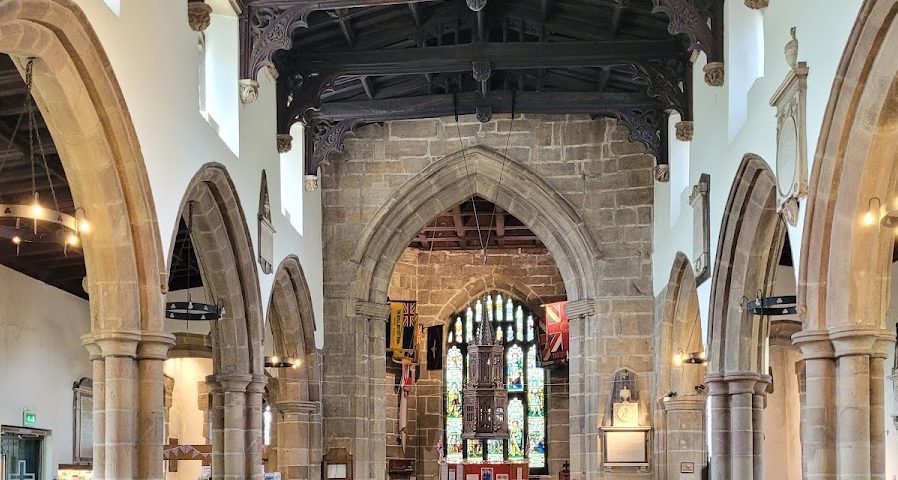
Holy Trinity has a Gothic plan centred on a nave, the main central space of the church, with a clerestory, an upper level of windows that lights the interior. A south porch gives access to the building, while the chancel, the eastern part surrounding the principal altar, extends beyond the nave. The west tower is embraced by the nave. The north transept contains the organ and vestries, rooms used by clergy and for storing church equipment. The Lady Chapel occupies the southeast corner of the chancel, with the Prayer Corner in the corresponding northeast position.
Medieval architectural features
Windows and Gothic details
The window tracery is mainly Perpendicular, a phase of English Gothic architecture distinguished by strong vertical lines, with some Decorated tracery, an earlier Gothic form associated with more flowing geometric patterns. One window contains stained glass by Kempe, the English designer and workshop. Together, these features reflect the church’s medieval fabric and later artistic additions.
Chancel furnishings
The chancel contains a triple sedilia, a set of three seats built into the south wall for clergy or ministers. Separating the chancel from the nave is a rood screen dating from 1533. At the west end of the nave stands the font, which has a Jacobean cover, a decorative cover in the style associated with the reign of James I.
Organs and bells
Organs
The church’s first pipe organ was built in 1803 by Lincoln of London. It was initially installed in a gallery in the northeast part of the church and had been moved to the southeast corner by 1855. Jardine built a new organ in 1875, and Abbott and Smith of Leeds moved it in 1888 to a new organ chamber on the northeast side.
The 1875 organ was destroyed in the fire caused by lightning in 1925. A replacement three-manual organ, with three separate keyboards for controlling its ranks of pipes, was built by Rushworth and Dreaper of Liverpool and designed by Edward Bairstow, an English organist and composer. Laycock and Bannister of Keighley rebuilt and reduced it to two manuals in two stages, in 1966 and 1970, before moving it into the left bay of the north transept.
Bell ring
The west tower contains a ring of eight bells. All were cast by John Taylor & Co. of Loughborough in 1921.