Ein Gedi Synagogue: A Jewish House of Worship in the Judean Desert


Site at a Glance
- Rating
- 4.5
- Popularity
- Low
- Country
- Israel
- Primary era
- Medieval
- Eras represented
- Classical, Medieval
- Civilizations
- Byzantine, Roman
- Site type
- Religious
- Remains
- Synagogue
On this page9 sections
History
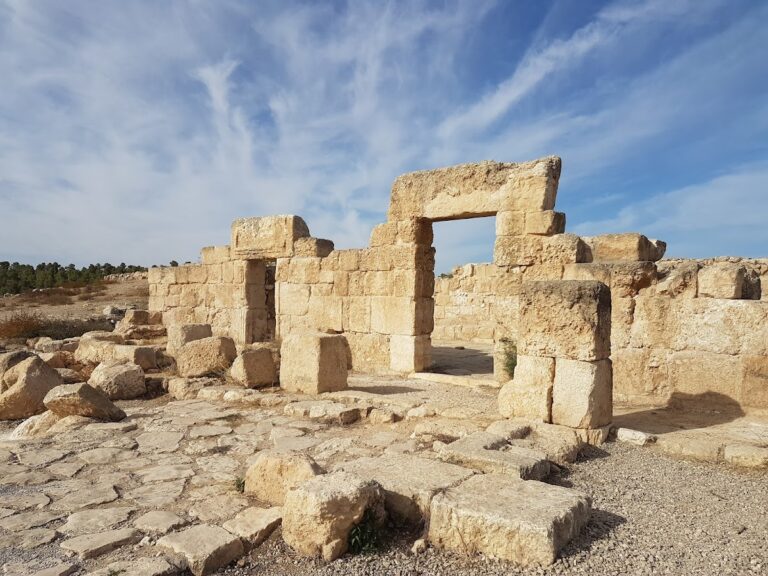
The Ein Gedi synagogue is an ancient Jewish house of worship in Israel, within the remains of the settlement of Ein Gedi in the Judean Desert. Its excavated remains date from the third century onward, and the settlement itself is mentioned in the Tanakh, the Jewish biblical canon corresponding broadly to the Hebrew Bible.
Foundation and development
The synagogue’s history is divided into three architectural phases. The first was a complex established in the third century. Repairs and alterations followed, including the addition of a modest Torah ark, the cabinet or enclosure used to house Torah scrolls. A later major renovation changed the prayer hall into a basilica, a longitudinal building form organized around a large central hall. At this stage, the ark was replaced by a larger one with a platform in front of it, and a new polychrome mosaic floor was installed.
The settlement was renewed after its destruction during the Bar Kokhba revolt, the Jewish uprising against Roman rule in Judaea from AD 132 to 135. The synagogue then remained in use for approximately 400 years. Between AD 602 and 610, the settlement was destroyed again, and the synagogue was completely burned.
The Ein Gedi community
The synagogue’s eastern wall contained a carved seat for the head of the community, known in ancient sources as the “chair of Moses.” A long Aramaic inscription set out rules for communal conduct. It condemned provoking disputes, slandering another member to non-Jews, theft, and revealing Ein Gedi’s secret, the method used to produce balsam oil. This valuable aromatic product supported the local economy as an export.
The inscription also imposed an unusually severe curse on offenders, including a formula extending the curse to the offender’s family. The text may relate to an association of balsam growers whose production knowledge was guarded within families, although that interpretation remains conjectural.
Destruction and archaeological investigation
Early visits, surveys, measurements, and documentation took place before 1949. Evidence for the synagogue was discovered while a field was being plowed in 1965, followed by excavations in 1970 to 1972 directed by Dan Barag, Y. Porat, and Ehud Netzer. The ancient settlement and synagogue have continued to be investigated since the 1970s.
A hoard of 5,000 coins, dating from the fourth century to the reign of Justin II, who ruled from AD 565 to 578, was found at the site. It may have served as the synagogue’s charity fund. The synagogue’s destruction also preserved a parchment scroll inside the Torah ark. Excavators recovered it in burned form in 1970, and in 2015 three-dimensional scanning and micro-computed tomography, which creates detailed internal images without opening an object, allowed it to be virtually unfolded and deciphered. The sixth-century scroll contains the beginning of the Book of Leviticus.
Remains
Layout and architectural phases
The synagogue has a north-south longitudinal axis. Its original entrance stood on the north side, while a southern entrance was opened later. The earliest phase had a simple mosaic floor. In a subsequent phase, the building was enlarged with additional rooms, benches were built along the southern wall, and a structure resembling a bimah, a raised platform used in Jewish worship for reading the Torah, was added. Its precise function remains uncertain, although it may have supported a Torah scroll.
The final major renovation created a basilica from the large, simple prayer hall. It introduced a larger Torah ark with a platform before it and replaced the earlier floor with a complex, multicolored mosaic. The Torah ark and the carbonized scroll fragments were found together within the synagogue’s burned remains.
Mosaic floors
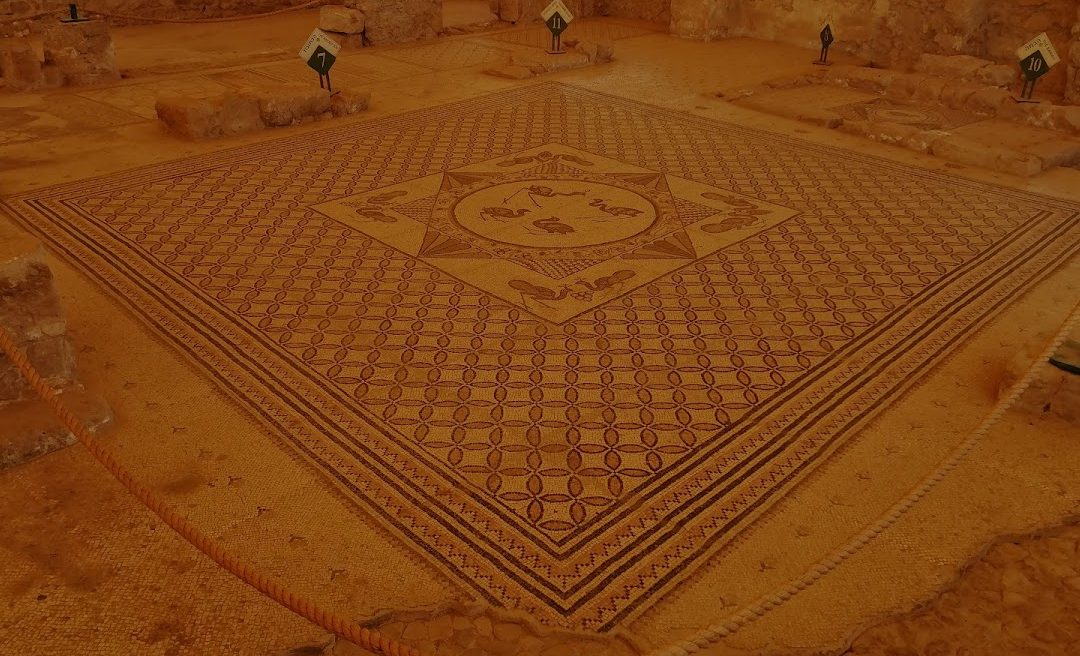
The earliest mosaic preserves a swastika-like design, an ancient decorative motif also found in the synagogues of Katzrin and Gamla. A later mosaic included two geometric carpets made of squares and triangles, with plant and bird motifs. Lamp designs surrounded a central carpet. Its four corners contained pairs of male peacocks holding clusters of round grapes, while the central circle depicted two cranes and two blue purple gallinules.
Inscriptions and communal memory
Another mosaic carried Aramaic inscriptions listing the generations from Adam to Japheth, the zodiac, and the Hebrew months. The list of months ends with the words “Hananiah, Mishael and Azariah, Peace upon Israel.” A separate inscription records that townspeople contributed their own money to repair the synagogue and that Jonathan the cantor also contributed. Part of this donor inscription is displayed at the Hecht Museum in Haifa, while the other Aramaic inscriptions are displayed at the Rockefeller Museum.
Ritual objects and excavated materials
A small cast-bronze seven-branched menorah, a ritual lampstand, measures 22 by 14 centimetres and probably belonged to the Torah ark’s decoration. A second, tiny menorah was made of silver. Other finds include a bronze cup, embroidered curtain ornaments made with gold thread and gold leaves, and the remains of burned parchment scrolls.
Goat and sheep bones were found beneath the Torah ark. Most had been burned, but their connection with the synagogue fire or with an earlier event could not be determined. They may represent an altar from the Second Temple period, several centuries before the synagogue.
The scroll fragments had been reduced to carbonized pieces that could not be physically unrolled without destroying them. Three-dimensional scanning and micro-computed tomography made it possible to reconstruct their writing virtually, revealing the opening of Leviticus while preserving the fragile remains. The fragments have been preserved by the Israel Antiquities Authority since 1970.