Stift Clarholz: A Premonstratensian Provostry in Germany

Site at a Glance
- Rating
- 4.6
- Popularity
- Very Low
- Country
- Germany
- Primary era
- Medieval
- External website
- Open
- Eras represented
- Medieval, Early Modern, Modern
- Civilizations
- Holy Roman Empire
- Site type
- Religious
- Remains
- Monastery
On this page17 sections
History
Stift Clarholz, commonly called Clarholz Monastery, is a former Premonstratensian provostry in Herzebrock-Clarholz, Germany. Founded in 1133, it developed over approximately 670 years into a religious, cultural, and economic center between the dioceses of Münster, Osnabrück, and Paderborn before its secularization in 1803.
Foundation and medieval development
In 1133, the nobleman Rudolf of Steinfurt donated his properties in Clarholz and neighboring Lette to the Premonstratensian Order, including a chapel in each place. The donation was intended to secure the perpetual commemoration of Rudolf and his parents. Emperor Lothar III confirmed the foundation in January 1134 with the participation of Norbert of Xanten, founder of the Premonstratensian Order and then Archbishop of Magdeburg.
The new institution was settled from Cappenberg Monastery, the first Premonstratensian establishment in Germany. It initially formed a double monastery, meaning that separate male and female religious communities belonged to one connected foundation. The male community lived at Clarholz, while the female convent was established at Lette.
In 1134, Bishop Werner of Münster enlarged the foundation’s endowment and transferred pastoral responsibility for the neighboring parish of Beelen to Clarholz. Pope Eugene III placed the institution under papal protection in 1146 and named its first provost, Ermward, who remained in office until 1184. After the collegiate church was completed and consecrated in 1175, Bishop Arnold of Osnabrück granted it parish rights and established the parish of Clarholz, including the farming community of Heerde, within the Diocese of Osnabrück. Lette and Beelen remained within the Diocese of Münster.
During the Middle Ages, Clarholz maintained religious and economic connections with the area around Vollenhove on the Zuiderzee, then part of the Diocese of Utrecht. The foundation’s properties there were sold in 1549. Its wider economic base included tenant farms, hereditary holdings, mills, fishing rights, and income from the saltworks at Werl.
Provosts, property, and regional connections
Provost Friedrich of Tecklenburg, who held office from 1187 to 1216, pursued extensive economic activity. After unsuccessful attempts to obtain the bishopric of Münster and the abbacy of Corvey, he was deposed and later became abbot of Knechtsteden Monastery. His successor, Provost Ludger, served from 1217 to 1234 and was associated with Archbishop Engelbert of Berg of Cologne.
In 1231, Pope Gregory IX issued a declaration of protection for Clarholz. The possessions named in the document included 20 tenant farms, 45 hereditary holdings, two mills, fishing rights on the Ems between Hüttinghausen and Warendorf, income from the saltworks at Werl, and other property. The descendants of Rudolf of Steinfurt initially exercised the monastery’s advocacy rights, which concerned the protection and representation of the institution. Bishop Everhard of Diest of Münster became advocate in 1275, followed by Count Simon of Lippe in 1296.
Clarholz stood where the road from Münster to Paderborn crossed the road from Bielefeld to Hamm. A monastery hospital, recorded in 1300, received travelers, pilgrims, and sick people. One of the canons served as hospital master, extending the institution’s pastoral responsibilities beyond its parishes.
Gothic transformation and fifteenth-century reform
From around 1320, the collegiate church was transformed from its earlier Romanesque form into a Gothic hall church. A hall church has a nave and aisles of approximately equal height. During the fourteenth century, the declining number of lay brothers also changed the way the monastery managed its lands. Direct agricultural management gave way to leasing property and employing paid labor.
In 1437, during the long feud between Lippe and Tecklenburg, the monastery was plundered and set on fire. The community was also facing an internal crisis. In 1439, following the intervention of the Council of Basel, two Cistercians from Marienfeld took the offices of provost and prior. They invited Premonstratensian abbots from Steinfeld and Wittewierum to conduct visitations and assist with reform.
Under Provost Johannes Hundebeke, who served from 1456 to 1487, the community gained many new members. A school was established in 1463, and a rood screen, a partition separating the sanctuary from the main body of the church, was built in the collegiate church. The administration of the Dutch properties around Vollenhove was reorganized, and in 1496 Marienfeld Abbey, Stift Clarholz, and the Herzebrock Benedictine Convent formed a friendship alliance.
Confessional conflict and Catholic reform
During the sixteenth century, Marienfeld, Clarholz, and Herzebrock sought the protection of Emperor Charles V against territorial and Protestant interference by Count Konrad of Tecklenburg, lord of Rheda. After lengthy proceedings before the Imperial Chamber Court, a Holy Roman Empire institution concerned mainly with judicial disputes, the Catholic confession was maintained in the parishes of Lette, Clarholz, and Herzebrock. The three religious institutions also secured positions as territorial estates of the Lordship of Rheda.
In the last third of the sixteenth century, the Clarholz community adopted the lifestyle of the landed nobility and fell into serious neglect. The women’s convent at Lette ceased to function. From about 1625, the Premonstratensian Westphalian circary, an administrative subdivision overseeing several religious houses, together with the major abbeys of Knechtsteden and Steinfeld, gradually introduced reforms associated with the Council of Trent. That Catholic council sought to regulate clerical life, worship, education, and church administration.
Under Provost Bernhard of Kerckering, who served from 1666 to 1693, the community regained stability. The Archconfraternity of Our Lady of Mount Carmel was established at the Clarholz church in 1679. From 1680 to 1685, the Steinfeld Premonstratensian Leonhard Goffiné served as pastor at Clarholz and began work there on the Handpostille, a Catholic household and devotional book that was repeatedly reprinted into the twentieth century and translated into many languages.
Baroque expansion and the final provosts
Elbert of Kückelsheim was elected provost in 1693 at the age of 34 and died on 10 May 1750 at the age of 91. His long administration brought extensive building and artistic activity. The collegiate church received its Baroque interior, while the provost’s residence, farmyard, and monastery gate were also built or renewed during this period.
Provost Leopold of Rübel served from 1750 to 1763. He built the Clarholz tithe barn in 1759, a building used to store agricultural dues, and the gardener’s house at Lette in the same year. The incorporated parishes of Saint Vitus in Lette and Saint John the Baptist in Beelen received new rectories in 1709 and 1746. Both parishes also received new organs by the Beckum organ builder Heinrich Menke.
The penultimate provost, Franz Philipp of Meuseren, held office from 1765 to 1794 and was associated with the Catholic Enlightenment, an eighteenth-century movement combining Catholic commitment with educational, intellectual, and administrative reform. He established an in-house study program and a library. His cellarer, Clemens August of Dücker, modernized the agricultural operations, mills, and brickworks.
The last provost, Jodokus van Oldeneel, came from a Catholic noble family in Overijssel. From 1794, he gave permanent refuge to Premonstratensians and other clergy who had fled France during the revolutionary Terror. They returned to France in 1802. In 1798, van Oldeneel became godfather to Jodokus Temme, the eldest son of his secretary and legal administrator Carl Bernhard Temme. The younger Jodokus Temme later became a prominent democratic advocate during the German revolutions of 1848–49 and died in Swiss exile in 1881.
Secularization and later ownership
The monastery sought legal assistance from the Imperial Aulic Council in Vienna, the supreme court and advisory body of the Holy Roman Empire, against impending secularization. Although the council issued a corresponding mandate, it could not be enforced. On 27 October 1803, Count Moritz Casimir II, supported by Prussian troops, forced the community to evacuate and expropriated the monastery.
After secularization, the chapter house, cloisters, and several economic buildings were demolished. During the nineteenth century, the provost’s residence was separated from the convent house and converted into a castle. Prince August Ludwig of Sayn-Wittgenstein-Berleburg lived there from 1849 to 1852 and later served as the last chief minister of the Duchy of Nassau from 1852 to 1866.
A patronage arrangement established by the Counts of Bentheim-Tecklenburg in 1806 was later dissolved. Since 1969, the church and convent house have belonged to the Catholic parish of St. Laurentius in Clarholz. The provost’s residence, economic buildings, and tithe barn belong to the Princes of Bentheim-Tecklenburg in Rheda. The monastery gardens were redesigned between 1999 and 2003 according to historical models as part of the East Westphalia-Lippe garden-landscape project. The Prälatenweg links Clarholz with the former monastery complexes at Herzebrock and Marienfeld, while the Kerkherrenweg connects it with Beelen and Lette, the places of its incorporated parishes.
Remains
Church and medieval fabric
Collegiate church
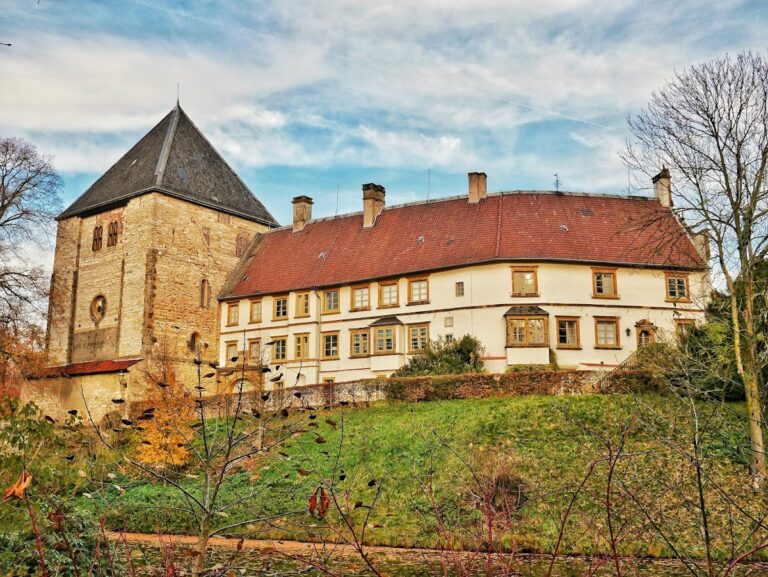
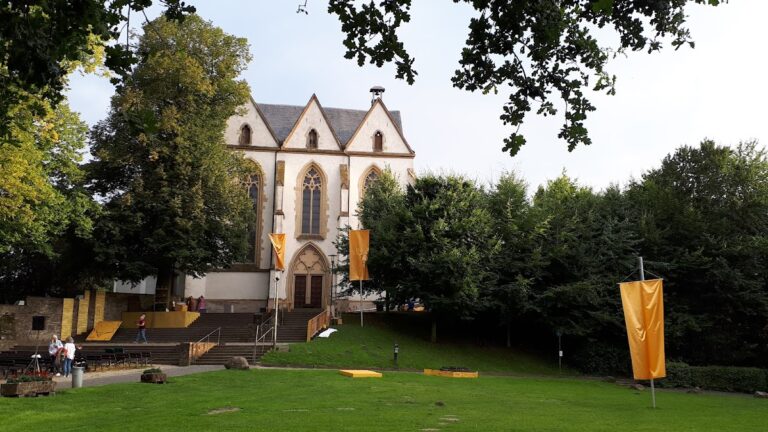
The collegiate church was completed and consecrated in 1175 as a flat-roofed Romanesque basilica with a westwork, transept, and three apses. A westwork is the substantial entrance block at a medieval church’s western end, while a transept forms the crosswise arm of the plan and an apse is a terminal space, usually semicircular or polygonal.
From around 1320, the basilica was remodeled as a Gothic hall church. Vault paintings from this phase carry symbolic animal and plant motifs. They were uncovered by the art historian Hilde Claussen (1919–2009). A relic of Archbishop Thomas Becket of Canterbury, murdered in 1170 and associated with the Premonstratensian reform movement, also survives in the church in a Limoges reliquary.
Rood screen and Baroque interior
The church received a rood screen during the tenure of Provost Johannes Hundebeke. Later, the building campaign associated with Provost Elbert of Kückelsheim gave the interior a Baroque character through new altars, a pulpit, and an organ. These elements belong to the period of renewed stability and building activity that shaped the monastery in the late seventeenth and early eighteenth centuries.
Provost’s residence and monastery gate
Provost’s residence
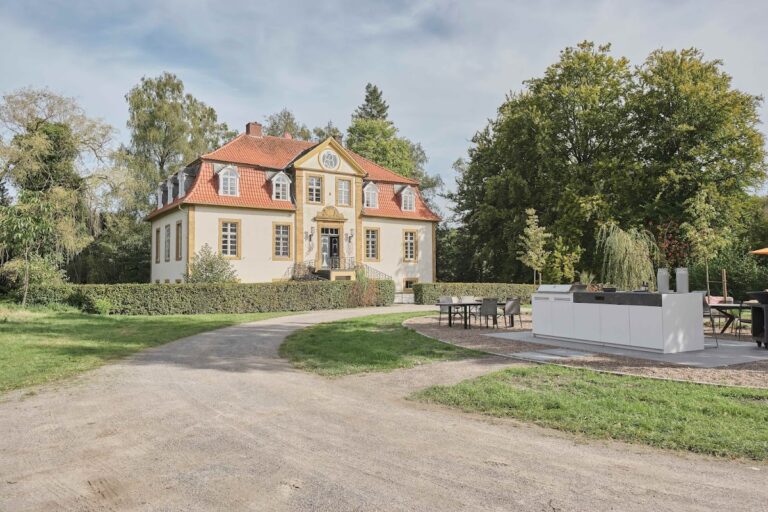
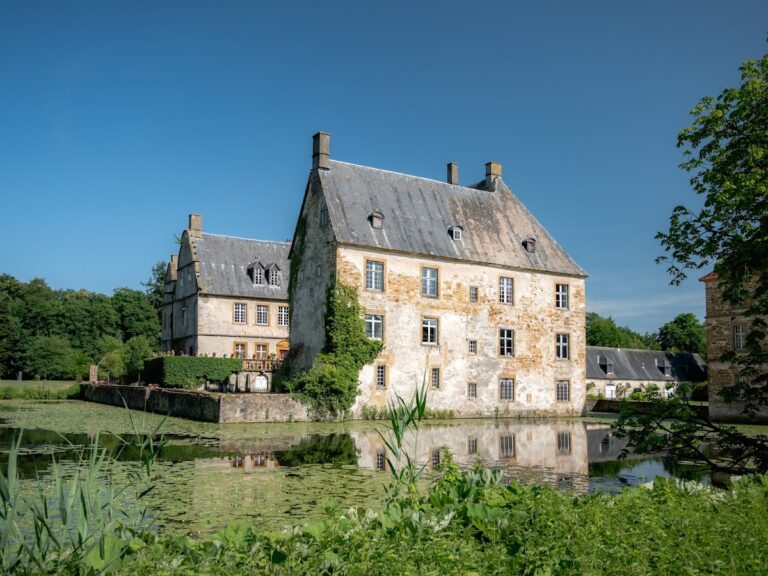
The provost’s residence was built from 1705 to 1707 according to plans by Gottfried Laurenz Pictorius. The Lippstadt master builder Nikolaus Wurmstich carried out the construction. In the nineteenth century, the residence was separated from the convent house and converted into a castle. Its chapter hall is now used for concerts and other cultural events.
Monastery gate and farmyard
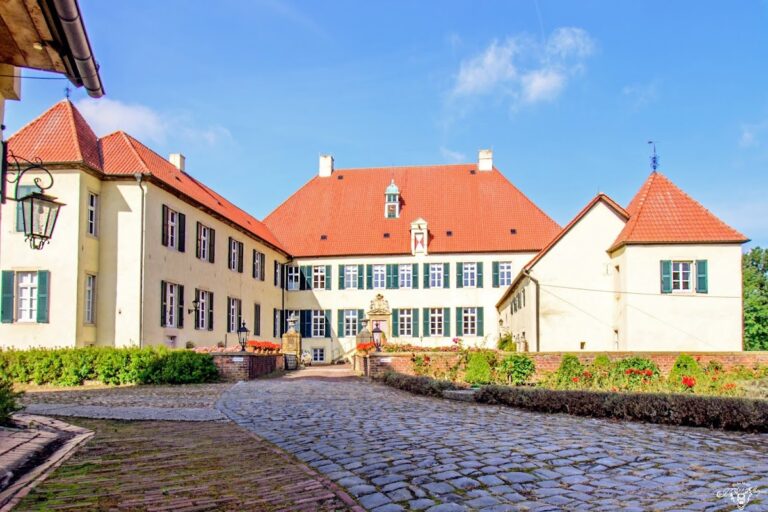
The monastery gate was built from 1725 to 1728 as part of Elbert of Kückelsheim’s Baroque building program. The same campaign produced the economic farmyard. Together, these buildings formed part of the material framework through which the provostry organized its property and agricultural production.
Economic buildings and gardens
Tithe barn and gardener’s house
The Clarholz tithe barn was built in 1759 under Provost Leopold of Rübel. The gardener’s house at Lette was also constructed in 1759. The tithe barn now functions as a community center, while the gardens were redesigned between 1999 and 2003 in accordance with historical models.
Cellarer’s building and wider facilities
The cellarer’s building houses a monastery museum. A cellarer was the monastic official responsible for provisions, stores, and often parts of the institution’s finances. The monastery’s documented facilities and possessions also included a hospital, two mills, agricultural holdings, fishing rights on the Ems, income from the Werl saltworks, a brickworks, and monastery gardens. The hospital served travelers, pilgrims, and sick people, while the mills, agricultural buildings, and brickworks supported the provostry’s economy.
The surviving properties are divided among several present owners and uses. The Catholic parish of St. Laurentius Clarholz owns the church and convent house. The Princes of Bentheim-Tecklenburg own the provost’s residence, economic buildings, and tithe barn. The chapter hall, cellarer’s building, and tithe barn continue in cultural, museum, and community uses that reflect different parts of the former monastery complex.
Nearby sites