San Lio: A Historic Roman Catholic Church in Venice


Site at a Glance
- Rating
- 4.2
- Popularity
- Very Low
- Country
- Italy
- Primary era
- Early Modern
- Eras represented
- Medieval, Early Modern
- Civilizations
- Venetian
- Site type
- Religious
- Remains
- Church
On this page19 sections
History
San Lio is a Roman Catholic church in Venice, Italy, whose first foundation is traditionally placed in the ninth century and whose present form largely dates from a radical rebuilding begun in 1783. Located in the Castello district, the church has served religious, administrative, and cultural purposes across more than a millennium.
Foundation and dedication
Tradition attributes the first church to the Badoer family, a patrician Venetian lineage associated with its foundation. The building was briefly dedicated to the Holy Cross of Luprio before receiving the name of Saint Catherine of Alexandria.
In 1054, the church received its final dedication to Pope Leo IX, an eleventh-century pontiff whose support for Venice had mattered during the city’s conflict with the Patriarchate of Aquileia over Grado. Doge Domenico I Contarini had recovered Grado from Poppo, Patriarch of Aquileia, in 1043. After the Saint Catherine church was destroyed and rebuilt, the new dedication honored Leo IX and his support for Venice. The first documented mention of the church dates to 1108. San Lio is the Venetian form of Saint Leo.
Medieval and Renaissance transformations
The church underwent several architectural changes before the modern period. It was modified in the Gothic style in the early fourteenth century and redesigned in the Renaissance style in 1520, with that work attributed to Pietro Lombardo. A sixteenth-century view by Jacopo de’ Barbari shows the building as a three-aisled basilica in the Venetian-Byzantine tradition.
Seventeenth- and eighteenth-century rebuilding
A major modernization took place during the seventeenth century, and the church was reconsecrated in 1619. A more radical reconstruction began in 1783. Much of the earlier building was demolished, and the present broad single nave, presbytery, and two lateral apsidal chapels were created. The organ and the painted panels above the entrance also belong to this rebuilding campaign.
The fall of the Venetian Republic in 1797 was followed by administrative changes under Napoleonic rule. Decrees issued in the Kingdom of Italy from 5 June 1805 suppressed and reorganized churches and monasteries in Venice and altered parish boundaries. San Lio ceased to be a parish church and became a filial church of Santa Maria Formosa, formally the parish of the Purificazione di Maria.
Religious and cultural role
San Lio remains affiliated with the Latin Church and Roman Catholicism. It is administered by the Patriarchate of Venice, serves as a deanery church, and functions as a pastoral center for tourism and cultural-heritage communities. Its relatively small exhibition area has also hosted site-specific contemporary art intended to bring modern artistic work into dialogue with the liturgy and the church’s historical artworks. Exhibitions associated with the Venice Biennale included Già e non ancora in 2005, Lech Majewski’s Bruegel Suite in 2011, and Beyond the Veil, a triptych by Sylke von Gaza commissioned for the 2015 Biennale by the Cultural Heritage Office of the Patriarchate of Venice.
Remains
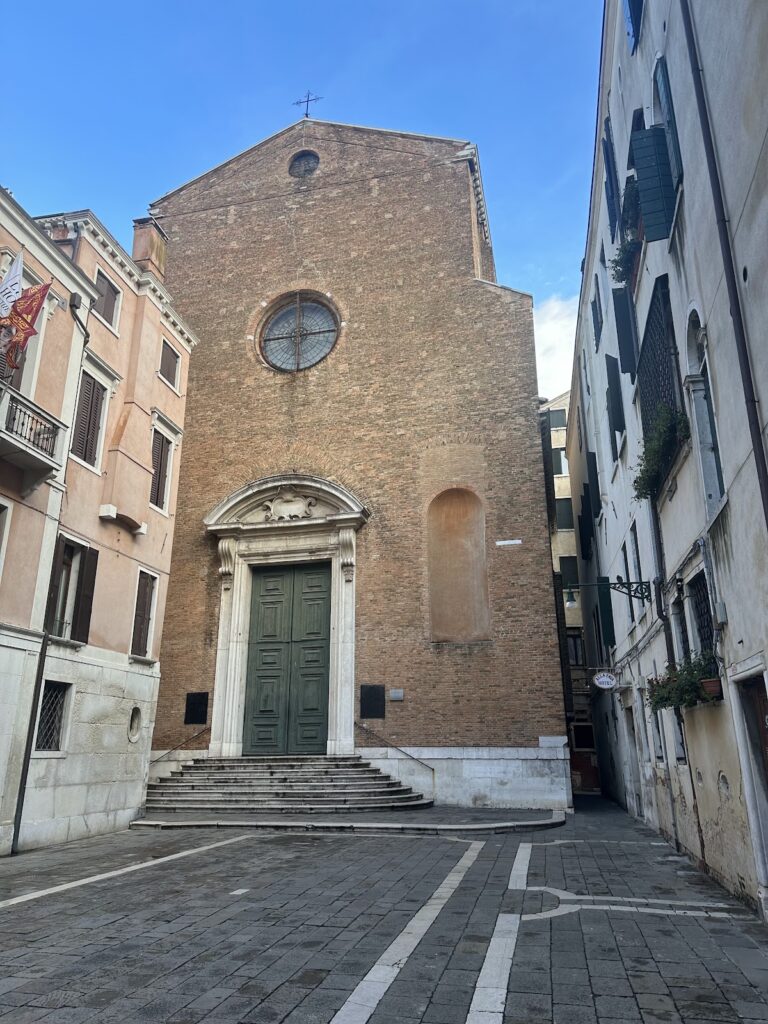
Urban setting and exterior
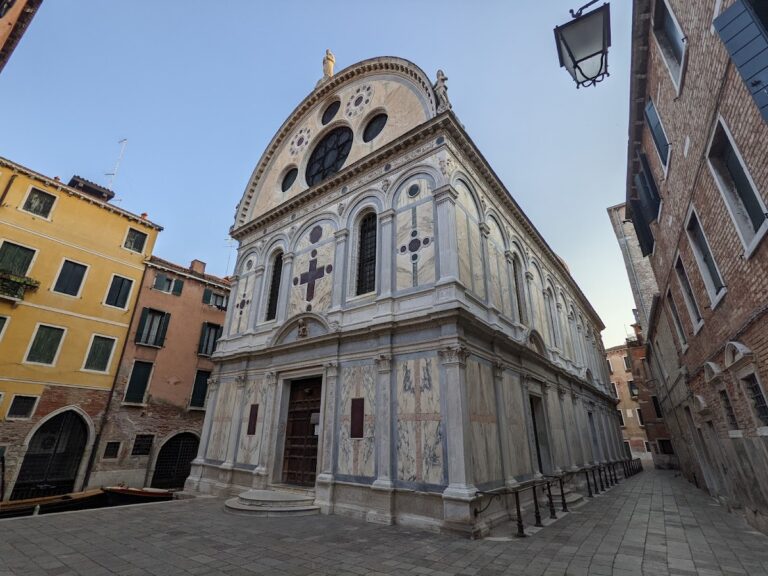
San Lio stands beside the small Campo San Lio amid dense surrounding buildings. Its west-facing facade opens onto the campo, while the southern side borders the Salizada San Lio. Neighboring buildings largely conceal the apse and the left side. The facade belongs to the 1783 reconstruction. Two levels are separated by a projecting cornice, and pilasters, flat rectangular projections resembling columns, divide the front vertically into three sections. Windows occupy the outer sections, while a triangular tympanum, the field of a classical pediment, crowns the facade. Its center contains a trefoil-shaped oculus, or shaped opening. At ground level, a Doric portal from the beginning of the sixteenth century survives from the earlier church.
Bell towers and surviving medieval fabric
The medieval bell tower, probably built in 1054, was dismantled during the 1783 reconstruction. Its lower section remains to the left of the entrance. The former brick tower had paired lesenes, narrow vertical wall strips, a bell chamber with bifora windows, or two-light openings, and a conical roof surrounded by four pinnacles. A discreet wall belfry remains on the north side of the church.
Interior arrangement
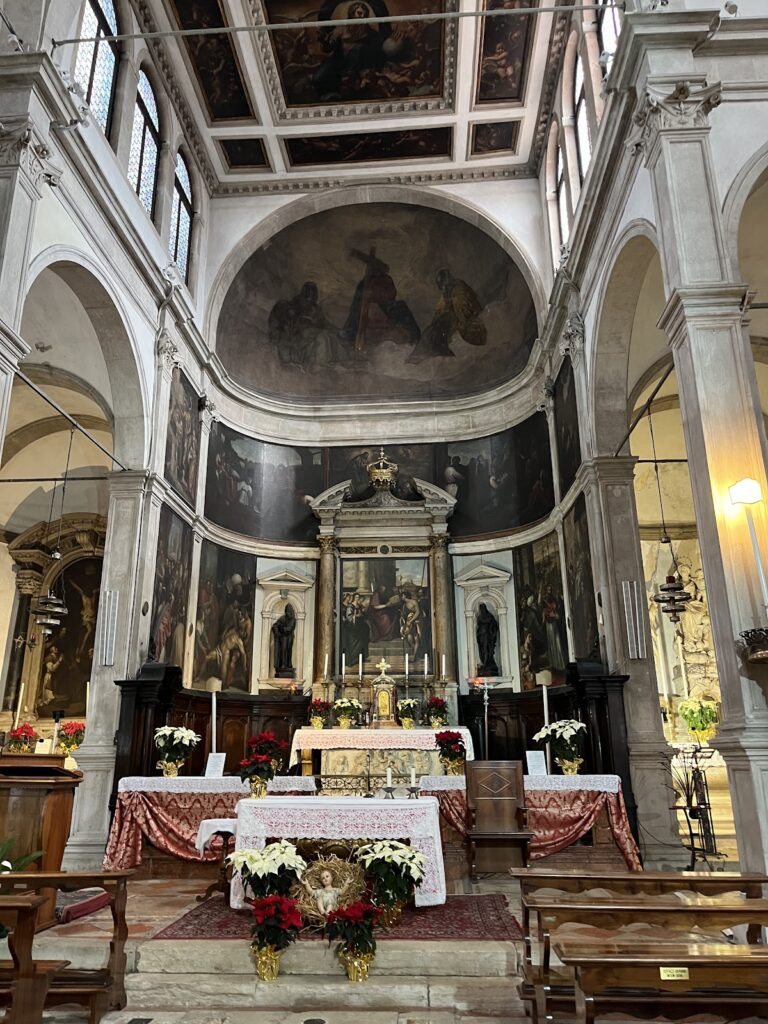
The rebuilding of 1783 replaced the earlier three-aisled plan with a broad single nave. At the eastern end, the presbytery, the area around the principal altar, is accompanied by two lateral apsidal chapels. The flat nave ceiling carries three frescoes by Giandomenico Tiepolo, Saint Leo in Glory, Exaltation of the Cross, and Angels and Cardinal Virtues, all painted in 1783.
Presbytery and main artworks
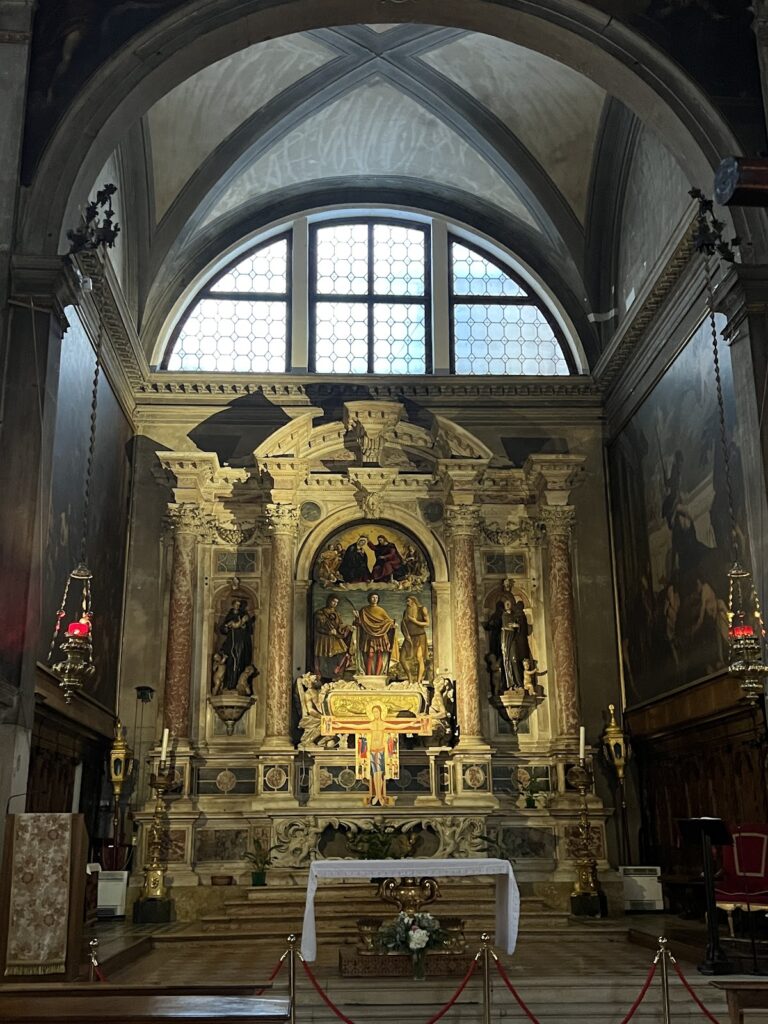
Main altar
The main altar bears Jacopo Palma the Younger’s oil painting Dead Christ Upheld by Angels and Saints. A small icon of the Virgin and Child stands to the left of the altar in a gilded case. On the right wall of the presbytery is The Washing of the Feet by A. Merli, while the left wall holds The Crucifixion by Pietro Della Vecchia. The ceiling painting The Angel Descending to Comfort Elijah is attributed to Pietro Moro.
Gussoni Chapel
The right apsidal chapel is the Gussoni Chapel, built at the expense of the Gussoni family. Canaletto’s tomb is set into its pavement. The entrance carries the Allegories of the Humanist Sacrifice of Jesus. Its altar contains a marble relief of the Pieta and Four Saints, attributed to Tullio Lombardo and framed by pilasters. A medallion of the Eternal Father Blessing occupies the vault, while the pendentives, curved triangular sections beneath a vault, contain gilded reliefs of the Four Evangelists by Pietro Lombardo. The chapel also contains a relief of the Lamentation of Christ attributed to Tullio Lombardo.
Left apsidal chapel
The left apsidal chapel contains an altarpiece depicting Saint Barbara, Saint Aloysius Gonzaga, and Saint Vincent Ferrer. The work is attributed to Ludovico Gallina.
Nave altars and paintings
Side altars
The second nave altar bears Pietro Antonio Novelli’s Saint Mark the Evangelist, Saint Anthony, Saint Lucy, Saint Louis, and Saint John the Evangelist, dated 1779. Nearby hangs a marble-framed Pieta attributed to Liberale da Verona. Another altar was founded by the Schola Picola dei Capeleri de Feltro, a confraternity associated with felt hat makers, and bears Titian’s Saint James the Greater, dated 1558.
Other nave works
The nave also contains Palma the Younger’s Saint Catherine of Alexandria and his painting of Saint Leo IX. A Venetian-school work depicts Mary in Glory with Saint Martin the Bishop, Saint Francis, Saint Dominic, Saint Marina, Saint Mark the Evangelist, and Saint Joseph. Above the side entrance is The Last Supper by M. del Moro, set in a marble frame. An inscription there commemorates the church’s reconsecration after the rebuilding completed in 1619. A seventeenth-century painting by an anonymous artist depicts The Baptism of Christ. Paintings from the Venetian school also portray the life of David and the Virgin with a cherub.
Furnishings and memorials
Pulpit, font, and monument
The pulpit is decorated with Allegories of the Church and Christian Virtues, attributed to Gaetano Zompini. The baptismal font is associated with Canaletto’s baptism in 1697. A funerary monument to Andrea Pisani, who died in 1718 and is identified as an admiral, was built around the entrance to the sacristy.
Choir and organ
The eighteenth-century choir has a balustrade decorated with Zompini’s Stories of David. Gaetano Callido built the organ in 1784, and it has 16 stops. Two wooden statues, Saint Barbara and Saint Cecilia, stand beside it. Contemporary works intended for devotional use are also housed in the church, whose exhibition area is equipped with electrical, lighting, and alarm systems.