San Giovanni dei Lebbrosi: A Norman Church and Medieval Leprosarium in Palermo


Site at a Glance
- Rating
- 4.5
- Popularity
- Low
- Country
- Italy
- Primary era
- Medieval
- Eras represented
- Medieval
- Civilizations
- Byzantine, Norman
- Site type
- Religious
- Remains
- Church
On this page10 sections
History
San Giovanni dei Lebbrosi is a Roman Catholic church in Palermo, Italy, dedicated to Saint John the Baptist and built during the Norman conquest of Sicily around 1071 in the Sicilian-Norman Romanesque tradition. Its foundation is attributed to Robert Guiscard, the Norman military leader, and Roger I, the count who established Norman rule in Sicily. Another tradition places its foundation in 1070, when Roger I established it on the site of a captured Arab fortress. The church is regarded as one of Palermo’s oldest medieval Norman buildings and is possibly the city’s oldest Latin-cross church.
Norman foundation beside the Oreto
The church stands on or beside the remains of the former castle of Yahya, a Byzantine-Arab stronghold near the mouth of the Oreto River. The castle protected Palermo’s eastern approach and was intended to prevent hostile ships from sailing upstream. During the Norman siege of Palermo, troops camped on the surrounding alluvial plain, near the strategic districts of the Kalsa and Cassaro. The plain had been used for growing date palms during the Arab period. Tradition holds that the Norman forces erected a temporary shrine there, which later developed into San Giovanni dei Lebbrosi.
By the late eleventh century, the church was associated with a hospital for people affected by leprosy. The hospital is specifically recorded as attached to the church in 1119, giving the church its title, “of the Lepers.” Roger II, the first king of Sicily, endowed the church with rural settlements, property, and privileges. His son William I confirmed these provisions. A charter from May 1155 also records William’s confirmation of the hospital and its associated facilities, which had been founded and constructed by Roger II, although it does not state when that work began. William transferred patients from the institution of San Leonardo to the hospital. Tradition further connected the establishment of the leprosarium, an institution for isolating and caring for people with leprosy, with the death of Roger II’s brother from the disease.
Medieval administration and later institutional use
In 1219, Frederick II placed administration of the hospital under the preceptor of La Magione. A preceptor was an official responsible for administering an institution or estate. In 1221, Frederick permanently united the hospital with the Teutonic Order, a German religious-military order that also operated hospitals. By 1324, the institution was known as the Hospital for Infectious Diseases, and several religious institutions subsequently administered the church and hospital.
A letter issued by Alfonso V of Aragon in 1434 refers to the complex as the leprosarium of San Giovanni de’ Lebbrosi. Alfonso exempted it from taxes and duties and asked the Teutonic knights to surrender its management. He nevertheless allowed the church to remain canonically united with the Church of the Holy Trinity of the Chancellor, later known as La Magione. Around 1442, the leprosarium and the Hospital of San Bartolomeo degli Incurabili became dependent institutions of the Great and New Hospital. The Palermo Senate administered the leprosarium from 1495, and it was later converted into a lazaretto, a quarantine facility for people suspected of carrying contagious disease, during the plague epidemic that began in Palermo in June 1575.
Convent, decline, and restoration
In 1596, the College of Notaries transferred members of the Augustinian hermit community, together with older members of the pre-existing order, to the convent of Santa Maria della Sanità, which was attached to San Giovanni dei Lebbrosi. The former convent and church complex belonged to the Reformed Augustinians of the Congregation of Sant’Adriano between 1581 and 1662. The church and associated buildings received further stylistic additions during the seventeenth century.
When Queen Maria Carolina of Austria visited in 1802, she found the facilities dilapidated and the patients living in very poor conditions. She ordered the patients and the institution to be moved to a hospital for mentally ill or consumptive patients housed in the former novitiate of the Discalced Teresian Fathers. Major restoration followed between 1920 and 1934 under Francesco Valenti, then superintendent of monuments. The work removed centuries of later additions, including Baroque alterations, and recovered the building’s medieval character. The bell tower received a red cupola modeled on the cupola over the crossing. The church’s foundation period, half-dome cupolas, and architectural language place it within the same broad Sicilian-Norman tradition as San Giovanni degli Eremiti, Santa Maria dell’Ammiraglio, and San Cataldo.
Remains
Plan and exterior
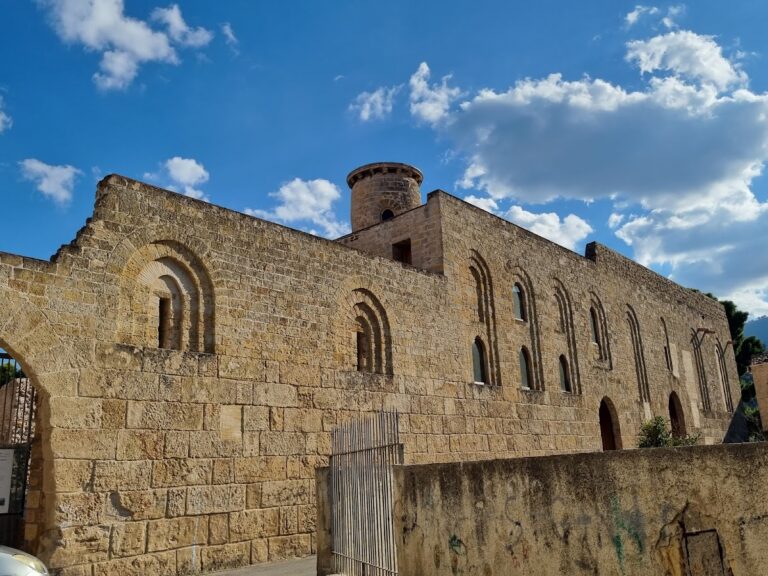
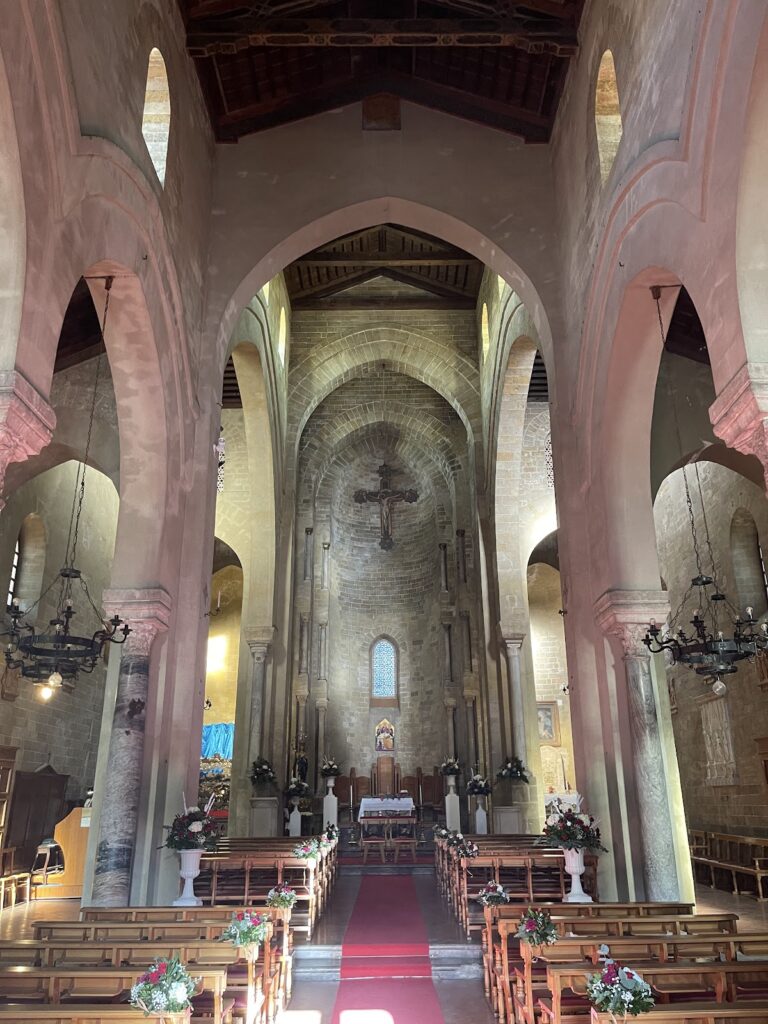
San Giovanni dei Lebbrosi stands in southern Palermo, in the Settecannoli district near the Oreto River and not far from the Admiral’s Bridge. The former castle of Yahya stood near the river mouth, while the church lies east of the river. The building follows a Sicilian-Norman Romanesque plan in the form of a Latin cross, with a projecting transept and three apses. Its basilican interior has three aisles divided by piers, a wooden roof, and a domed presbytery above the altar. The original design also included a primitive tribune.
Entrance and bell tower
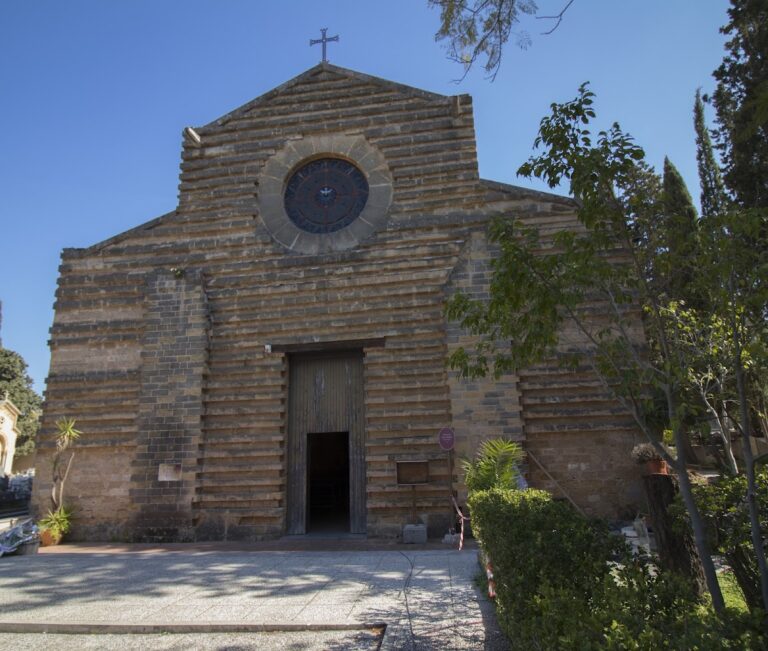
The exterior is austere and largely undecorated. Single-light windows framed by raised masonry provide its principal articulation. A simple entrance is preceded by a small porch supported by a single corner pillar. The bell tower rises above this porch as a two-storey addition, with arched openings in an Arabic style, sparse carved false-arch decoration, and a red hemispherical cupola modeled on the dome over the crossing.
Interior and surviving decoration
Capitals, crossing, and altar
The interior maintains the building’s restrained character. Embedded corner colonnettes carry decorated capitals with Arabic inscriptions in Kufic script, a formal angular style of Arabic writing, of an Umayyad-Andalusian type associated with Islamic Iberian artistic traditions. Some internal column capitals also bear Kufic decoration. A painted wooden crucifix from the fifteenth century is mounted on the arch of the crossing.
The present altar is contemporary and incorporates gammadia, symbolic Christian markings often shaped like Greek gamma forms. It also includes images of the Ecce Homo, representing Christ presented to the people before the Crucifixion, and the Pietà, depicting the Virgin Mary mourning over the dead Christ.
Garden and former complex
Sections of wall and fragments of pavement in the garden behind the church are attributed to the castle of Yahya. Medieval frescoes were found in the courtyard, including an Annunciation with a kneeling, praying Teutonic knight. The adjacent hospital no longer survives, while the former convent of Santa Maria della Sanità remains part of the history of the church complex. The surrounding agricultural landscape was associated with date-palm cultivation for food during the Arab period.