Santuario della Madonna di Salzana: A Catholic Sanctuary in Pizzino, Italy


Site at a Glance
- Rating
- 4.6
- Popularity
- Very Low
- Country
- Italy
- Primary era
- Medieval
- External website
- Open
- Eras represented
- Medieval, Early Modern, Modern
- Civilizations
- Italian, Venetian
- Site type
- Religious
- Remains
- Sanctuary
On this page13 sections
History
The Santuario della Madonna di Salzana, also known as the Santuario della Madonna Assunta di Salzana, is a Catholic sanctuary in Pizzino, Italy, in the Taleggio Valley. Construction began in 1466 after two landslides destroyed the settlement of Salzana, and the church was dedicated to the Assumption of Mary, the Catholic feast commemorating Mary’s being taken bodily into heaven. It remains a subsidiary church of the parish of Sant’Ambrogio Dottore in Pizzino, within the Diocese of Bergamo.
Salzana before the sanctuary
During the fourteenth century, Salzana was a small settlement at the foot of Mount Ardino, where routes from Pizzino to Fraggio and Sottochiesa crossed. Its residents worked mainly as cattle herders, dairy farmers, and agricultural laborers. The settlement had a small church dedicated to Saint Gregory and a roadside shrine containing a much-venerated wooden statue of the Madonna and Child. Pregnant women and mothers held the statue in particular devotion.
On the evening of 27 November 1359, severe snow and storms destabilized the slopes above Salzana. During the evening meal, the mountainside collapsed and buried 60 families, killing approximately 250 to 300 people. The roadside shrine and its statue survived intact even though the settlement was devastated.
To protect the statue from looting, it was temporarily taken to the parish church at Pizzino. It later returned, in an unexplained manner according to local tradition, to the ruins of Salzana. A related tradition concerns a painting of the Madonna that is now preserved as a relic at the Santuario della Costa di San Gallo in San Giovanni Bianco.
Foundation and ecclesiastical administration
Survivors and other families began rebuilding Salzana after the 1359 disaster, but another landslide destroyed the reconstructed settlement at the beginning of 1466. On 16 March that year, representatives of Peghera, Sottochiesa, Olda, and Pizzino met in the forecourt of the church at Pizzino. They decided to build a sanctuary at Salzana dedicated to the Assumption of the Virgin Mary. A five-member commission was formed, with three representatives from Sottochiesa and one each from Pizzino and Fraggio. Don Antonio Zonca da Caprino is identified as the sanctuary’s founder, and construction began in 1466.
The sanctuary was intended to be administered jointly by the parish priest of Pizzino and the parish priests of Taleggio, who would take responsibility in rotation. The arrangement later produced disputes when priests of Pizzino claimed exclusive jurisdiction, although the statute provided for shared administration among the four parishes of Taleggio. The conflict involved Don Nicola Luca of Scalve and Don Pietro Buttoni de Ballavitis of Pizzino. In 1679, they exchanged parish assignments, with Don Nicola serving as parish priest of Pizzino and Olda and Don Pietro serving at Olda and Pizzino.
In 1696, the Reformed Franciscan friar Father Antonio of Bergamo forcibly established himself at the sanctuary with an armed escort, an act described as approaching banditry. The church was consecrated on 17 June 1548 by Melchiorre Crivelli, auxiliary bishop of Milan.
Devotional life and later use
From 1652 until the 1960s, the sanctuary was an important center for Lenten celebrations. In 1713, Don Giacomo Maria Salvioni, parish priest of Peghera, established a perpetual endowment for these observances. The Confraternity of Carmel, an organized religious association supporting worship and devotional activities, was founded at the sanctuary on 6 September 1721. It organized the solemn festival held on the third Sunday of July, when a wooden statue of the Madonna of Carmel was carried in procession. The statue was dressed in embroidered silk and decorated with valuable jewelry, which has since disappeared.
In 1802, Don Giovanni Salvioni, a chaplain and teacher in the municipality of Taleggio, was recorded as living permanently at Salzana. During the mid-nineteenth century, the small rectory beside the church was enlarged and raised into a modest two-story building. It served summer custodians and chaplains from Bergamo and the valley.
A group of nuns occupied the rectory from the beginning of the 1940s. After their deaths immediately after the war, the building fell into advanced disrepair. Don Severino Vitali, parish priest of Osio Sopra and a native of Pizzino known as the “builder priest,” purchased and completely renovated it with assistance from the S.A.V.A.S. Construction ended in 1951, and Giuseppe Piazzi, bishop of Bergamo, inaugurated the building on 10 June that year.
The renovated complex operated as a children’s summer colony. It initially accommodated up to 40 children per session, with priority given to girls, and later expanded to 70 places for mixed groups. The colony was intended mainly for children from poor farming families, although children of workers and employees also increasingly attended. It operated successfully until 1957.
After Don Severino Vitali died on 12 January 1958, his 1956 holographic will left the complex to the Parish of Pizzino, while its furnishings went to the Diocese of Bergamo. The Parish of Osio Sopra retained a perpetual right to rent the facility. A proposed addition of two floors was never begun because of Vitali’s sudden death. Scout groups used the colony briefly during the 1970s, and a group of confirmation candidates from Zogno used it for the last time in 1980. Staff accommodation remained occupied during summers until the beginning of the 1990s, when the complex was definitively abandoned.
Restoration and present condition
The sanctuary roof was renovated in 2000. The 1534 altarpiece was restored in summer 2002 under the direction of the Cultural Heritage Superintendency of Bergamo and Brescia and returned to its frame in July 2003. The church and the surrounding fountain have since been affected by deterioration and humidity, which have partly compromised their integrity and created an urgent need for internal and external restoration.
Remains
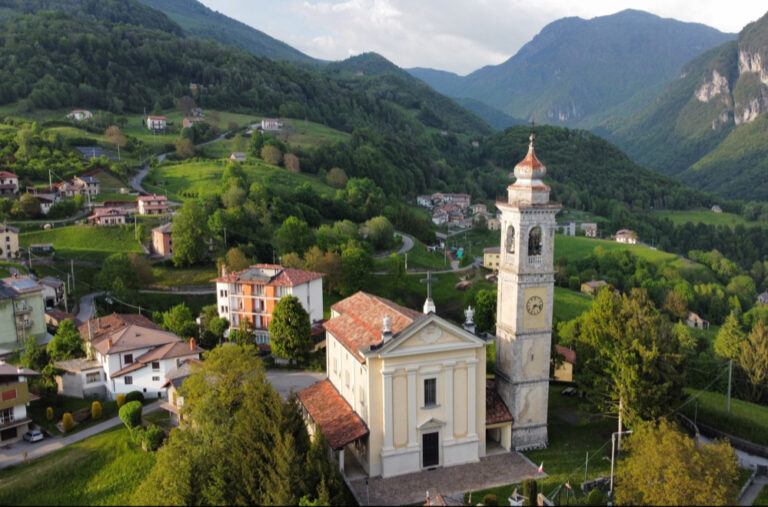
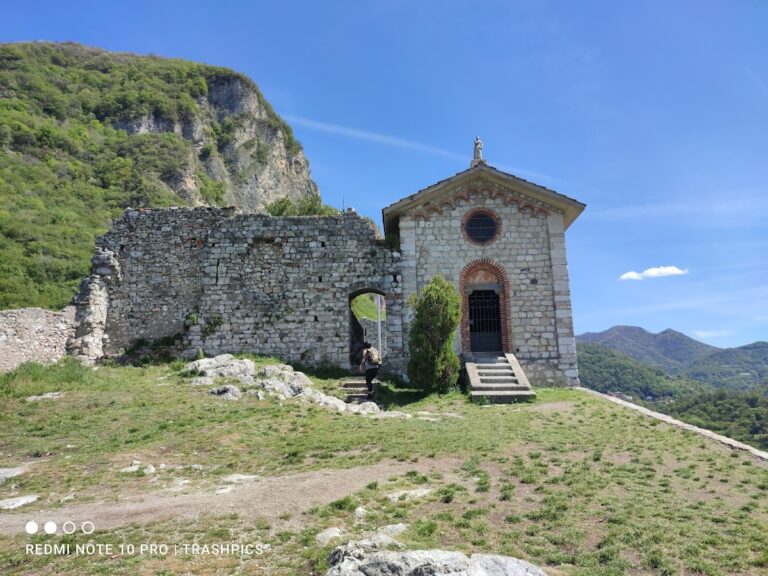
The sanctuary stands around a mainly grassy forecourt at Salzana. A porphyry pedestrian path runs parallel to the principal facade. The church has a north-facing apse, a gabled front, two aisles, and a bell tower rising where the nave meets the presbytery. Its surviving furnishings combine late medieval elements with later seventeenth-, eighteenth-, nineteenth-, and twentieth-century additions.
Exterior and bell tower
The plastered facade has a rough-textured base and exposed-stone elements at the corners. The stone-framed main portal is reached by three steps. Above it, an arched window with an iron grille provides light, while two lateral windows illuminate an adjoining room and the side aisle. Two small openings and a central rose window light the roof space, and the facade ends in two roof slopes. The principal door is walnut and dates from the fifteenth century. A white-marble offering box stands beside the entrance.
The pointed-roof bell tower contains two bells from different periods. Marino Fanzago of Clusone cast one in 1574, while the second was added in 1706.
Interior spaces and furnishings
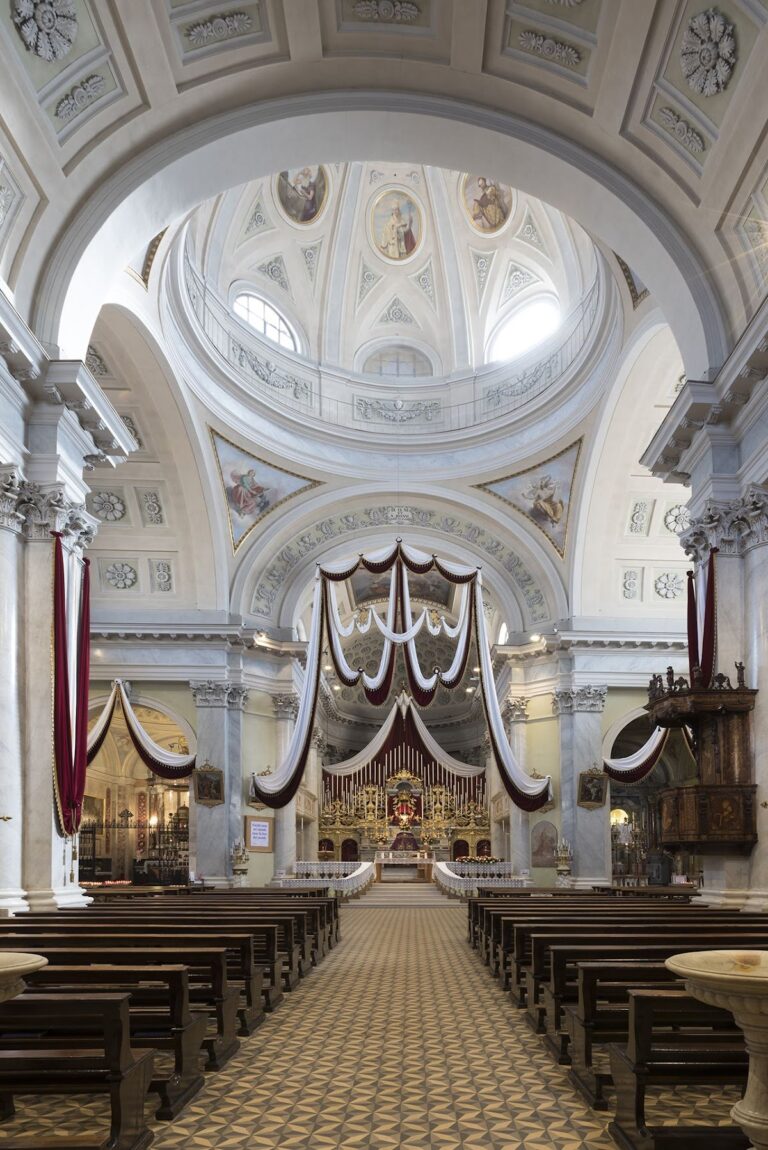
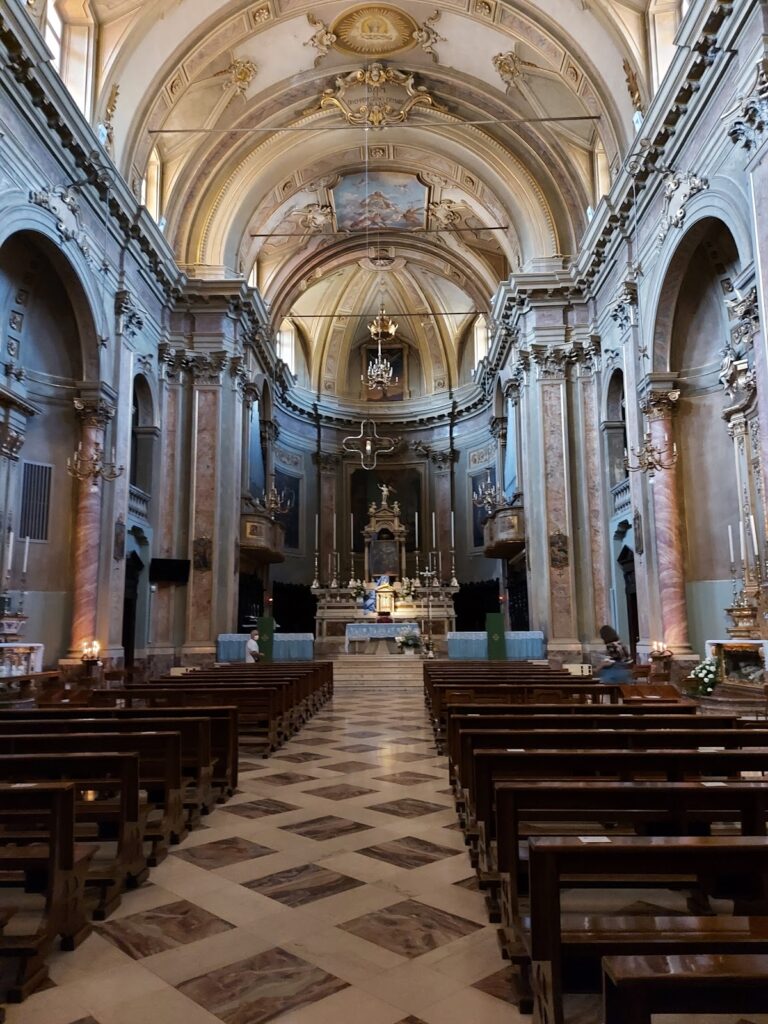
The interior is divided into a main aisle and a side aisle, each arranged in three bays by groups of piers. Lunetted barrel vaults cover the main aisle, while the side aisle has groin vaults. A door in the right side of the second bay of the main aisle leads to an adjoining room beneath the same roof slope. The church also preserves a walnut pulpit with Ionic colonnettes and decorated panels on its parapet, stylistically related to the choir in the presbytery.
Madonna of Carmel altar
The third bay of the side aisle contains a marble altar dedicated to the Madonna of Carmel, Mary in the devotional tradition of the Carmelite order. A marble balustrade encloses the altar, whose stucco decoration was commissioned by the priest Noè Lino Bellaviti in 1935. The altar displays a valuable nineteenth-century wooden statue of the Madonna of Carmel.
Madonna of Salzana altar
The right chapel contains the marble Altar of the Madonna of Salzana. Two arched windows light the chapel, and a marble balustrade encloses the altar. Its central relic is the wooden Madonna and Child statue associated with the landslides of 1359 and 1466. Rich stucco and gilded-sheet decoration formerly positioned above the altar has been lost through humidity and deterioration.
Presbytery and high altar
A triumphal arch separates the main aisle from the presbytery, the part of the church surrounding the main altar. The presbytery is raised by two steps, enclosed by a balustrade, and covered by a lunetted barrel vault. The marble high altar carries a marble altarpiece frame containing the Assumption of Mary, an oil painting on wooden panels made in 1534 by Francesco Bonetti of the Brembana Valley and Lucano da Imola, two pupils of Lotto. The painting was restored in 1933 during the reorganization of the presbytery and again in 2002. In 2003, it was returned to its eighteenth-century frame of Arabescato Orobico marble.
Choir, confessional, and angel statues
Along the presbytery walls stands a carved and painted walnut choir probably made between 1890 and 1910. Its pilasters with Ionic capitals reflect Neoclassical design, while shells and other details in the upper crest revive eighteenth-century forms. Two torch-bearing angel statues from the first half of the eighteenth century stand beside the high altar.
The first bay of the side aisle contains an elaborately carved walnut confessional dated 1700. Floral motifs decorate its surface.
Former rectory and surrounding features
The former rectory beside the sanctuary is a two-story building enlarged during the nineteenth century and extensively renovated and completed in 1951. The building formed part of the later residential and summer-colony complex associated with the church. The nearby fountain, like the sanctuary itself, has been affected by humidity and long-term deterioration.