Cervara Abbey: A Medieval Monastery and Cultural Landmark in Italy


Site at a Glance
- Rating
- 4.6
- Popularity
- Low
- Country
- Italy
- Primary era
- Medieval
- External website
- Open
- Eras represented
- Medieval, Early Modern
- Civilizations
- Genoese
- Site type
- Religious
- Remains
- Fortified Monastery
On this page15 sections
History
Cervara Abbey is a medieval monastery in Italy, near Santa Margherita Ligure, founded in 1361 by the Genoese chaplain Ottone Lanfranco and dedicated to Saint Jerome. Consecrated in 1364, it developed through successive religious, defensive, and artistic transformations on the wooded coast of the Gulf of Tigullio.
Foundation and Benedictine Reorganization
In the Middle Ages, the wooded coast around the Gulf of Tigullio and Portofino was known as Silvaria, a name derived from the Latin word for “woods.” Over time, Silvaria developed into Cervara. Lanfranco established the monastery after reaching an agreement in 1360 with the monastic owners of the land. The foundation was completed the following year, and the new religious house was consecrated in 1364.
Serious damage during the conflict between the Guelphs and Ghibellines, rival medieval factions broadly associated with papal and imperial political interests in Italy, weakened the monastery. Around 1420, Cervara was taken over by the black-robed Benedictines of Monte Cassino, monks following the Rule of Saint Benedict within the Monte Cassino tradition. Pope Eugene IV authorized restoration work in 1435. Cervara then became the mother house of an autonomous Cassinese congregation, which also incorporated San Fruttuoso near Camogli.
This change formed part of Eugene IV’s reform policy after the Western Schism, the period when rival claimants contested the papacy. The Benedictines were regarded as supportive of the pope and well suited to the spread of Renaissance humanism. During this period Cervara also became an important center for Flemish artistic culture in Liguria, especially through works associated with Gerard David and Pieter Coecke van Aelst, two Flemish Renaissance painters.
Abbey, Fortification, and Decline
Cervara was raised to the rank of abbey in 1546. Raids and sackings by North African pirates, then commonly called Saracens, affected Santa Margherita Ligure, Rapallo, Camogli, and Recco. Cervara was fortified in response, and the complex underwent major architectural changes, including the construction of new cloisters and a bell tower. Further remodeling took place during the sixteenth century, while the religious buildings were altered again in the seventeenth and eighteenth centuries.
The suppression of religious orders by the Ligurian Republic in 1798–1799 brought the abbey’s abandonment and sacking. The complex was subsequently used as a farmhouse and dwelling. French Trappist monks, members of a stricter Cistercian observance, acquired it in 1804 and opened a school there, but they left in 1811. The Archdiocese of Genoa later owned Cervara and offered the monastery for sale in 1859.
Marquis Giacomo Filippo Durazzo acquired the complex in 1868 and transferred it to the Somaschi Fathers in 1871. This Catholic order was founded to serve the poor and educate young people. French Carthusian monks, who followed the highly contemplative rule of the Carthusian order, were entrusted with the abbey from 1901 to 1937.
Modern Ownership and Restoration
Cervara was declared an Italian National Monument in 1912. Since 1937, the complex has been privately owned. Its spaces continue to serve cultural performances and concerts, while the church remains open for Catholic worship.
Restoration began after the current owners acquired the property. Structural work was directed by the architect Mide Osculati, while Pinin Brambilla Barcilon carried out pictorial restoration under the supervision and collaboration of Liguria’s office for environmental and architectural heritage. The project aimed to recover the complex as a whole and restore its historic appearance. In 2011, an additional chamber in the tower-prison associated with Francis I of France was recovered. A plaque there commemorates his forced stay and records the words traditionally attributed to his letter to his mother, Louise of Savoy, after his defeat by Emperor Charles V at the Battle of Pavia on 24 February 1525: “All is lost, except honor.”
Cervara’s history also includes visits by Francesco Petrarch, the fourteenth-century Italian poet and scholar, Catherine of Siena on her return from Avignon, Pope Gregory XI in 1376, Maximilian of Austria, Don John of Austria, Alessandro Piccolomini, and Guglielmo Marconi. Francis I was held at the abbey involuntarily for about a week in 1525 while awaiting transfer to Spain.
Remains
Church, Cloister, and Defensive Tower
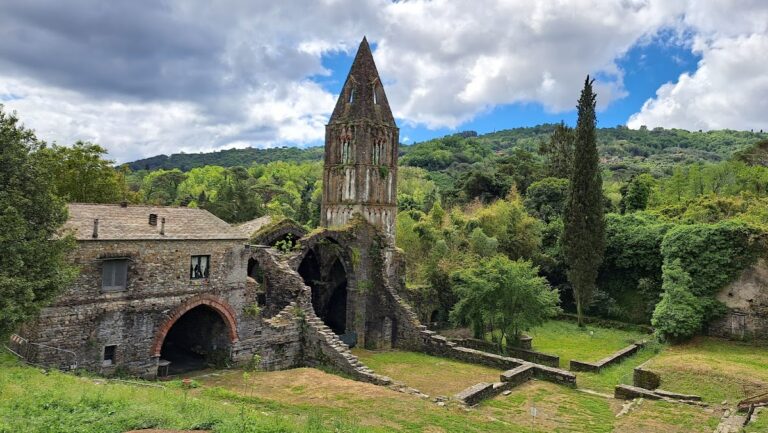
The surviving complex includes a consecrated church, a sixteenth-century cloister, a tower, the main building, and gardens. The main building now serves as a residence, while the church retains its religious function.
Church
The church has a Latin-cross plan, meaning a long nave crossed by a shorter transept, and is divided into three aisles. Its inclined apse, the terminal part of the church, was designed to suggest Christ’s bowed head. The bell tower forms part of the complex. The columns separating the aisles appear to alternate slate and marble blocks, a characteristic Ligurian effect, but restoration revealed that they are brick columns covered with two-colored plaster.
A burial discovered during restoration is probably that of Guido Scetten, archbishop of Genoa, poet, and scholar. Scetten was a fellow student and friend of Francesco Petrarch, linking the church’s physical remains with the intellectual world associated with the medieval monastery.
Cloister
The cloister is quadrangular and consists of two superimposed levels, or galleries. Its marble decoration dates from an eighteenth-century restoration, reflecting the later remodeling of the religious buildings while preserving the cloister’s central architectural form.
Defensive Tower
The tower stands at the entrance to the complex, opposite the church entrance. Built in the sixteenth century as a lookout and defense against pirate raids, it is set back behind the monastery rather than projecting in front of it. This unusual position has traditionally been interpreted as expressing respect for, and subordination to, the sacred monastic enclosure. The tower-prison associated with Francis I includes an additional chamber recovered in 2011.
Gardens and Cultivated Grounds
The former monastic garden occupies two levels and follows the Italian garden tradition. Facing directly toward the sea, it combines formal planting with terraces and structures that extend across the grounds. The upper areas also include land formerly cultivated in rows and Mediterranean woodland, preserving evidence of both ornamental and productive uses.
Sea-Facing Monumental Garden
The monumental garden contains boxwood hedges, topiary cones and stepped cones, terraces, pergolas, and painted or brick columns. A seventeenth-century marble fountain depicts a putto, a childlike decorative figure common in Renaissance and Baroque art. The garden extends toward views of the Gulf of Tigullio, from Rapallo to Chiavari, as well as the Portofino promontory and the inlets of Paraggi and Portofino.
A shaded court contains a very old monumental Chinese wisteria. Fragrant star jasmine covers the columns in the upper garden. Other recorded ornamental plants include bougainvillea, pink capers, bignonia, grapevines, pink pepper trees, camellias, roses, hydrangeas, and strelitzias.
Woodland and Monastic Herb Garden
The Mediterranean woodland includes holm oak, Aleppo pine, mastic, viburnum, and strawberry trees. The rare butterfly Charaxes jasius feeds on strawberry-tree leaves, while hoopoes and other birds occur in the area. Fox and wild-boar tracks have also been observed.
On the mountain-facing side, the Garden of the Simples preserves the monastic practice of growing medicinal plants and aromatic herbs. Here, “simples” refers to medicinal plants used individually or in simple preparations. Low boxwood hedges divide the plots, which alternate with rare citrus trees in terracotta pots. The recorded plants include calendula, chives, tarragon, rue, curry plant, lemon balm, peppermint, oregano, marjoram, anise, rhubarb, rosemary, sage, santolina, common thyme, and lemon thyme.
Garden of the Hesperides
The associated Garden of the Hesperides contains a collection of citrus plants. Its name refers to the classical myth of a garden of precious golden apples. The plants include citron, lemon, bergamot, bitter orange, grapefruit, variegated calamondin, mandarin, Nagami kumquat, oval kumquat, and Buddha’s-hand citron.
Flemish Renaissance Art
Cervara’s artistic importance is represented especially by the Cervara Polyptych, a multi-panel altarpiece painted by Gerard David in 1506 for Vincenzo Sauli, a Genoese official and banker. Installed on the high altar in 1507, it was painted in oil on panels of Flemish oak. The dismantled seven panels are now divided between Palazzo Bianco in Genoa, the Metropolitan Museum of Art in New York, and the Louvre in Paris. Four panels are in Palazzo Bianco, while the two museums abroad hold three between them.
The original work probably formed a three-tiered altarpiece. Its imagery included the Virgin and Child, two patron saints, the Crucifixion with the Angel Gabriel and the Annunciate Virgin, and God the Father. The arrangement and subject matter preserve the connection between Cervara’s monastic setting and the Flemish artistic culture that circulated in Liguria during the Renaissance.
Portable Triptych
The abbey also formerly housed a portable triptych, an altarpiece made of three panels, depicting the Adoration of the Magi by Pieter Coecke van Aelst. The work is now preserved in Palazzo Bianco in Genoa.