St. Andreas: A Protestant Church in Braunschweig


Site at a Glance
- Rating
- 4.7
- Popularity
- Very Low
- Country
- Germany
- Primary era
- Medieval
- External website
- Open
- Eras represented
- Medieval, Early Modern, Modern
- Civilizations
- Holy Roman Empire
- Site type
- Religious
- Remains
- Church
On this page14 sections
History
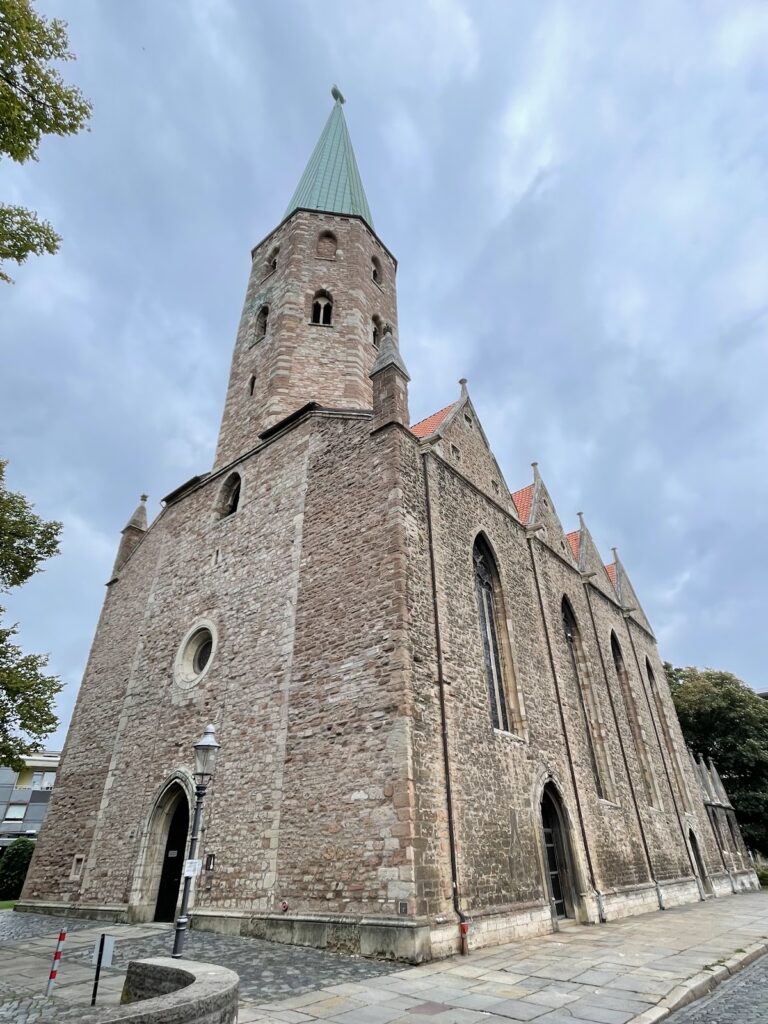
St. Andreas is a Protestant church in Braunschweig, Germany, whose origins probably reach back to a single-nave church built around 1160. From about 1230, a three-nave basilica was erected over it as the parish church of the Neustadt district. A basilica has a higher central nave flanked by lower aisles. St. Andreas was first mentioned in 1290 and became one of the defining historic buildings of central Braunschweig.
Medieval expansion
The church was converted from a basilica into a hall church around 1330. In this form, the central nave and side aisles were brought to approximately the same height. A westwork, meaning a monumental western entrance block that often incorporates towers and upper rooms, developed from the mid-to-late thirteenth century. Its bell stage was completed by about 1450. A sacristy and an apse, a rounded or polygonal sanctuary end, were added around 1400.
The south tower received its two upper stories between 1518 and 1532 under the direction of the late-medieval master builder Barward Tafelmaker. These stories were built in the Late Gothic style. From 1528 onward, St. Andreas served as a Protestant church and remains associated with the Evangelical-Lutheran Church.
Tower crowns and later history
A high Gothic spire raised the south tower to 122 metres in 1544, placing it among the highest towers in Central Europe. Storms, fires, and wars repeatedly brought down the tower crowns, including in 1550, 1551, and 1740. Between 1740 and 1742, the Gothic spire was replaced by the characteristic Baroque crown, a crowning structure in the ornate architectural style that developed in Europe during the seventeenth and eighteenth centuries. The north tower remained unfinished, and the westwork was never completed.
Extensive renovation took place around the end of the nineteenth century and the beginning of the twentieth. In 1913, brickwork was added inside the towers to strengthen them. This reinforcement helped prevent their collapse during the firestorm of 1944.
War damage and reconstruction
St. Andreas suffered heavy damage during the Second World War. On 13 August 1944, a direct hit struck the vicarage, while bombs damaged the church, its roof, and all its windows. The detonation of a large aerial mine threw a linden tree from the space between the church and vicarage into the interior. During the heaviest attack on Braunschweig, on the night of 14–15 October 1944, both towers caught fire but survived because of their internal brickwork. The Baroque crowns, bells, and almost the entire interior were destroyed.
The surrounding medieval setting was also transformed by the firestorm. Nearly all buildings immediately around the church and the adjacent Wollmarkt were destroyed, including many timber-framed houses dating as far back as the fifteenth century. Because St. Andreas held symbolic importance for Braunschweig’s population, it was among the first buildings in the largely ruined medieval city to be restored. The south tower received a new Baroque crown and the church new windows in 1955. The restored interior was dedicated in 1965.
Postwar restoration and memory
The interior was refurnished during the 1960s, and a new organ was installed in 1970. Seven new bells were cast between 1987 and 1989. A Peace Bell was added in memory of Braunschweig’s destruction in 1944, in gratitude for reconstruction, and as a warning against future war and the conversion of bells into weapons.
Repairs from September 2006 to November 2007 addressed long-unrepaired war damage in the towers. Work on the façades continued in 2009, and the organ was overhauled and tonally adapted to the interior in 2019–2020. The towers, especially the south tower, have long served as symbols of Braunschweig. Their silhouettes appear in historic prints, and their height traditionally made them the first and last features of the city visible to travellers. The south tower is now 93 metres high and remains Braunschweig’s highest church tower, although two other structures in the city are taller.
The church’s historic surroundings now include the Liberei, a freestanding public library dating from 1422, and the Alte Waage, rebuilt between 1990 and 1994. Together with St. Andreas, these surviving buildings preserve elements of the medieval urban setting that was largely destroyed in 1944.
Remains
Church body and tower complex
The surviving building retains the basic organization of a medieval church expanded over several centuries. Its original pier basilica had three nave bays, a transept, a choir, and three apses. Its architectural model was the slightly older Braunschweig Cathedral, located only a few hundred metres away. The nave was reshaped as a hall church around 1330, while the western end developed into an incomplete tower complex.
South tower
The south tower contains two Late Gothic upper stories built between 1518 and 1532. Its present height is 93 metres. The tower is crowned by the Baroque structure installed between 1740 and 1742 after the earlier Gothic spire had repeatedly collapsed. A stairway of 389 steps leads to a viewing chamber 72 metres above the ground. In suitable weather, the view extends toward the Weser Uplands and the eastern Harz.
North tower and westwork
The westwork remains an incomplete medieval entrance and tower complex. The north tower was left unfinished. Its masonry preserves approximately 100 repaired bullet holes as well as repaired cracks, while damaged stonework and decorative elements on both towers were restored during the 2006–2007 repairs.
Gables and sculpture
Groups of figures decorate the eastern gables and the four southern gables. Seen from the east, their subjects include the prophets, the Annunciation, the Adoration of the Magi, the Flight into Egypt, the Massacre of the Innocents, and Jesus at twelve years old in the Temple. The northwestern gable shows the church’s patron, the crucified Saint Andrew. A headless wall sculpture of Saint Andrew was restored during the tower repairs, and its reconstructed head was covered with gold leaf. Crockets, finials, and gargoyles on the south tower were also restored, using medieval gargoyle models preserved in the tower as patterns for replacements.
Interior and furnishings
Liturgical furnishings
The interior contains an altar, a crucifix, a baptismal font dating from 1963, and a sculpture of the Crucifixion of Saint Andrew made by Jürgen Weber during the 1960s. These furnishings belong to the postwar refitting of the church after the destruction of almost the entire earlier interior.
Stained-glass windows
Charles Crodel created the stained-glass windows in 1964–1965 and 1972. Their colours and detailed imagery form architectural enclosures within the interior while connecting the medieval building with the modern era. The choir windows, including the Pentecost and Easter windows, develop themes of missionary history and portrayals of Peter and Andrew. Side windows present the Creation and the Ark, together with suffering and destruction. Imagery from the Old Testament story of Job incorporates the 1944 bombing and the linden tree thrown into the church. Two windows above the organ gallery are devoted to Psalm 150.
Organ and bells
The present organ was built by Hillebrand of Altwarmbüchen. It has 30 stops across two manuals and a pedal. Its key actions are mechanical, while its stop actions are electrical. The instrument also has three adjustable combinations, hand registers, and a tutti, and was overhauled and tonally adapted to the interior in 2019–2020.
The present peal consists of seven bells cast in 1987 and 1989 by Florence Hüesker at the Petit & Gebr. Edelbrock bell foundry. An additional nineteenth-century bell is located in the nave. The Peace Bell adds a later commemorative element to the church’s surviving soundscape, linking the building’s material remains with remembrance of the wartime destruction of Braunschweig.